What Will a 12000-Watt Generator Run?
By the Generator Size Calculator Team · Updated · 8 min read
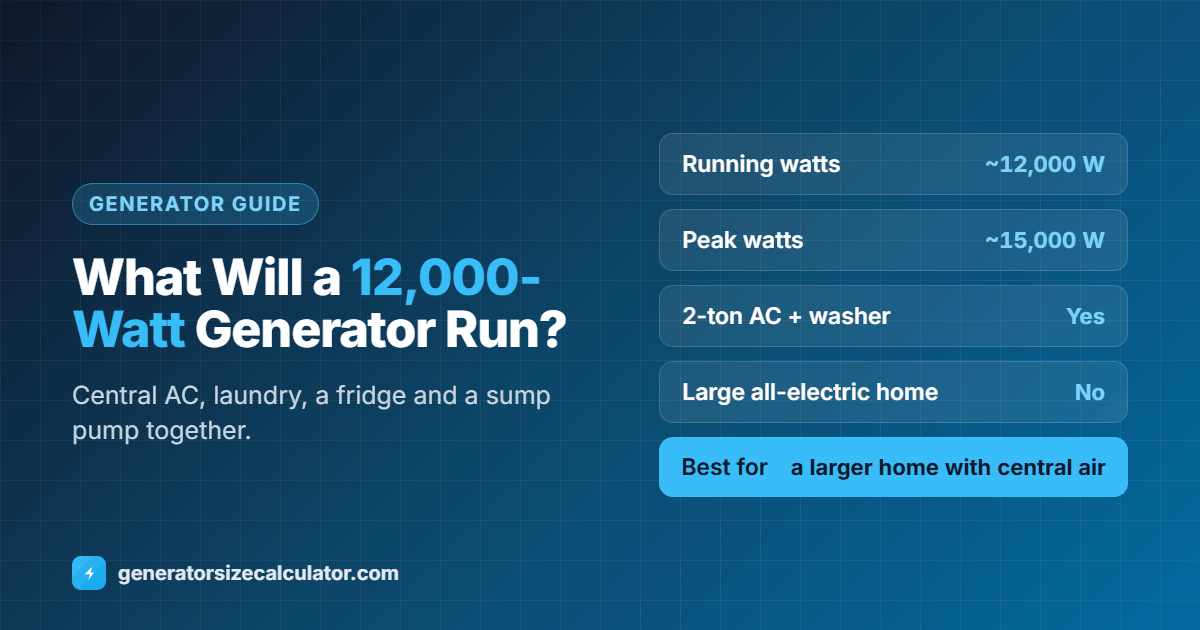
Quick answer: A 12000-watt generator runs most of a home's loads at once: a 2-ton central AC, a refrigerator, a sump pump, a furnace fan, a washer, a microwave and lights. An electric dryer or a range element is possible if you take turns. This guide assumes 12,000 running and about 15,000 starting watts. Large all-electric homes still need more.
What "12,000 watts" means on your generator
Generators list running watts (what they can supply for hours) and starting watts (a short burst for motors). Confirm that the 12,000 is the running rating. Some large portable models list 12,000 peak and about 9,500 running.
This guide assumes about 12,000 running watts and 15,000 starting watts. Check the label on yours. Anything with a motor or compressor needs extra watts for a moment to start, and lights, TVs and heating elements draw about the same all the time. See starting vs running watts.
12,000-watt generator appliance chart
Typical figures from Honda's wattage guide. The last column judges each appliance against 12,000 running watts, an 80% limit of 9,600 watts and about 15,000 starting watts. Your appliance may differ, so check its label.
| Appliance | Running watts | Starting watts | On a 12,000 W generator |
|---|---|---|---|
| Refrigerator or freezer | 700 | 2,200 | Yes, with other loads |
| Sump pump, 1/3 HP | 750 | 1,500 | Yes, with other loads |
| Sump pump, 1/2 HP | 1,000 | 2,100 | Yes, with other loads |
| Sump pump, 1 HP | 2,300 | 4,500 | Yes, with other loads |
| Well pump, 1/3 HP | 1,000 | 3,000 | Yes, with other loads |
| Furnace fan, 1/3 HP | 1,000 | 1,800 | Yes, with other loads |
| Microwave (625 W) | 625 | 800 | Yes, with other loads |
| Coffee maker | 1,750 | 1,750 | Yes, with other loads |
| Toaster, 2-slice | 1,050 | 1,050 | Yes, with other loads |
| Dishwasher | 1,450 | 1,800 | Yes, with other loads |
| Washing machine | 1,150 | 2,300 | Yes, with other loads |
| Clothes dryer, gas | 700 | 1,800 | Yes, with other loads |
| Clothes dryer, electric | 5,750 | 1,800 | Yes, start it first |
| Electric range, one 8-inch element | 2,100 | 2,100 | Yes, with other loads |
| Space heater, high | 1,500 | 1,500 | Yes, with other loads |
| Central AC, 10,000 BTU | 1,500 | 2,200 | Yes, with other loads |
| Central AC, 20,000 BTU | 2,500 | 3,300 | Yes, with other loads |
| Central AC, 24,000 BTU | 3,800 | 4,950 | Yes, with other loads |
| Central AC, 40,000 BTU | 6,000 | 7,800 | Yes, start it first |
| Air compressor, 1 HP | 1,500 | 4,500 | Yes, with other loads |
| Welder, 100 amp | 3,600 | 3,600 | Yes, with other loads |
| TV | 300 | 300 | Yes, with other loads |
| Computer | 150 | 150 | Yes, with other loads |
| Garage door opener, 1/3 HP | 725 | 1,400 | Yes, with other loads |
LED bulbs use about 8 to 15 watts each, and chargers are tiny. For appliances not listed, use the generator wattage calculator.
Example: what a 12,000-watt generator can run at the same time
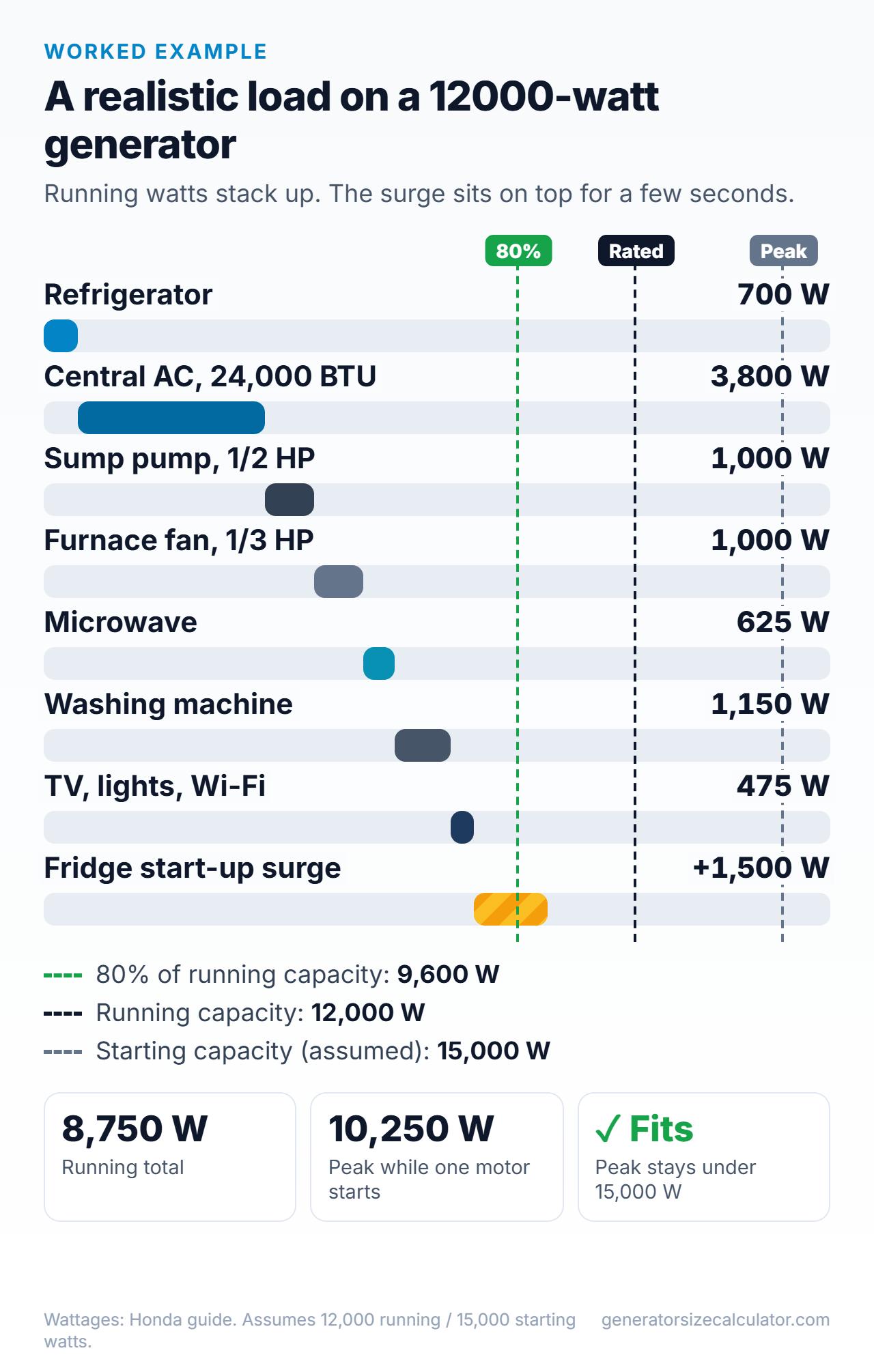
A realistic setup for a larger home with central air and laundry:
| Load | Running watts |
|---|---|
| Refrigerator | 700 |
| Central AC, 24,000 BTU | 3,800 |
| Sump pump, 1/2 HP | 1,000 |
| Furnace fan, 1/3 HP | 1,000 |
| Microwave | 625 |
| Washing machine | 1,150 |
| TV, lights, chargers, Wi-Fi | 475 |
| Running total | 8,750 |
The running total is 8,750 watts, under the 80% limit of 9,600 watts. Add only the largest extra start-up load, the refrigerator's 1,500 watts. That gives a peak of about 10,250 watts, under the 15,000-watt starting capacity.
Add your own appliances and see the running and peak watts.
What a 12,000-watt generator can't run
A 12000-watt generator still cannot run everything in a large all-electric home. Adding an electric dryer (5,750 W) brings the example to 14,500 watts, over the rating. A 40,000 BTU central AC plus an electric dryer and range together is also too much, and a 200-amp welder at 9,000 watts exceeds the 80% mark.
Can a 12,000-watt generator run a house?
For many homes, 12 kW covers nearly everything with some load management. Large homes with electric heat, a range and a water heater need 14 to 26 kW. See whole-house sizing and the standby generator calculator.
Tips to get more out of it
- Start the biggest motor first, with nothing else running, then add smaller loads.
- Take turns with heating appliances like the coffee maker, toaster and space heaters.
- Use heavy, outdoor-rated cords. See the extension cord calculator.
- Plan the fuel. See how long a generator runs on a tank of gas.
Safety rules
Run the generator outdoors, at least 20 feet from doors, windows and vents. Never in a garage or shed, even with the door open. See how far a generator should be from your house.
- Install battery-powered carbon monoxide alarms on every level of the home.
- Never plug a generator into a wall outlet. See how to connect a generator to your house.
Frequently asked questions
Can a 12000-watt generator run a whole house?
Many medium and some large homes, with load management. All-electric large homes need more.
Can a 12000-watt generator run an electric dryer and central AC?
Not comfortably together. Take turns, or choose a larger generator.
What size transfer switch do I need?
Size it from the amps. See the transfer switch calculator.
Is a 12000-watt generator portable?
Most are heavy open-frame units on wheels. Check the weight and the receptacles.
How much fuel does a 12000-watt generator use?
More than smaller models. See fuel consumption.
Related calculators
Sources: Appliance and tool running and starting watts from the Honda generator wattage guide, space heater watts from Lasko, and typical generator ratings from manufacturer guides. The 80% running-load rule and the assumed starting capacity are our planning assumptions, so confirm the ratings on your own generator.