How to Connect a Generator to Your House: Transfer Switch vs Interlock Kit
By the Generator Size Calculator Team · Updated · 9 min read
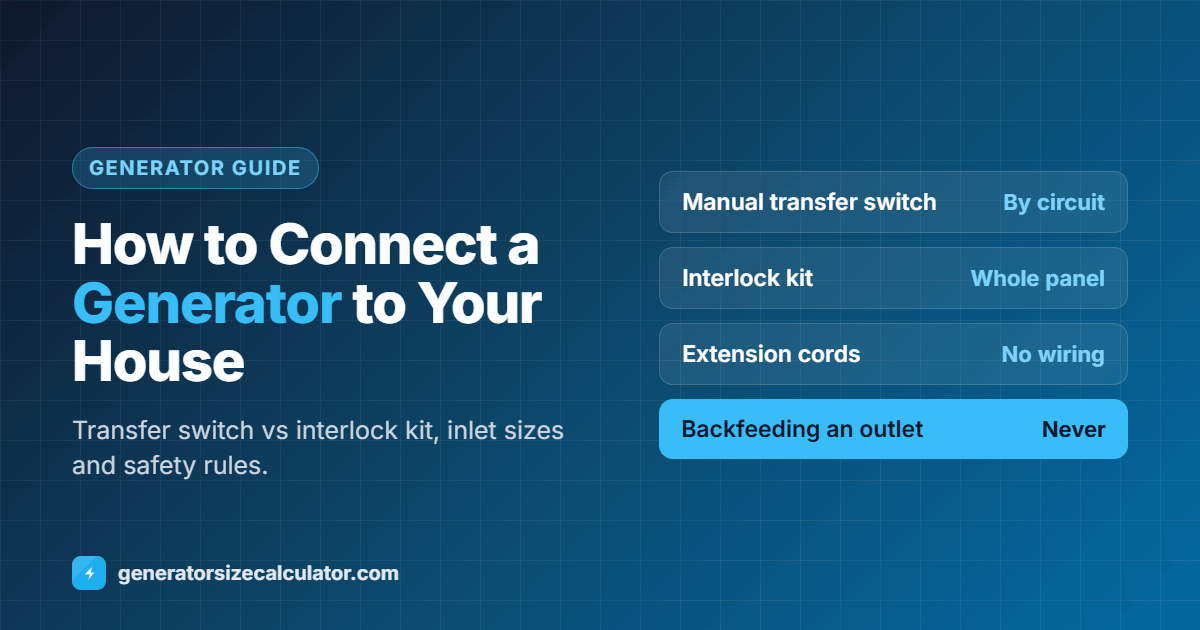
Quick answer: Never plug a generator into a wall outlet to power your house. The safe ways to connect a portable generator are a manual transfer switch, which moves a chosen group of circuits between the utility and the generator, or a generator interlock kit, a mechanical plate on your main panel that keeps the main breaker and the generator breaker from being on at the same time. Both need a power inlet on an outside wall, a matching generator cord and a licensed electrician (and, in most areas, a permit). If you only need a few appliances, heavy-duty extension cords run straight from the generator need no wiring at all.
Why you must never backfeed an outlet
Some people try to power the house by plugging a generator into a dryer or wall outlet with a cord that has a plug on both ends. This is called backfeeding, and the Consumer Product Safety Commission calls it extremely dangerous. The power can travel back out through the service line, endangering utility workers and neighbors, and it bypasses the protection your household circuit breakers provide, which can overload wiring and start a fire.
The safe alternative is a device that physically prevents the utility and the generator from feeding the house at the same time. That is the job of a transfer switch or an interlock kit.
Your three options compared
| Manual transfer switch | Interlock kit | Extension cords only | |
|---|---|---|---|
| How it works | A switch moves a dedicated subpanel of critical circuits between utility and generator power | A mechanical plate on the main panel stops the main breaker and the generator breaker from being on together | Appliances plug directly into the generator through outdoor-rated cords |
| What gets power | Only the circuits in the subpanel, such as the fridge, furnace blower and well pump | Any circuit in the main panel, so you turn off the big loads yourself | Only what you plug in |
| Hardwired loads (furnace, well pump) | Yes | Yes | No |
| Installation | The more involved job, with a new subpanel | Simpler and usually less costly, but the kit must be listed for your exact panel | None |
| Overload risk | Lower, since you choose the circuits in advance | Higher: you manage loads manually | Lower: limited by the cords |
| Best for | Homes with a clear set of essential circuits | Homes that want whole-panel flexibility on a budget | A fridge, a few lights and phone chargers |
For a short outage with a fridge, lights and a phone charger, cords are enough. For a furnace, a sump pump or a well pump you need one of the other two. Our transfer switch calculator helps you choose the amperage.
What you need for a transfer switch or interlock
- A generator with a 240-volt outlet, usually a 30-amp L14-30 or a 50-amp 14-50. Check your manual; many small inverters don't have one.
- A power inlet box mounted on an outside wall. This is the weatherproof plug your generator connects to.
- A generator cord with the matching connectors, rated for the full amperage.
- The transfer equipment: either a manual transfer switch with a subpanel, or an interlock kit made for your panel's brand and model.
- A licensed electrician and a permit. In most jurisdictions the work needs an electrical permit and inspection, and the rules vary, so check with your local building department.
Sizing the inlet and cord
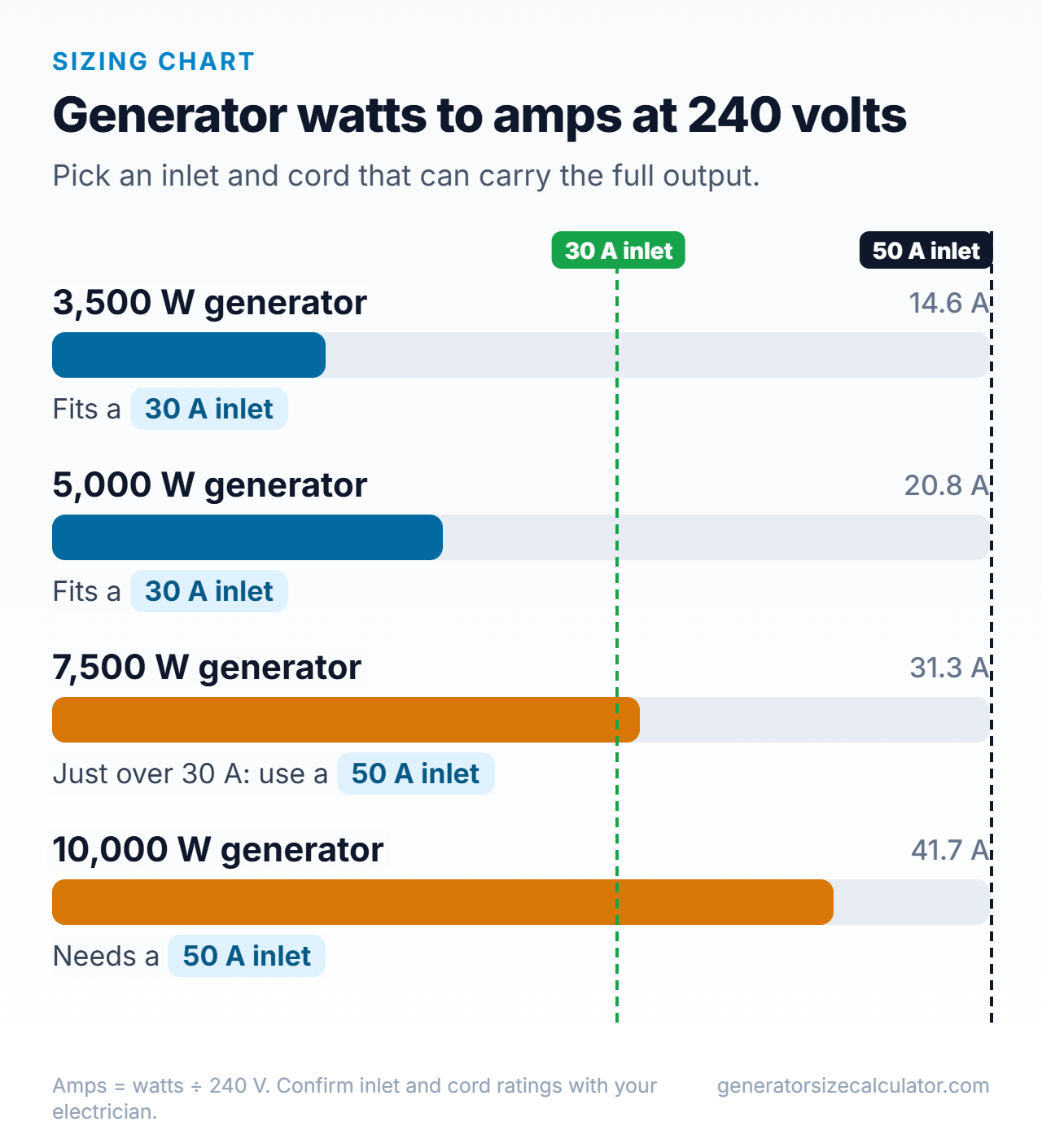
Divide the generator's watts by 240 volts to get the amps at 240 volts:
| Generator output | Amps at 240 V | Inlet and cord |
|---|---|---|
| 3,500 W | 14.6 A | 30 A inlet (L14-30) |
| 5,000 W | 20.8 A | 30 A inlet (L14-30) |
| 7,500 W | 31.3 A | 50 A inlet, or a 30 A inlet if you stay under 7,200 W |
| 10,000 W | 41.7 A | 50 A inlet (14-50) |
A 30-amp inlet can carry up to 7,200 watts (30 A × 240 V), so a 7,500-watt generator is just over the line at full output. Cords follow the same logic: heavier amperage needs thicker wire, and a longer run needs thicker wire still. Use the generator amps calculator for your own numbers and the extension cord calculator for the gauge.
How it works on outage day
The exact steps depend on your equipment, so follow the instructions your electrician leaves with you. In general, the sequence looks like this:
- Set the generator up outdoors, far from the house, and start it with nothing connected.
- Connect the generator cord to the generator and to the inlet box.
- With an interlock kit, turn off the main breaker, slide the interlock plate, then turn on the generator breaker. With a transfer switch, flip it to generator.
- Turn circuits on one at a time, largest motor loads first, and watch the load.
- To finish, switch the loads off, then reverse the process before shutting the generator down.
With an interlock kit the whole panel is live, so turn off big loads like the electric range, dryer and water heater first, or they'll overload the generator. A quick wattage list from the generator wattage calculator keeps you honest.
Enter your generator size and circuits to get the right amperage.
What to ask your electrician
- Is the interlock listed and labeled for my specific panel, and does my panel qualify?
- Which circuits should go on a transfer subpanel, and how many does my generator support?
- Do I need a switch that also switches the neutral? This depends on how your generator's neutral is bonded; our guide to grounding a portable generator explains why.
- What inlet and cord rating do you recommend for my generator?
- Will you pull the permit and schedule the inspection?
Safety rules
Place the generator outdoors, at least 20 feet from doors, windows and vents. Never run it in a garage, crawl space or shed, even with the doors open. The cord to the inlet box should be long enough to make that distance possible. See how far a generator should be from your house.
- Install battery-powered carbon monoxide alarms on every level of the home.
- Turn the generator off and let it cool before refueling.
- Check cords for cuts, and don't pinch them in doors or windows.
Frequently asked questions
Can I plug a generator into a wall outlet to power my house?
No. This is backfeeding, and it can electrocute utility workers and neighbors and bypass your circuit protection. Use a transfer switch or interlock kit installed by a licensed electrician instead.
Is a generator interlock kit legal?
Interlock kits are widely used, but the kit must be listed for your specific panel, and most areas require a permit and an inspection. Check with your local building department and use a licensed electrician.
What is the difference between a transfer switch and an interlock kit?
A manual transfer switch moves a dedicated subpanel of critical circuits between utility and generator power. An interlock kit is a plate on your main panel that prevents the main breaker and generator breaker from being on together, so the whole panel can be powered, and you manage the loads yourself.
What size transfer switch do I need?
Match it to the generator: a 5,000-watt generator is about 21 amps at 240 volts and fits a 30-amp switch, while generators above 7,200 watts usually need 50 amps. The transfer switch calculator on this site helps you choose.
Can a 3500-watt generator work with a transfer switch?
Yes, as long as it has a 240-volt outlet or you use the right adapter, and you power only the circuits it can handle. See what a 3500-watt generator can run.
Related calculators
Sources: Backfeeding, outdoor placement and cord guidance from the U.S. Consumer Product Safety Commission; transfer switch and interlock comparison, permit requirements and neutral-switching notes from electrical installation guides. Amps are calculated as watts ÷ volts. Rules vary by location, so confirm requirements with your local building department and use a licensed electrician for any connection to house wiring.