What Size Generator Do You Need to Run a Whole House?
By the Generator Size Calculator Team · Updated · 8 min read
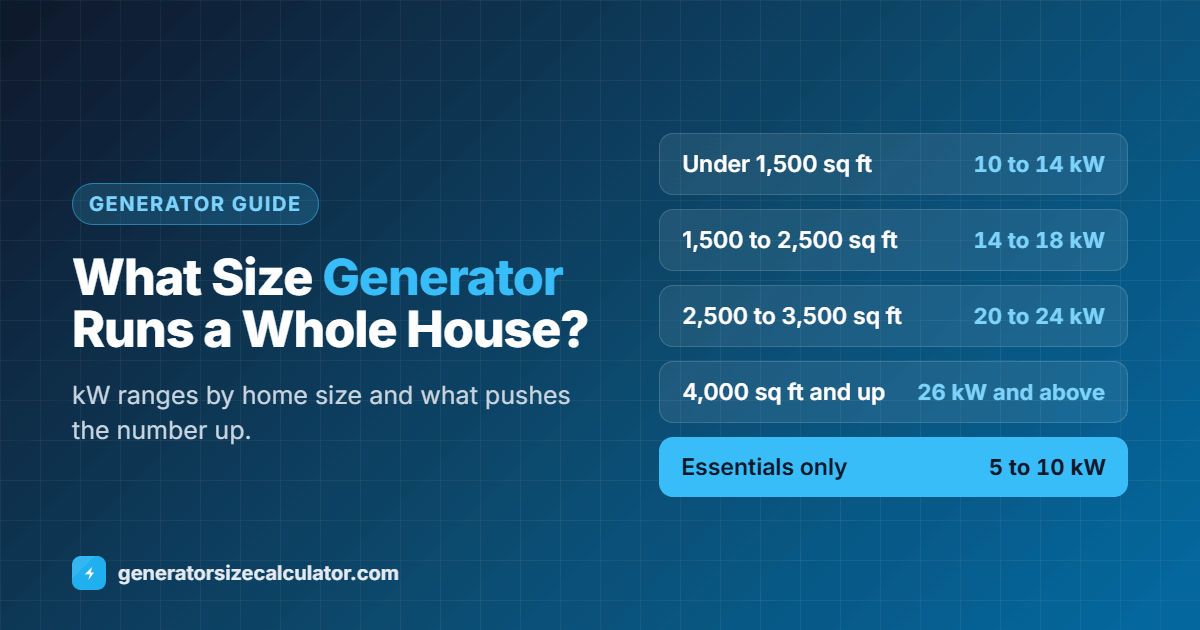
Quick answer: Most homes need a generator of about 14 to 26 kW to run everything at once, depending on size and what is electric. Rough guides: under 1,500 sq ft about 10 to 14 kW, 1,500 to 2,500 sq ft about 14 to 18 kW, 2,500 to 3,500 sq ft about 20 to 24 kW, and 4,000 sq ft or more about 26 kW and up. If you only back up essential circuits, 5 to 10 kW is often enough. A licensed electrician should confirm with a load calculation.
Whole house vs essential circuits
There are two ways to back up a home. A whole-house generator runs nearly everything at once, including central AC, an electric range and a dryer. An essential-circuits setup runs only what you need, such as the fridge, a furnace fan, a sump pump, lights, Wi-Fi and a few outlets. Essential-circuit backup usually fits a generator of about 5,000 to 10,000 watts, while whole-house backup is typically 14 to 26 kW.
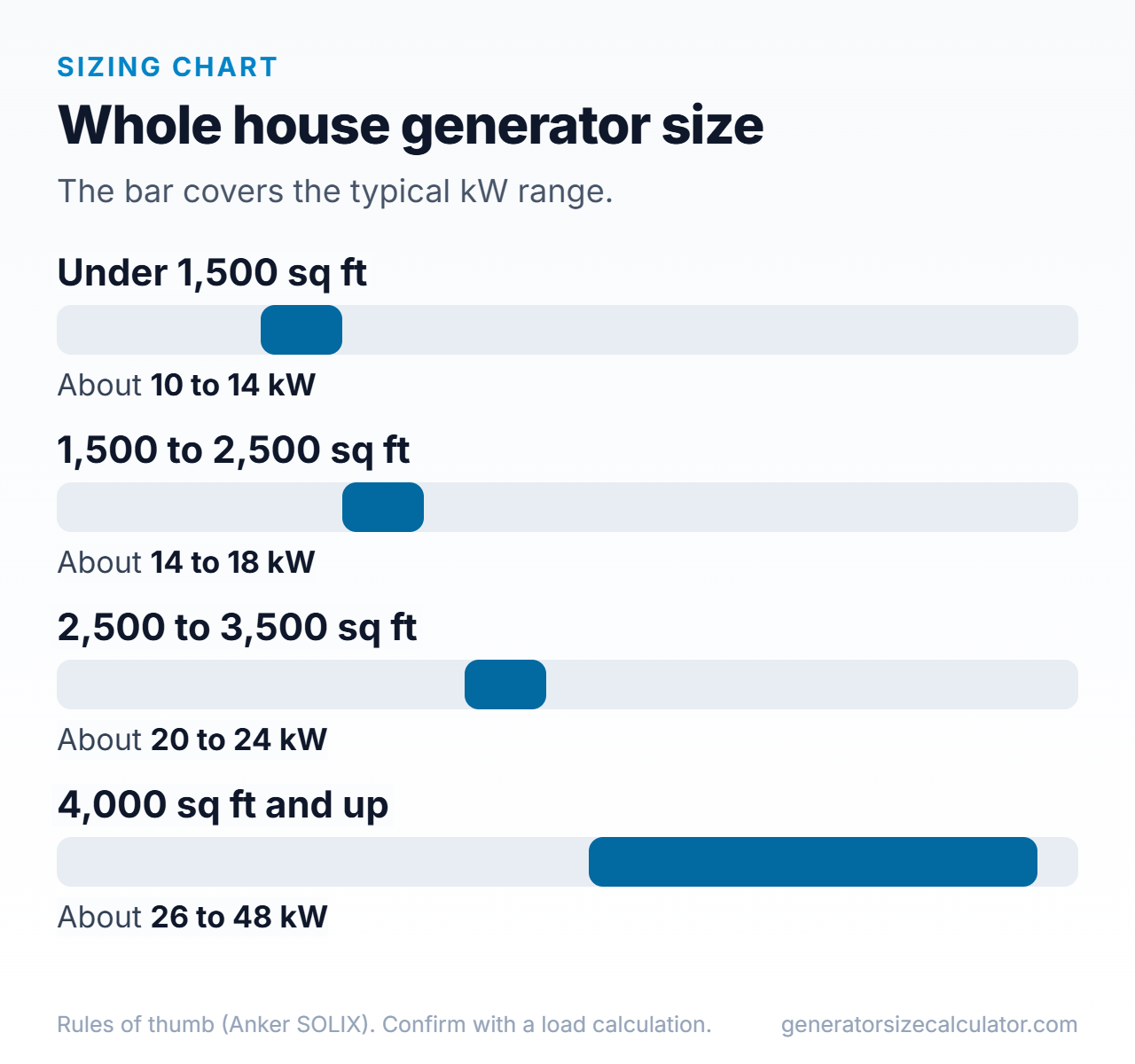
Sizes by square footage
| Home size | Typical whole-house generator |
|---|---|
| Under 1,500 sq ft | 10 to 14 kW |
| 1,500 to 2,500 sq ft | 14 to 18 kW |
| 2,500 to 3,500 sq ft | 20 to 24 kW |
| 4,000 sq ft and larger | 26 kW to 48 kW or more |
These ranges are rules of thumb from generator makers. The actual number depends on your appliances and your climate, not only the size of the house. An electrician uses a load calculation based on NEC Article 220 for an accurate figure.
Worked example
Here is a typical all-in-one list for a medium home with central AC, using running watts from Honda's wattage guide.
| Load | Running watts |
|---|---|
| Refrigerator | 700 |
| Central AC, 2-ton (24,000 BTU) | 3,800 |
| Sump pump, 1/2 HP | 1,000 |
| Furnace fan, 1/3 HP | 1,000 |
| Microwave | 625 |
| TV, lights, Wi-Fi | 475 |
| Running total | 7,600 |
At the 80% rule, a generator should be about 9,500 watts (7,600 divided by 0.8). Now add the big electric loads:
| Add this | New total | Generator needed at 80% |
|---|---|---|
| Nothing | 7,600 W | About 9,500 W |
| Electric dryer (5,750 W) | 13,350 W | About 16,700 W |
| Dryer and an 8-inch range element (2,100 W) | 15,450 W | About 19,300 W |
The start-up surge of the AC and the pump has to be covered too, so larger units with high starting capacity are a better fit. If you want the exact figure for your house, the generator load calculator and the standby generator calculator do the sums for you.
List your appliances and get a recommended generator size.
What pushes the size up
- Central air conditioning. A 24,000 BTU unit is about 3,800 running watts and 4,950 starting, and a 40,000 BTU unit about 6,000 and 7,800. See what size generator runs a central AC.
- Electric dryer and range. An electric dryer adds about 5,750 watts, and one range element about 2,100 watts.
- Electric water heater and electric heat. These are the biggest loads in many homes.
- Well pump and sump pump. Motors need extra power to start. See sump pump generator sizes.
How to shrink the generator you need
- Back up essential circuits only. A smaller generator and a transfer switch cost much less than a full-house system. See the transfer switch calculator.
- Use a load management device that pauses the AC or dryer when the generator is near its limit.
- Skip the dryer and range during outages. Use gas appliances where you have them.
- Choose a soft-start AC or add a soft-start kit to reduce the starting surge.
Next steps and safety
Ask a licensed electrician to run a load calculation, handle the permit and install an approved transfer switch. Standby generators also need a gas line and a pad. Never connect a portable generator to a wall outlet. For the options, read how to connect a generator to your house.
Place any generator outdoors, well away from doors, windows and vents, and install battery-powered carbon monoxide alarms inside the home.
Frequently asked questions
What size generator do I need to run my whole house?
Most homes need about 14 to 26 kW. Under 1,500 sq ft is about 10 to 14 kW, 1,500 to 2,500 sq ft about 14 to 18 kW, 2,500 to 3,500 sq ft about 20 to 24 kW, and 4,000 sq ft or more about 26 kW and up.
Can a 10000-watt generator run a whole house?
It can run a smaller home or the essentials of a larger one, such as the fridge, furnace fan, sump pump, lights and a central AC, but not everything at once with an electric dryer and range.
How many kW do I need for essential circuits only?
Typically about 5 to 10 kW, enough for a fridge, furnace fan, sump pump, lights, Wi-Fi and a few outlets.
What uses the most power in a house?
Central AC, an electric dryer, an electric range, an electric water heater and electric heating usually use the most.
Do I need an electrician for a whole house generator?
Yes. A licensed electrician should do the load calculation, the permit and the transfer switch installation.
Related calculators
Sources: Whole-house size ranges from Anker SOLIX sizing guidance; appliance running and starting watts from the Honda generator wattage guide; 80% running-load rule applied. These are rules of thumb. A licensed electrician should confirm with an NEC Article 220 load calculation.