How Far Should a Generator Be From Your House?
By the Generator Size Calculator Team · Updated · 7 min read
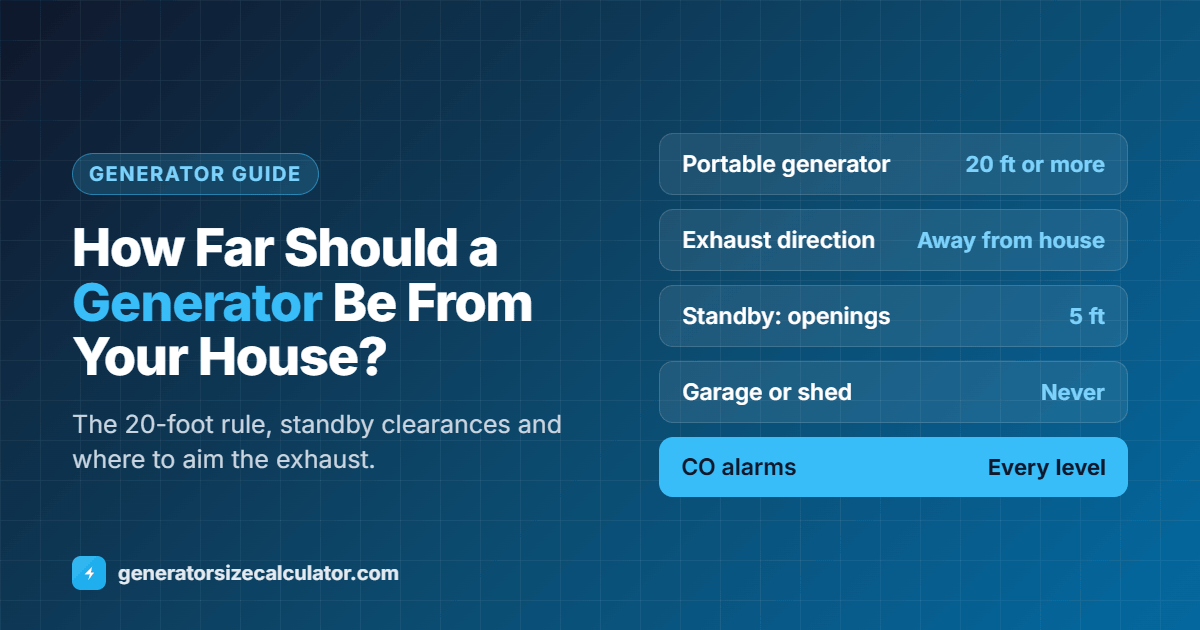
Quick answer: Run a portable generator outdoors, at least 20 feet from doors, windows and vents, with the exhaust pointed away from the house. Never run one in a garage, crawl space or shed, even with the door open. A permanently installed standby generator follows different clearances, typically 5 feet from windows, doors and other wall openings under NFPA 37 as cited by manufacturers, with local codes taking precedence.
Why distance matters
A gasoline or propane generator produces carbon monoxide (CO), a colorless, odorless gas. It can seep through open windows, doors, vents and gaps, and build up inside a home faster than people expect. Early symptoms such as headache, dizziness, weakness, nausea and confusion are easy to mistake for the flu or fatigue, and people who are asleep may not notice them at all.
Distance and exhaust direction are the two cheapest ways to keep CO out of the house, and they only work if the generator stays outside.
The distance rules
| Situation | Guidance | Source |
|---|---|---|
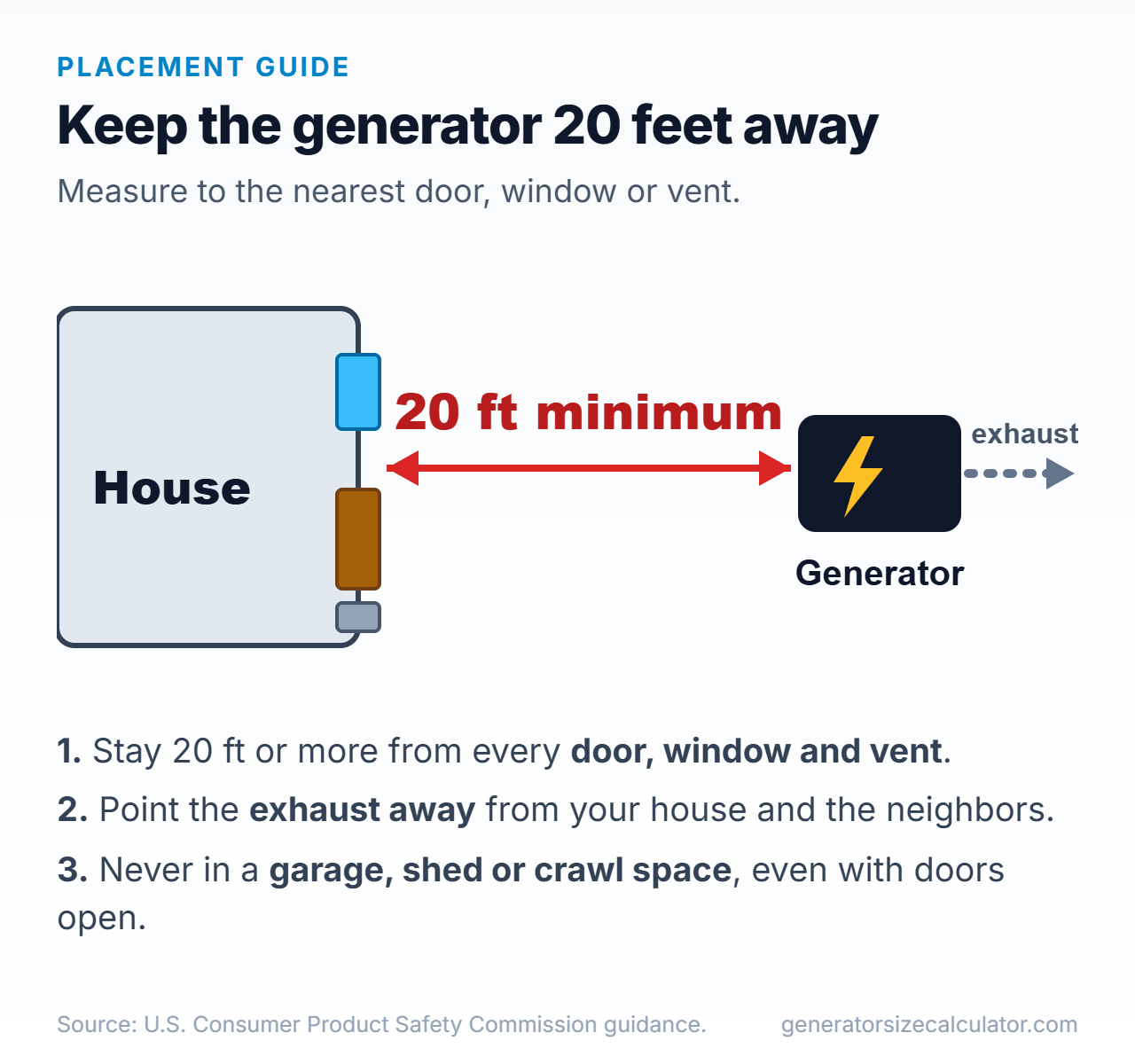
| Portable generator to doors, windows and vents | At least 20 feet, outdoors only | U.S. Consumer Product Safety Commission |
| Portable generator in a garage, crawl space, shed or basement | Never, even with doors open or a fan running | U.S. Consumer Product Safety Commission |
| Standby generator to operable windows, doors and vents | 5 feet | NFPA 37, as cited by Generac |
| Standby generator, back to a wall (units with the SwRI mark) | 18 inches | NFPA 37, as cited by Generac |
| Standby generator, back to a wall (units without it) | 5 feet from combustible and 3 feet from non-combustible material | NFPA 37, as cited by Generac |
| Standby generator, front and ends | 3 feet clear, including shrubs and trees | NFPA 37, as cited by Generac |
Local codes, your fire department and the manufacturer's installation manual take precedence. Even a standby generator that meets those clearances can still let CO enter in some layouts, so placing it farther from the house is better when you can.
How to place and aim the generator
- Measure to the nearest opening. Count from the generator to the closest door, window, vent or crawl-space opening, including your neighbors'.
- Point the exhaust away. The muffler should face away from the house and from neighboring homes.
- Mind the wind. Place it so that the breeze carries exhaust away from openings, not toward them.
- Choose a level, firm, dry spot with open space on all sides. Check your manual for the clearance it wants for cooling and fire safety.
- Keep it off decks and out from under overhangs. A standby generator shouldn't go under a wooden deck, and a portable unit needs open air around the engine.
- Don't block the exhaust or cooling air with covers, boxes or furniture.
Cords and long runs
The 20-foot rule means you need cord that reaches. Use heavy-duty, outdoor-rated extension cords, and make sure each cord's wattage rating exceeds the total wattage plugged into it. Longer runs lose voltage, so the right gauge grows with distance and load. Our extension cord calculator and voltage drop calculator show what gauge to buy. Keep cords from being pinched in doors and windows, and don't leave a gap that lets exhaust drift in. To power hardwired loads you'll want a transfer switch or interlock; see our connection guide.
Enter your load and distance to find the gauge you need.
What if you can't get 20 feet away?
Apartments, small lots and tight yards make this hard. If you can't put a generator at least 20 feet from every door, window and vent (yours and your neighbors'), don't run it there. Safer alternatives include:
- A battery power station for small loads. It has no exhaust and can be used indoors. Use our portable power station calculator to see how long one will run your essentials.
- A different spot, such as a larger part of the yard, using longer cords.
- A community resource, like a shelter or a friend's home, for medical equipment that needs steady power.
Common mistakes
- Running it in the garage with the door open. CO still builds up and flows into the house.
- Setting it on the porch or right next to a window "just for tonight".
- Forgetting the neighbors. Exhaust can enter their windows too.
- Skipping CO alarms. Use battery-powered or plug-in alarms with battery backup, certified to UL 2034, on every level, and test them monthly.
- Refueling while it's hot or running. Turn it off and let it cool first.
If your CO alarm sounds, or you feel dizzy, weak or sick while a generator is running, get everyone into fresh air immediately, turn the generator off and call emergency services.
Frequently asked questions
How far should a portable generator be from the house?
At least 20 feet from doors, windows and vents, with the exhaust pointed away from the house. That is the guidance from the U.S. Consumer Product Safety Commission.
Can I run a generator in the garage with the door open?
No. Carbon monoxide still builds up and can enter the home, even with the garage door open or fans running. Run it outside only.
How far should a standby generator be from the house?
Under NFPA 37, as cited by manufacturers like Generac, 5 feet from windows, doors and vents, and a small gap to the wall depending on the unit. Follow your manual and local code, and note that farther is safer.
Can I put a generator on my porch or deck?
Not a portable one while it's running. A porch or deck is usually well under 20 feet from doors and windows, and exhaust can collect under roofs and overhangs.
Does it matter which way the exhaust points?
Yes. Point it away from your house and from neighbors' homes, and consider wind direction so exhaust drifts away from openings.
Related calculators
Sources: Portable generator placement, CO alarm and cord guidance from the U.S. Consumer Product Safety Commission; standby generator clearances from Generac's guidance based on NFPA 37. Local codes and manufacturer instructions take precedence. Carbon monoxide poisoning is an emergency; call emergency services if you suspect it.