How Long Will a Generator Run on a Tank of Gas?
By the Generator Size Calculator Team · Updated · 8 min read
Quick answer: Runtime is the usable fuel in gallons divided by the gallons the generator burns per hour. As a typical example, a 5,000-watt gasoline generator burns about 0.5 gallons per hour at half load, so a 6-gallon tank lasts about 12 hours. At a quarter load it burns about 0.3 gallons per hour (20 hours on 6 gallons), and at full load about 0.9 gallons per hour (about 6.7 hours). Your manual lists the runtime for your model; use our runtime calculator for your exact load.
The runtime formula
Every runtime estimate comes down to one equation:
Runtime (hours) = fuel (gallons) ÷ fuel use (gallons per hour)
The fuel use depends on how hard the generator is working, which is its load. A generator running at a light load burns far less than one running flat out. To find your load percentage, divide the watts you're running by the generator's running (rated) watts. For example, 2,075 watts on a 3,500-watt generator is a 59% load. Our generator runtime calculator does this for you.
Typical gas use by generator size
These are typical published estimates for gasoline generators. Real numbers vary by engine, age and altitude, so treat them as a guide and compare with the figure in your manual.
| Generator size | 25% load | 50% load | 100% load |
|---|---|---|---|
| Small, 2,000 W | 0.10 gal/hr | 0.20 gal/hr | 0.40 gal/hr |
| Medium, 5,000 W | 0.30 gal/hr | 0.50 gal/hr | 0.90 gal/hr |
| Large, 10,000 W | 0.60 gal/hr | 0.90 gal/hr | 1.50 gal/hr |
How many hours per 5 gallons
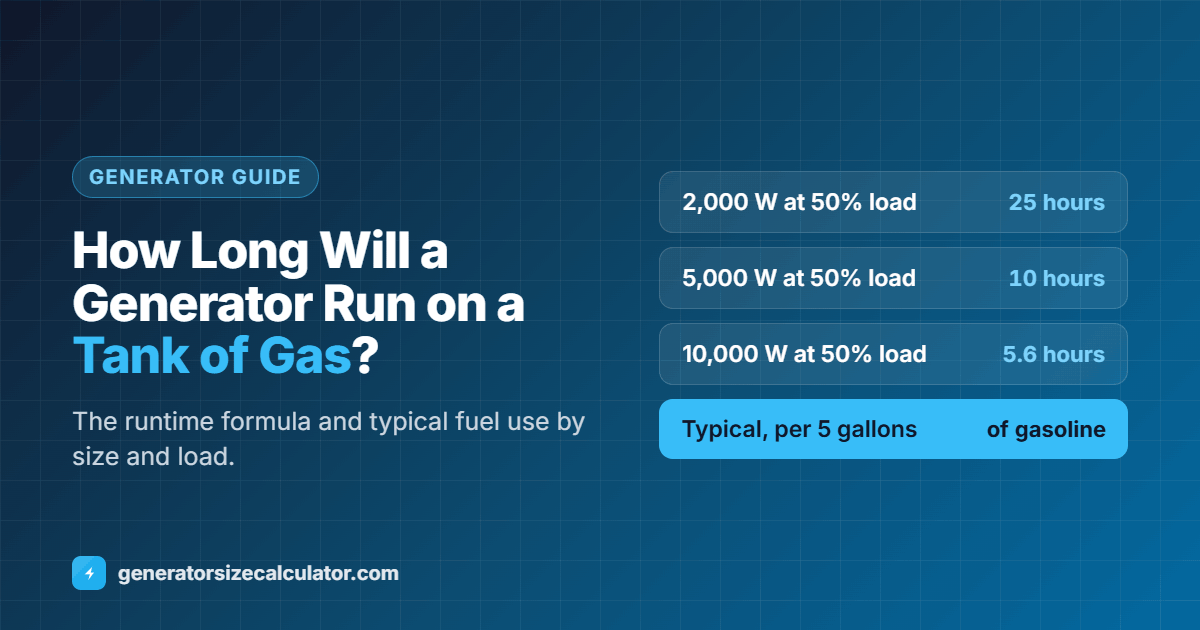
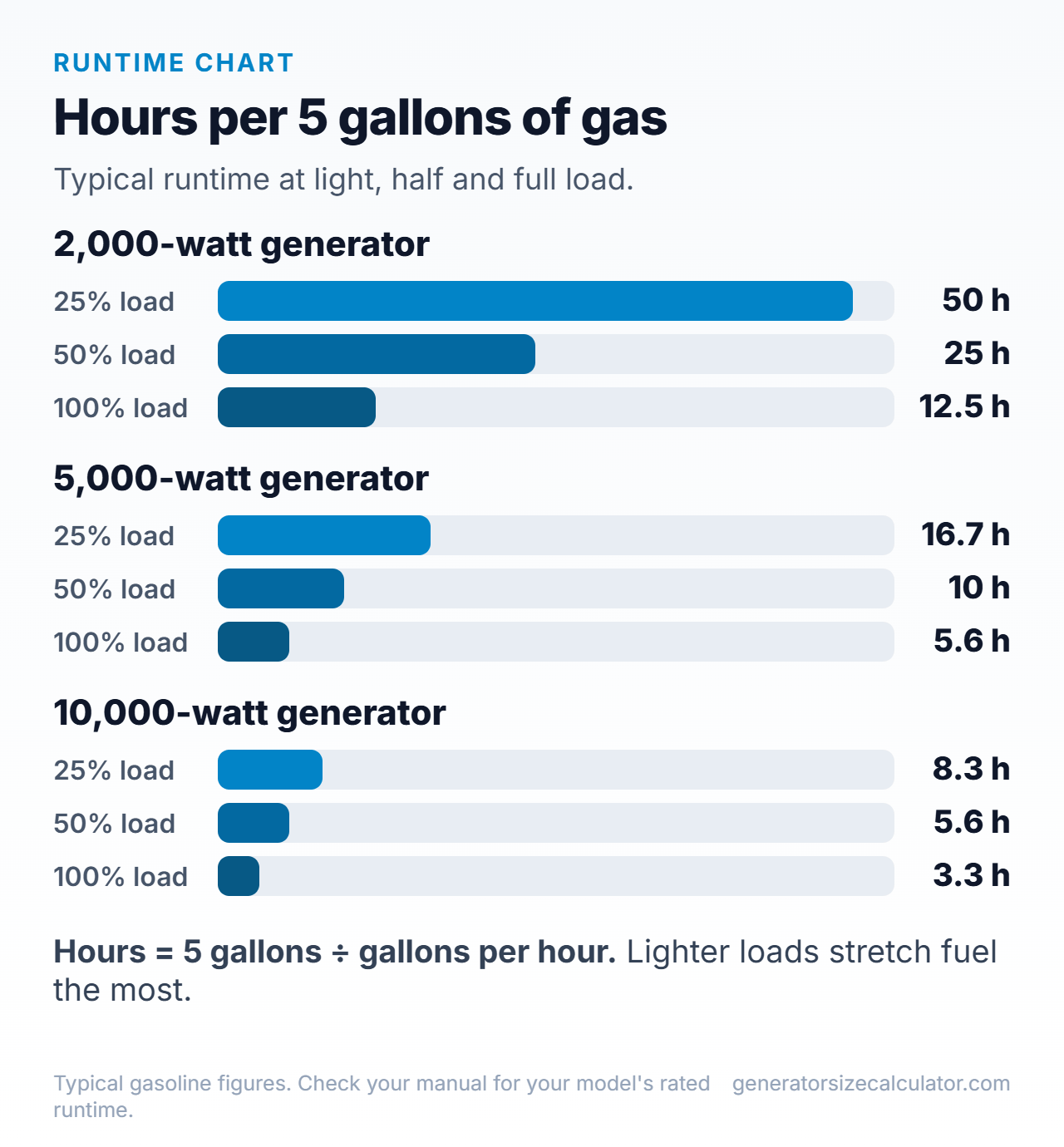
Dividing 5 gallons by each rate above gives the hours you can expect from a full 5-gallon can:
| Generator size | 25% load | 50% load | 100% load |
|---|---|---|---|
| 2,000 W | 50 hours | 25 hours | 12.5 hours |
| 5,000 W | 16.7 hours | 10 hours | 5.6 hours |
| 10,000 W | 8.3 hours | 5.6 hours | 3.3 hours |
Use the same math for your own tank. If your generator has a 6.5-gallon tank and burns 0.5 gallons per hour at your load, you can expect about 13 hours (6.5 ÷ 0.5). Leave a small safety margin; don't plan to run a tank dry.
Example: a 5,000-watt generator in an outage
Suppose the 5,000-watt generator is carrying a 3,175-watt load (a refrigerator, sump pump, furnace fan, TV and lights). That is a 63% load. Between the 50% rate (0.5 gal/hr) and the 100% rate (0.9 gal/hr), that works out to roughly 0.6 gallons per hour.
| Measure | Estimate |
|---|---|
| Fuel use at 63% load | about 0.6 gal/hr |
| 6.5-gallon tank lasts | about 11 hours |
| Fuel for 24 hours | about 14.5 gallons |
| Fuel for a 3-day outage | about 43 gallons |
That fuel need surprises many people. Lower the load and the numbers drop fast: running only the refrigerator and a few lights on the same generator is closer to a 25% load, or about 0.3 gallons per hour.
Enter your tank size and load to see how long your fuel will last.
How to stretch a tank
- Cut the load. Switch off what you don't need. Fuel use climbs with load, so this is the biggest lever.
- Run it in cycles. For a refrigerator, you can often run the generator for a few hours, then switch it off and keep the fridge closed, instead of running all day. Follow food safety guidance on how long food stays cold.
- Right-size the generator. A big generator running at a very light load wastes fuel compared with a smaller one running closer to its range.
- Choose an inverter model with an economy mode, which lets the engine speed follow the load.
- Keep it maintained. Clean air filters, fresh oil and a good spark plug help it run efficiently.
Also compare costs between fuels with our running cost calculator and fuel consumption calculator.
How much fuel to store for an outage
Multiply your fuel use by the hours you expect to run. If you'll run 8 hours a day on 0.5 gallons per hour, that's 4 gallons a day, or 12 gallons for three days. Fuel storage adds some practical limits: gasoline can degrade within a few months, so rotate it and consider a fuel stabilizer, and keep only the amount you can store safely in approved containers.
Fuel safety
Never refuel a running or hot generator. Spilled gasoline on hot parts can ignite. Turn the generator off and let it cool first. Store fuel outside living areas in properly labeled, non-glass safety containers, away from fuel-burning appliances like a water heater.
- Run the generator outdoors, at least 20 feet from doors, windows and vents.
- Install battery-powered carbon monoxide alarms on every level of the home.
Frequently asked questions
How long will a generator run on 1 gallon of gas?
It depends on load. A typical 5,000-watt generator burning 0.5 gallons per hour at half load runs about 2 hours on 1 gallon. At a quarter load (0.3 gal/hr) it runs about 3.3 hours. A 2,000-watt generator at half load (0.2 gal/hr) runs about 5 hours.
How long will a 5000-watt generator run on a tank?
With a typical 6-gallon tank, about 12 hours at half load, about 20 hours at a quarter load and about 6.7 hours at full load. The figures depend on the model, so check your manual's runtime rating.
Can a generator run continuously for 24 hours?
Yes, if you keep it fueled, but you must stop to refuel safely, and your manual may call for oil checks and rest periods. Never refuel while it's running or hot.
Does a bigger generator use more gas?
At the same load, a larger generator usually burns more because it has a larger engine, but a larger generator running at a light load can still be wasteful. Size the generator to your load.
How can I make a tank of gas last longer?
Reduce the load, run in cycles, keep the engine maintained and consider an inverter generator with an economy mode. See our 5000-watt guide to plan which loads to run.
Related calculators
Sources: Typical gasoline generator fuel use by size and load from a published fuel-consumption guide (real figures vary by model); fuel storage and refueling safety guidance from the U.S. Consumer Product Safety Commission. The example outage figures are estimates interpolated from those rates; check your generator's manual for its rated runtime.