
What Will a 3500-Watt Generator Run?
By the Generator Size Calculator Team · Updated · 8 min read
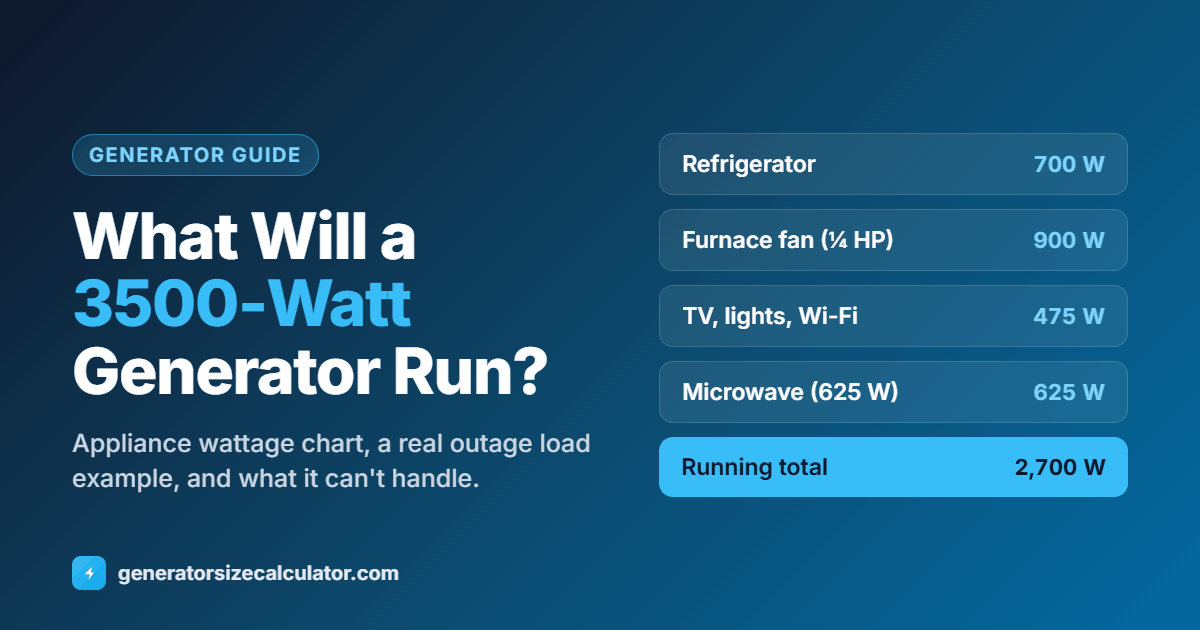
Quick answer: A 3500-watt generator can run the essentials of a small to mid-size home at the same time: a refrigerator, a freezer, a furnace fan, lights, a TV, Wi-Fi, phone chargers and a microwave. It can also handle a ½ HP sump pump, a ⅓ HP well pump or a small 10,000 BTU central air conditioner. It can't run an electric dryer, an electric water heater, an electric range or a 24,000 BTU central AC.
What "3500 watts" really means
The number on the box is only half the story. Most portable generators list two ratings:
- Running watts is what the generator can supply continuously.
- Starting watts (surge or peak) is a burst it can deliver for a few seconds to start motors and compressors.
A typical "3500-watt" model delivers 3,500 running watts and roughly 4,000 to 4,400 starting watts. Some brands do it the other way around and advertise 3,500 starting watts with only about 2,800 running. The figures in this guide assume 3,500 running watts. If your unit is the second kind, reduce every running-load number below by about 20%. Your manual or the spec label settles it in ten seconds.
Appliances follow the same logic. Lights, TVs and heating elements draw steady power. Anything with a motor or compressor (a fridge, pump, furnace blower or air conditioner) pulls two to three times its running watts for a moment at start-up. Our starting vs running watts calculator shows the difference for your own appliances.
3500-watt generator appliance chart
Typical values from Honda Power Equipment's published wattage guide, plus a utility sizing guide for the well pump. The last column shows whether a 3,500-watt generator can handle each one. Always check the data plate on your own appliance.
| Appliance | Running watts | Starting watts | On a 3500 W generator |
|---|---|---|---|
| Refrigerator or freezer | 700 | 2,200 | Yes, with other loads |
| Sump pump, ½ HP | 1,000 | 2,100 | Yes, with other loads |
| Sump pump, 1 HP | 2,300 | 4,500 | Alone; start it first |
| Well pump, ⅓ HP | 1,000 | 3,000 | Yes, usually needs 240 V |
| Furnace fan, ¼ HP | 900 | 1,800 | Yes, with other loads |
| Furnace fan, ⅓ HP | 1,000 | 1,800 | Yes, with other loads |
| Microwave (625 W) | 625 | 800 | Yes |
| Coffee maker | 1,750 | 1,750 | Yes, run it briefly |
| Toaster, 2-slice | 1,050 | 1,050 | Yes |
| Dishwasher | 1,450 | 1,800 | Yes, avoid other big loads |
| Washing machine | 1,150 | 2,300 | Yes |
| Dehumidifier | 650 | 800 | Yes |
| Clothes dryer, gas | 700 | 1,800 | Yes |
| Clothes dryer, electric | 5,750 | 1,800 | No |
| Electric range, 8-inch element | 2,100 | 2,100 | One burner only |
| Central AC, 10,000 BTU | 1,500 | 2,200 | Yes |
| Central AC, 20,000 BTU | 2,500 | 3,300 | Alone, little else |
| Central AC, 24,000 BTU | 3,800 | 4,950 | No |
| Garage door opener, ⅓ HP | 725 | 1,400 | Yes |
| TV | 300 | 300 | Yes |
| Computer | 150 | 150 | Yes |
| Modem / router | 25 | 25 | Yes |
LED bulbs add only 8 to 15 watts each, and phone chargers a few watts apiece. For appliances that aren't listed, the generator wattage calculator has typical values for dozens more.
Example: what a 3500-watt generator can run at the same time
Here is a realistic outage setup for a home with a gas furnace:
| Load | Running watts | Extra watts to start |
|---|---|---|
| Refrigerator | 700 | 1,500 |
| Furnace fan, ¼ HP | 900 | 900 |
| TV | 300 | 0 |
| 10 LED bulbs | 100 | 0 |
| Phone chargers | 50 | 0 |
| Modem and router | 25 | 0 |
| Total | 2,075 | Largest: 1,500 |
The running total is 2,075 watts, comfortably under the 80% mark (2,800 watts). Motors rarely start at the exact same instant, so you add only the largest start-up surge, the fridge's extra 1,500 watts, for a peak of 3,575 watts. That is within the generator's roughly 4,400 watts of starting capacity.
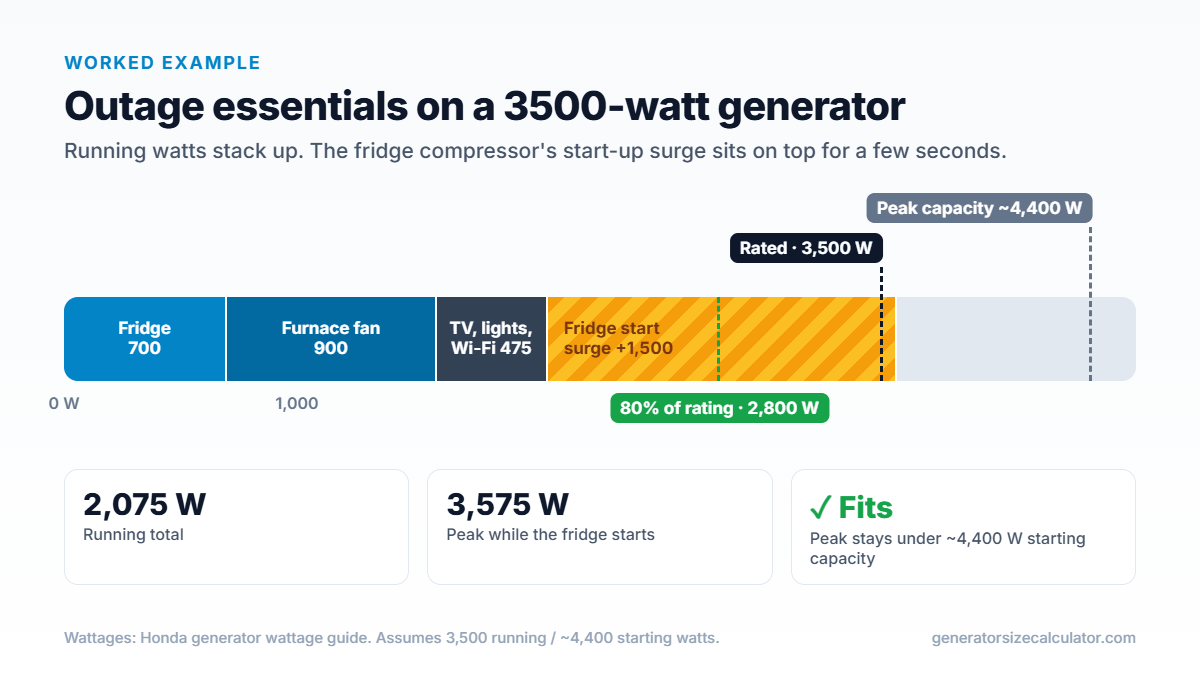
That leaves about 725 watts of headroom under the 80% mark, enough to add a 625-watt microwave for a minute or two. Use it between motor cycles rather than while the furnace blower is starting.
Check your own load in 2 minutes
Write down only what has to run at the same time. Add the running watts (if a label shows amps, multiply by volts: 120 V × 5 A = 600 W). Then find the one appliance with the biggest start-up gap and add that gap on top. Keep the first number under about 2,800 watts and the second under your generator's starting rating, and you're done.
Pick your appliances and get running and starting watts instantly.
What a 3500-watt generator can't run
- Electric clothes dryer: about 5,750 running watts, far above the limit.
- Electric water heater: commonly 4,000 to 4,500 watts by itself.
- Electric range and oven: each element is 1,500 to 2,100 watts. One burner is the most you can spare.
- 24,000 BTU and larger central AC: 3,800 running watts and about 4,950 to start.
- Electric heat strips and heat pumps: often 10,000 watts or more.
- Big shop tools or welders: a 100-amp welder alone is 3,600 watts.
If you need any of these, step up to a larger portable unit. See our guide to what a 5000-watt generator can run or the 7500-watt version.
Can a 3500-watt generator run a house?
It can keep the essentials going, which is what most outages call for: cold food, light, internet, phone charging and a working furnace blower. It can't run a home the way the grid does, because most homes have several large 240-volt appliances. Pick the 5 to 8 circuits that matter and power only those.
For plug-in loads, heavy-duty outdoor extension cords are fine; use the extension cord calculator to pick the right gauge. For hardwired loads like a furnace or well pump, you need a transfer switch or an interlock kit installed by a licensed electrician (see the transfer switch calculator). Never plug a generator into a wall outlet to backfeed the house. It can electrocute utility workers and start fires.
Tips to stretch 3,500 watts
- Start big motors one at a time. Let each one settle for a minute before the next.
- Treat the microwave and coffee maker as short bursts. They draw a lot for only a few minutes.
- Choose gas appliances for heat and drying where you can.
- Add a soft starter to an air conditioner to cut its surge, which can let a smaller generator start it.
- Watch your fuel. A lighter load stretches every tank. The generator runtime calculator estimates how long you'll last.
Safety rules
Carbon monoxide kills quickly. Run the generator outdoors only, never in a garage (even with the door open), basement or crawl space. The CDC advises keeping it at least 20 feet from the house with the exhaust pointed away from doors, windows and vents.
- Install battery-powered CO alarms on every level of the home.
- Let it cool before refueling and store fuel in approved containers.
- Keep it dry, under an open generator canopy, and out of standing water.
- If the breaker trips, unplug loads before resetting it.
Frequently asked questions
Can a 3500-watt generator run a whole house?
Not a typical whole house with central air, an electric range, a water heater and a dryer. It can run the essentials of most homes in an outage: refrigerator, freezer, furnace fan, lights, TV, internet and chargers, as long as you start the big motors one at a time.
Can a 3500-watt generator run a central air conditioner?
A small 10,000 BTU central AC (about 1,500 running and 2,200 starting watts) runs easily. A 20,000 BTU unit (2,500 running, 3,300 starting) can work if almost nothing else is running. A 24,000 BTU unit needs about 3,800 running watts, which is more than the generator can supply. See our central AC generator size guide.
Can a 3500-watt generator run a refrigerator and a freezer together?
Yes. Each needs about 700 running watts, so together they use about 1,400. Start them one at a time so their 2,200-watt start-up surges don't overlap.
Can a 3500-watt generator run a well pump?
Yes for a ⅓ HP pump (about 1,000 running and 3,000 starting watts) and usually a ½ HP pump. Most deep well pumps are 240 volts, so you need a 240-volt outlet and a transfer switch or interlock. See what size generator a well pump needs.
Can a 3500-watt generator run an RV air conditioner?
A 13,500 BTU RV AC runs on about 1,800 watts, but its start-up surge can be several times that. With a soft start device a 3,000 to 3,500-watt generator will typically start it; without one it often can't. Read the details in our RV AC generator guide.
Related calculators
Sources: Appliance wattages from Honda Power Equipment's generator wattage guide; well pump figures from Eugene Water & Electric Board's generator sizing guide; carbon monoxide guidance from the U.S. Centers for Disease Control and Prevention. Figures are typical values; always check your appliance's data plate and your generator's manual, and consult a licensed electrician before connecting a generator to your home's wiring.