
What Will a 7500-Watt Generator Run?
By the Generator Size Calculator Team · Updated · 9 min read
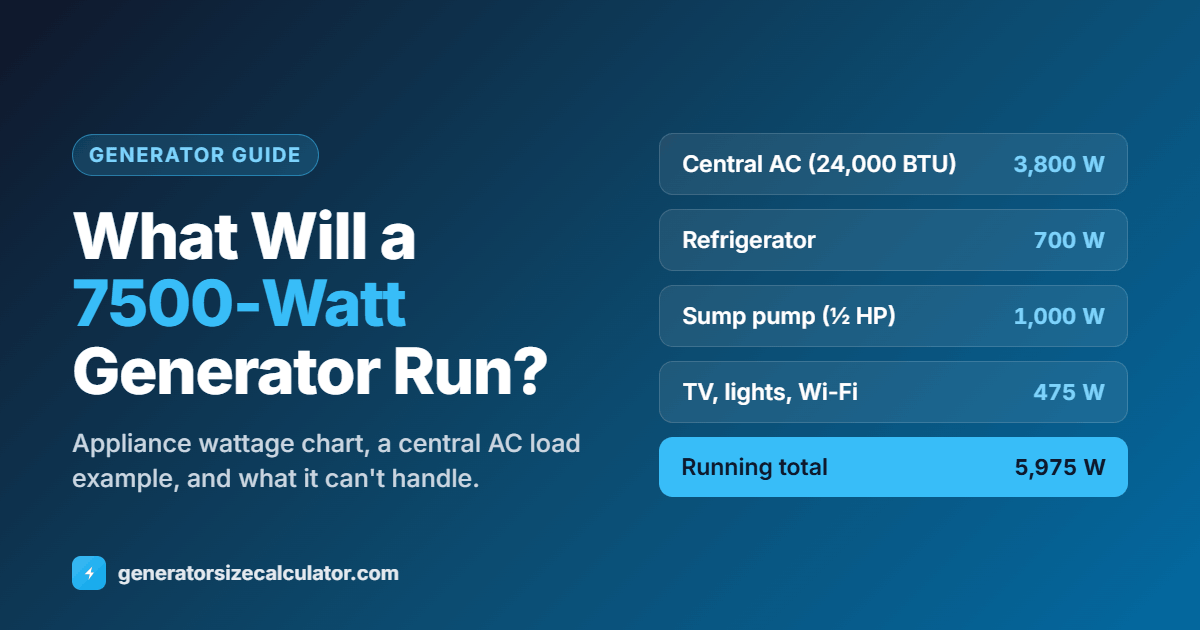
Quick answer: A 7500-watt generator can run a 24,000 BTU central air conditioner together with a refrigerator, a sump pump, lights, a TV and Wi-Fi. It can also start and run a larger 40,000 BTU central AC if you keep other loads light, a 1 HP air compressor, a 100-amp welder or a deep well pump. It can't run an entire all-electric house, and an electric dryer, an electric water heater and an electric range together exceed it.
Running watts vs peak watts on a "7500-watt" generator
Manufacturers use the label two ways, and the difference matters at this size:
- 7,500 running watts with about 9,000 to 9,400 starting watts. This is a common version of the label.
- 7,500 peak (starting) watts with about 6,000 running watts.
The examples below assume the first version. If yours is the second, plan around 6,000 watts and treat it like a "6000-watt" generator. Either way, the running rating limits what you can run all day, and the starting rating only covers the few seconds a compressor takes to spin up. Our starting vs running watts calculator explains how the two numbers fit together.
7500-watt generator appliance chart
Values come from Honda Power Equipment's published wattage guide (the well pump is from a utility sizing guide, and the water heater figure is a typical range). Check your own data plates when you can.
| Appliance | Running watts | Starting watts | On a 7500 W generator |
|---|---|---|---|
| Central AC, 24,000 BTU (2 ton) | 3,800 | 4,950 | Yes, with other loads |
| Central AC, 40,000 BTU (3.3 ton) | 6,000 | 7,800 | Yes, keep other loads light |
| Refrigerator or freezer | 700 | 2,200 | Yes |
| Sump pump, 1 HP | 2,300 | 4,500 | Yes |
| Well pump, ⅓ HP | 1,000 | 3,000 | Yes, usually needs 240 V |
| Furnace fan, ½ HP | 1,200 | 2,500 | Yes |
| Dishwasher | 1,450 | 1,800 | Yes |
| Washing machine | 1,150 | 2,300 | Yes |
| Clothes dryer, electric | 5,750 | 1,800 | Alone, little else |
| Electric range, 8-inch element | 2,100 | 2,100 | Two burners at most |
| Electric water heater (typical) | 4,000-4,500 | 4,000-4,500 | Yes, but it uses over half |
| Coffee maker | 1,750 | 1,750 | Yes |
| Air compressor, 1 HP | 1,500 | 4,500 | Yes |
| Air compressor, 2 HP | 2,800 | 7,700 | Yes, with light other loads |
| Electric welder, 100 amp | 3,600 | 3,600 | Yes |
| Electric welder, 200 amp | 9,000 | 9,000 | No |
| Table saw, 2.5 HP | 1,800 | 4,500 | Yes |
| TV, computer, modem | 475 | 475 | Yes |
Honda's figures are a guideline. If your furnace or air handler has its own blower on a separate circuit, check its data plate and add it. For a deeper look at air conditioners by size, read our central AC generator size guide.
Example: central AC plus the essentials on a 7500-watt generator
A hot-weather outage in a house with a basement:
| Load | Running watts | Extra watts to start |
|---|---|---|
| Central AC, 24,000 BTU | 3,800 | 1,150 |
| Refrigerator | 700 | 1,500 |
| Sump pump, ½ HP | 1,000 | 1,100 |
| TV, lights, Wi-Fi, chargers | 475 | 0 |
| Total | 5,975 | Largest: 1,500 |
Running watts total 5,975, just under the 80% mark (6,000 watts). The biggest start-up surge is the refrigerator's extra 1,500 watts, so the worst-case peak is 7,475 watts, well within roughly 9,375 starting watts.
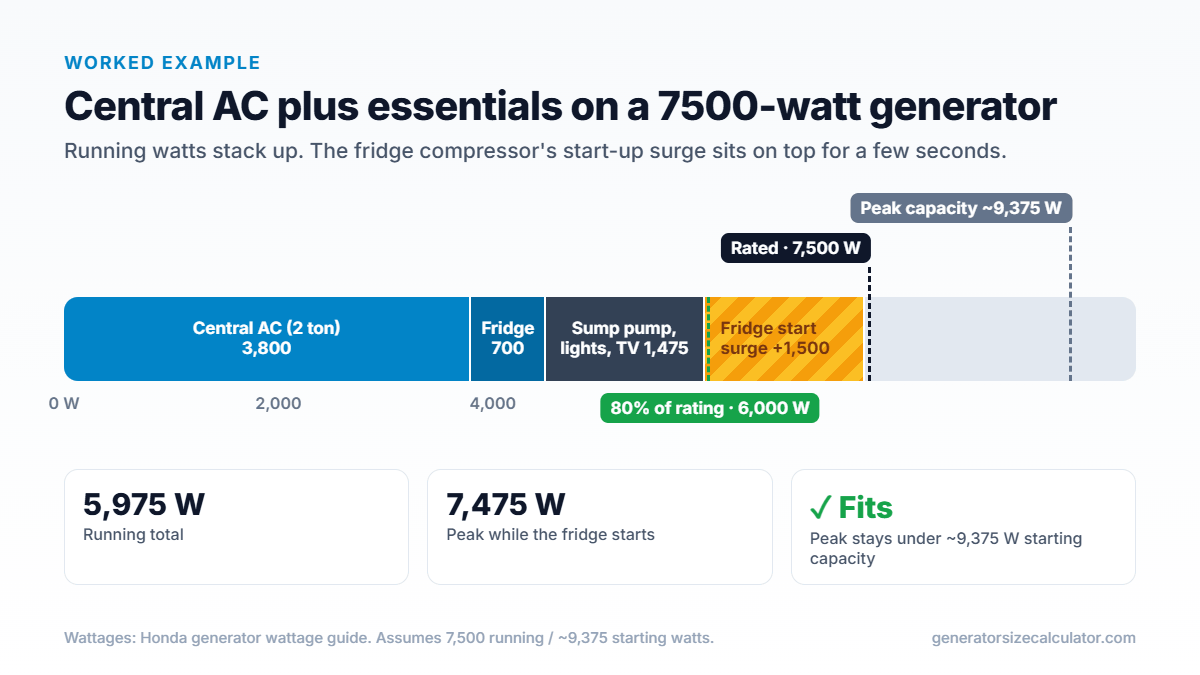
There's very little room left on the running side, so this is where a plan helps. Run the AC and fridge continuously and treat anything else as a short, deliberate add-on.
Load priorities when power is tight
Sort your loads into three tiers and switch things on in that order:
- Always on: refrigerator, freezer, sump pump, medical equipment, internet.
- On when needed: central AC or furnace blower, well pump, lights.
- Short bursts only: microwave, coffee maker, washer, dishwasher, hair dryer.
Start the largest motor first, while the generator is lightly loaded. If a surge makes the engine bog down or the breaker trips, shed a tier-3 load. The generator load calculator shows what percentage of the rating you're using.
Add your appliances and see running and starting watts in seconds.
What a 7500-watt generator can't run
- An all-electric house at once. Electric heat strips, a water heater, a range, a dryer and two AC systems can total well over 20,000 watts.
- A 200-amp welder, which draws about 9,000 watts alone.
- A level 2 EV charger alongside central AC. A level 2 charger can draw 7,000 watts or more by itself.
- Two large central AC units running together.
For a whole-house setup, a standby generator sized to your service is the better tool.
Connecting a 7500-watt generator to a house
Divide watts by volts to get amps: 7,500 W ÷ 240 V is about 31 amps, and 6,000 W ÷ 240 V is 25 amps. That's why 7500-watt generators usually have a 30-amp, 240-volt outlet (L14-30), and why a 30-amp transfer switch or interlock kit is the usual match. At 120 volts the same output is 62.5 amps spread across several outlets, so the load is split between two legs.
Have a licensed electrician install the transfer switch or interlock and the inlet. Never backfeed the house through a dryer or wall outlet. The transfer switch calculator and generator amps calculator help you choose sizes before you call.
Safety rules
A generator this size puts out a lot of carbon monoxide. Run it only outdoors, at least 20 feet from the house per CDC guidance, with the exhaust pointed away from windows, doors and vents. Never run it in a garage, even with the door open.
- Install battery-backed CO alarms on every floor.
- Refuel only when it is off and cool.
- Keep it under a generator canopy, never in standing water.
- Use cords rated for the load; check our extension cord calculator.
Frequently asked questions
Can a 7500-watt generator run a whole house?
It can run a mid-size house that uses gas for heat, cooking, hot water and drying if you manage the large motor loads, and it can run selected circuits in almost any house through a transfer switch. It can't power every circuit of an all-electric home at once.
Can a 7500-watt generator run a central air conditioner?
Yes. A 24,000 BTU unit needs about 3,800 running and 4,950 starting watts, leaving room for the essentials. A 40,000 BTU unit needs about 6,000 running and 7,800 starting watts, which fits if you keep everything else light.
How many amps is a 7500-watt generator?
Divide watts by volts. At 240 volts it is about 31 amps (7,500 ÷ 240). At 120 volts it is 62.5 amps in total, split across the generator's outlets.
Is a 7500-watt generator enough for a 50-amp RV?
A 30-amp RV can draw up to 3,600 watts (30 A × 120 V) and a 50-amp RV up to 12,000 watts (50 A × 240 V). A 7500-watt generator covers a 30-amp RV easily and a 50-amp RV as long as you don't run everything at once.
How long will a 7500-watt generator run on a tank of gas?
It depends on the tank size and your load. Manufacturers list runtime at 50% load; heavier loads shorten it. Use the generator runtime calculator for an estimate.
Related calculators
Sources: Appliance wattages from Honda Power Equipment's generator wattage guide; well pump figures from Eugene Water & Electric Board's generator sizing guide; carbon monoxide guidance from the U.S. Centers for Disease Control and Prevention. Amps are calculated as watts ÷ volts. Figures are typical values; check your appliance data plates and generator manual, and use a licensed electrician for any connection to house wiring.