
Can a 2000-Watt Generator Run an RV Air Conditioner?
By the Generator Size Calculator Team · Updated · 7 min read
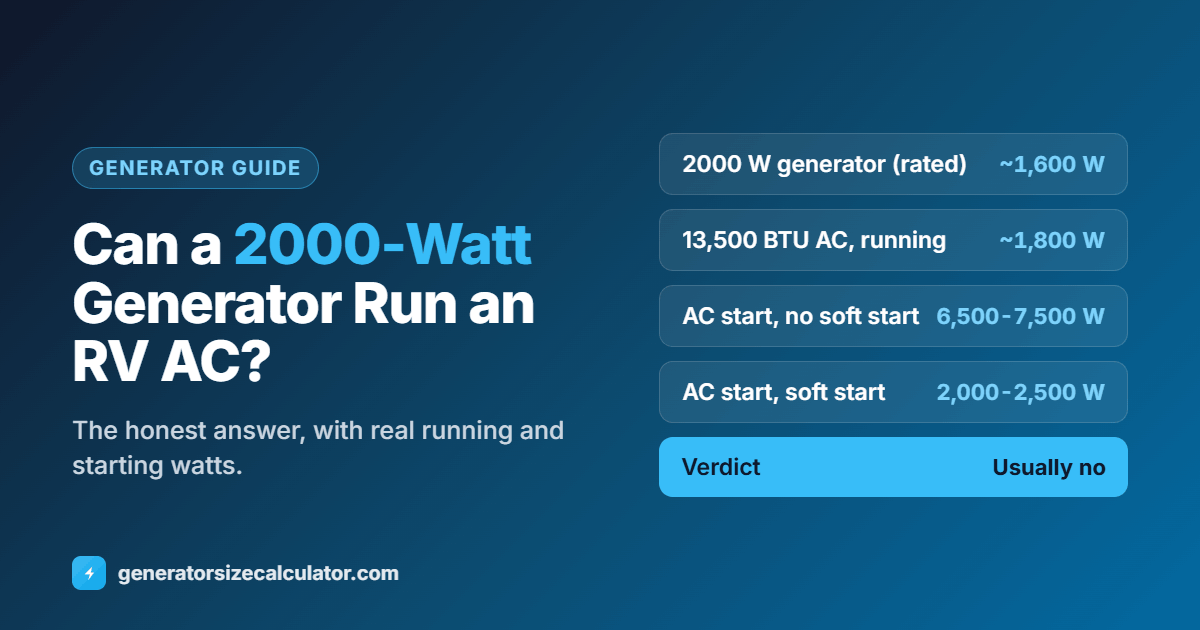
Quick answer: Usually no. A 13,500 BTU RV air conditioner draws about 1,800 running watts, and without a soft start it needs roughly 6,500 to 7,500 watts to start. Most 2000-watt inverter generators are rated at only about 1,600 running watts (2,000 at peak), so they can't even sustain the AC. A 2200-watt model with about 1,800 running watts is borderline with a soft start. A 3,000-watt generator with a soft start, or two 2000-watt inverters run in parallel, is the realistic minimum.
What "2000 watts" usually means on a generator
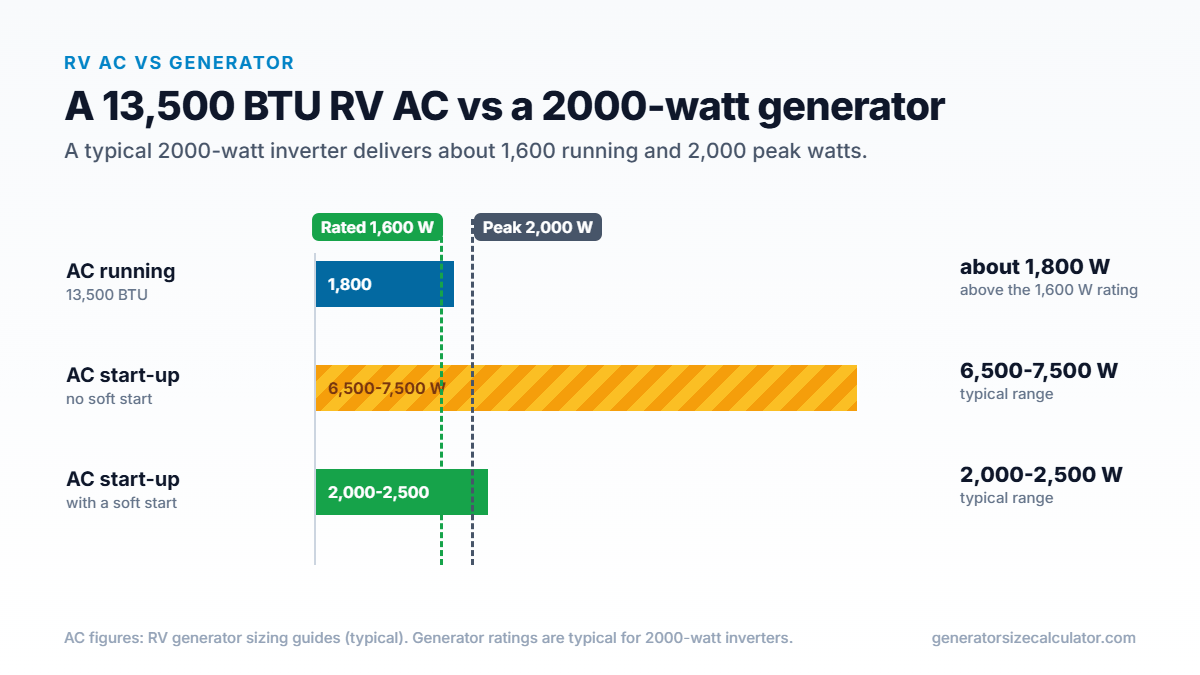
On small portable generators, the headline number is often the peak (starting) rating, not what the engine can supply all day. Many 2000-watt inverter generators list about 1,600 running watts and 2,000 peak watts, and 2200-watt models list about 1,800 running watts. The running figure is the one you size an air conditioner against, because the AC runs continuously while it is cooling. Check your own manual or spec label before you decide anything.
What an RV air conditioner needs
A rooftop RV air conditioner has a compressor like a home unit, so it has the same two numbers. These are typical figures from RV generator sizing guides; your unit's data plate is the authority.
| RV AC | Running watts | Starting watts, no soft start | Starting watts, with soft start |
|---|---|---|---|
| 13,500 BTU | about 1,800 | 6,500-7,500 | 2,000-2,500 |
| 15,000 BTU | about 2,000 | 7,000-8,000 | 2,200-2,700 |
The start-up surge without a soft start is three to four times the running watts, which is why a unit that runs on 1,800 watts can trip a generator that looks big enough on paper.
Which generator can run an RV AC?
Putting those numbers against common generator sizes gives this picture:
| Generator | 13,500 BTU AC | 15,000 BTU AC |
|---|---|---|
| 2000-watt inverter (about 1,600 W rated) | No; running load exceeds the rating | No |
| 2200-watt inverter (about 1,800 W rated) | Borderline, AC alone with a soft start, cool weather | No |
| 3000-watt generator | Yes, with a soft start | Yes, with a soft start |
| 3500-watt generator | Yes, with a soft start | Yes, with a soft start |
| Two 2000-watt inverters in parallel (about 3,200 W rated) | Yes, with a soft start | Yes, with a soft start |
Without a soft start, results vary by unit, and small generators often can't deliver the start-up current. Check the parallel generator calculator if you're considering two units, and use the RV generator calculator to size for your whole rig, not just the AC.
Soft start kits: what they fix and what they don't
An RV soft start is a small module that goes on the compressor and limits the start-up current. Guides report it brings the surge down to roughly 2,000 to 2,700 watts, a reduction of about two thirds. It makes a 3,000-watt generator capable of starting the AC.
It does not reduce running watts. If the AC needs 1,800 watts while cooling and your generator is rated 1,600, it is still overloaded, so a soft start alone can't rescue a typical 2000-watt unit. It is most useful for a generator that is large enough on running watts but short on surge.
Add the AC and your other RV loads to find the right generator.
What a 2000-watt generator can run in an RV
Plenty, just not the AC. These figures are from Honda Power Equipment's wattage guide, and the last column assumes a generator rated 1,600 running watts.
| Appliance | Running watts | Starting watts | On a 2000 W generator |
|---|---|---|---|
| Microwave (625 W) | 625 | 800 | Yes |
| TV | 300 | 300 | Yes |
| Computer | 150 | 150 | Yes |
| Modem / router | 25 | 25 | Yes |
| Toaster, 2-slice | 1,050 | 1,050 | Yes, run it alone |
| Vacuum, upright | 800 | 1,100 | Yes |
| Electric blanket | 800 | 800 | Yes |
| Hair dryer | 300-1,500 | 300-1,500 | Low heat only |
| Coffee maker | 1,750 | 1,750 | No on a 1,600 W unit |
A typical evening load of a microwave, TV, laptop, modem and chargers is about 1,150 running watts, comfortably under the 1,600-watt rating. Run the microwave and a hot appliance at different times rather than together.
Your options if you want AC
- Buy a bigger generator. A 3,000 to 3,500-watt inverter generator with a soft start is the common choice for a 13,500 BTU AC.
- Run two 2000-watt inverters in parallel. A parallel kit combines them for about 3,200 running watts, and each unit stays easy to carry.
- Add a soft start to the AC. Combine it with one of the two options above.
- Use shore power where it's available, and save the generator for the places without it.
- Reduce the cooling load. Park in shade, use window covers and vent fans, and run the AC only in the hottest hours.
Heat and altitude reduce a small generator's output
Engines make less power in hot weather and at elevation. A common rule of thumb is a loss of about 3 to 4% per 1,000 feet of altitude, and hot afternoons cost more, exactly when you want the AC. A generator that is barely big enough at sea level may not be enough in the mountains. Our generator derating calculator shows how much capacity you'll really have.
Safety rules
Carbon monoxide is a serious risk around RVs. Run the generator outdoors on level ground, with the exhaust pointed away from your RV's doors, windows and vents and away from neighbors. Never run it inside a storage bay, awning enclosure or tent, and keep a working CO alarm inside the RV.
- Let the generator cool before refueling.
- Follow campground rules on quiet hours and generator use.
- Use a cord with enough gauge for the run to the RV; our extension cord calculator helps.
Frequently asked questions
Can a 2000-watt generator run a 13,500 BTU RV air conditioner?
Usually not. The AC draws about 1,800 running watts, more than the roughly 1,600 watts a typical 2000-watt inverter is rated for, and it needs about 6,500 to 7,500 watts to start without a soft start. A 2200-watt model is borderline with a soft start.
What size generator do I need to run an RV air conditioner?
Plan on about 3,000 watts with a soft start for a 13,500 or 15,000 BTU unit, or two 2000-watt inverters in parallel. Size up if you also run a microwave or other appliances at the same time.
Can I run a smaller RV air conditioner on a 2000-watt generator?
A smaller or lower-draw unit needs fewer watts, but check the data plate for both running and starting amps. The running watts must be under about 1,600 and the start-up surge must fit the generator's peak rating.
Can a 2000-watt generator run an RV AC and a microwave together?
No. The AC alone already exceeds a typical 2000-watt unit's running rating. Even with a larger generator, run the microwave while the AC compressor is off.
Will a 2000-watt generator run a 30-amp RV?
It can run parts of one. A 30-amp RV can draw up to 3,600 watts (30 A × 120 V), so a 2000-watt generator works only if you leave the AC and other big loads off.
How much does a soft start help?
Guides report it cuts the start-up surge by about two thirds, to roughly 2,000 to 2,700 watts. It does not lower running watts, so the generator must still cover the AC's steady draw.
Related calculators
Sources: RV air conditioner running and starting watts, soft start figures and generator pairings from RV generator sizing guides (typical values vary by unit; check your data plate); household and appliance wattages from Honda Power Equipment's generator wattage guide; carbon monoxide guidance from the U.S. Centers for Disease Control and Prevention. The 1,600-watt rated figure is typical for 2000-watt inverter generators; confirm yours in the manual.