
What Size Generator Do You Need to Run a Central AC?
By the Generator Size Calculator Team · Updated · 9 min read
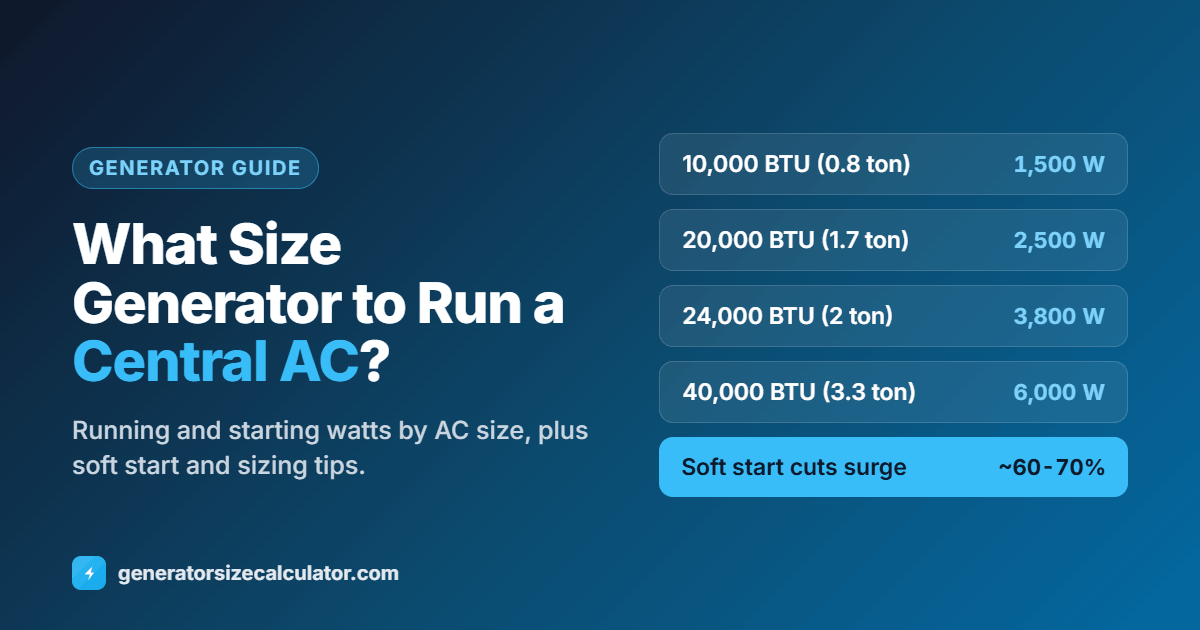
Quick answer: A central air conditioner is one of the hardest loads for a portable generator. By Honda's typical figures, a 24,000 BTU (2-ton) unit needs about 3,800 running watts and 4,950 starting watts, so plan on a 5,000-watt generator for the AC alone and about 7,500 watts if you also run a fridge, lights and a TV. A small 10,000 BTU unit needs about 2,500 watts, a 20,000 BTU unit about 3,500 watts, and a 40,000 BTU unit about 7,500 watts. A soft start kit can cut the start-up surge.
Why a central AC is hard on a generator
A central air conditioner has two jobs that both draw power: a compressor that moves refrigerant, and fans that move air over the coils. The compressor is a big motor, and a motor needs a surge of current to start turning, often several times what it uses once running. That is why generator sizing for AC always involves two numbers:
- Running watts: what the AC draws while cooling. Your generator must supply this continuously.
- Starting watts: the brief spike when the compressor kicks on, usually lasting a second or less. Your generator must be able to deliver this peak.
Because the compressor cycles on and off all afternoon, you meet that spike over and over. A generator that can only barely cover it will stall, sag in voltage or trip its breaker.
Step 1: read the nameplate
The outdoor unit has a data plate with the exact electrical ratings. These are the labels that matter:
| Label | Meaning | How to use it |
|---|---|---|
| Volts | Supply voltage, almost always 240 V | Your generator needs a 240 V outlet |
| RLA | Rated load amps of the compressor | Volts × RLA ≈ running watts |
| MCA | Minimum circuit ampacity of the whole unit | Volts × MCA is a conservative running figure |
| LRA | Locked rotor amps, the worst-case start-up current | Volts × LRA is the worst-case start-up load |
For example, a unit with RLA of 16 amps at 240 volts uses about 240 × 16 = 3,840 running watts, which lines up with the 3,800 watts in the table below for a 24,000 BTU unit.
LRA is the number to treat with care. It describes a compressor that is locked and not turning, so real start-ups usually draw less. Still, it explains why two units of the same size can need very different generators: an older single-stage compressor with a high LRA is much harder to start than a newer one. If your LRA is high, plan for a soft start kit or a larger generator.
Step 2: generator size by AC size
Honda Power Equipment's wattage guide gives typical values for four common sizes. One ton of cooling equals 12,000 BTU, so these are roughly 0.8, 1.7, 2 and 3.3 tons. The last two columns apply the 80% rule (keep continuous load under 80% of the generator's running rating) and check the starting watts.
| AC size | Running watts | Starting watts | Generator for the AC alone | With a fridge, lights and TV |
|---|---|---|---|---|
| 10,000 BTU (≈0.8 ton) | 1,500 | 2,200 | 2,500 W | 3,500 W |
| 20,000 BTU (≈1.7 ton) | 2,500 | 3,300 | 3,500 W | 5,000 W |
| 24,000 BTU (2 ton) | 3,800 | 4,950 | 5,000 W | 7,500 W |
| 40,000 BTU (≈3.3 ton) | 6,000 | 7,800 | 7,500 W | 10,000 W |
A 3-ton (36,000 BTU) unit falls between the last two rows, at roughly 5,000 to 6,000 running watts by interpolation. Expect to need about 7,500 watts for the AC alone and 9,000 to 10,000 watts with other loads, and confirm with your nameplate. Bigger 4 and 5-ton systems move into standby-generator territory; our standby generator calculator sizes those.
Step 3: add your other loads
The "with other loads" column above assumes a modest set of essentials: a refrigerator (700 watts), plus about 475 watts of lights, a TV, Wi-Fi and chargers, for 1,175 watts in total. Add the running watts of anything else that must run at the same time, then add the single largest start-up surge once. The largest extra surge in that essentials mix is the refrigerator's 1,500 watts, which is why the larger sizes in the last column have headroom.
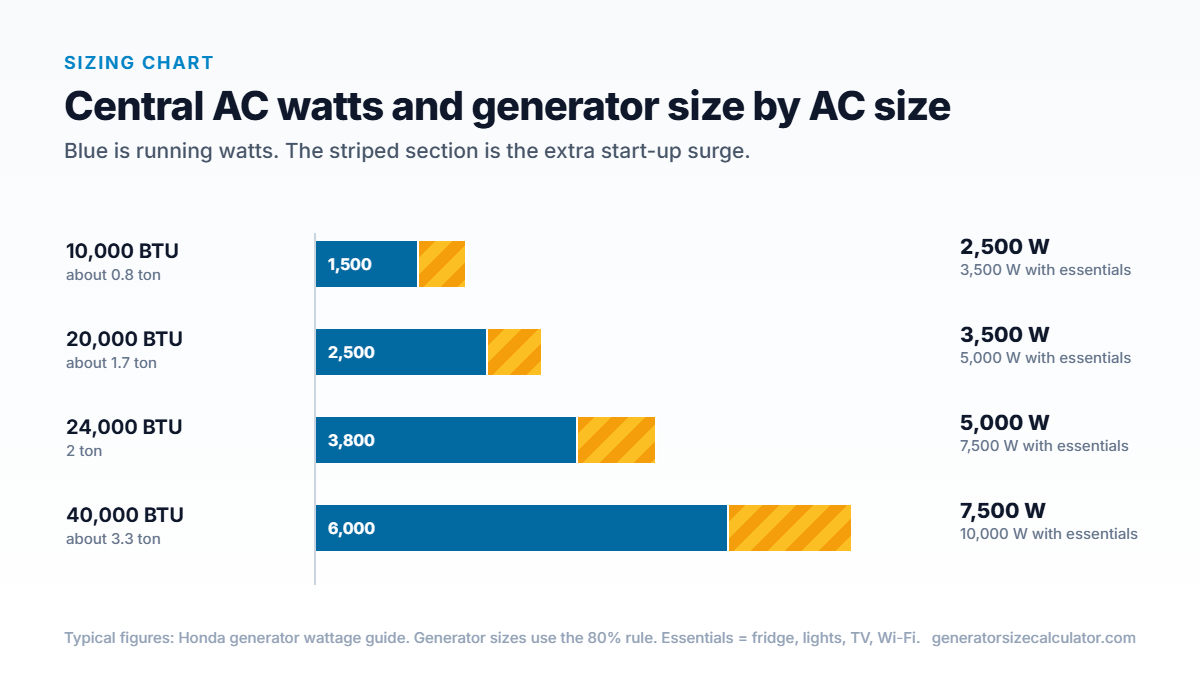
Use your nameplate numbers to see the running and starting watts for your system.
Soft start kits: the cheapest way to shrink the generator
A soft start device is a small module wired to the compressor that ramps the motor up gradually. Sizing guides commonly report that it reduces start-up current by roughly 60 to 70%. It does not change running watts, so it helps most when the starting surge, not the running load, is what is forcing you to buy a bigger generator.
For example, a 24,000 BTU unit that runs on 3,800 watts will still need a generator rated for about 4,800 running watts after the 80% rule, but the 4,950-watt start no longer decides the choice. Have an HVAC technician install it, since it is wired into the outdoor unit.
Connecting a generator to a central AC
Most central ACs run on 240 volts and are hardwired, which means you can't simply plug them in. You need:
- A generator with a 240-volt outlet (usually L14-30 or 14-50). Many small inverter generators are 120-volt only and can't run a 240-volt compressor.
- A transfer switch or interlock kit installed by a licensed electrician so the AC circuit can be fed safely. The transfer switch calculator helps you size it.
- Heavy-duty cable and a properly rated inlet. Never backfeed the house through a wall or dryer outlet.
Tips to run an AC on a generator
- Pre-cool the house before an expected outage, then raise the thermostat a few degrees so the compressor cycles less.
- Start the AC first while the generator is lightly loaded, then add other loads one at a time.
- Keep the filter and coils clean. A restricted system draws more power.
- Close blinds and doors to rooms you aren't using to cut the cooling load.
- Plan fuel. A generator at 70 to 80% load burns fuel quickly; check the generator runtime calculator.
Safety rules
Never run a generator inside or near the AC's air intake. Keep it outdoors at least 20 feet from the house (CDC guidance), with the exhaust pointed away from windows, doors and vents, so exhaust can't be pulled into your home.
- Install battery-powered carbon monoxide alarms on every level.
- Turn the AC off at the thermostat before starting or stopping the generator.
- Don't overload the generator; if it labors or the breaker trips, shed load.
Frequently asked questions
What size generator do I need to run a 2-ton central AC?
A 2-ton (24,000 BTU) unit typically needs about 3,800 running and 4,950 starting watts. A 5,000-watt generator can run it alone; if you also want a refrigerator, lights and a TV, plan on about 7,500 watts.
What size generator do I need to run a 3-ton central AC?
A 3-ton (36,000 BTU) unit falls between the 24,000 and 40,000 BTU figures, at roughly 5,000 to 6,000 running watts. Expect to need about 7,500 watts for the AC alone and 9,000 to 10,000 watts with other loads, and confirm with the nameplate.
Can a 5000-watt generator run a central air conditioner?
Yes for units up to about 24,000 BTU if little else is running. See what a 5000-watt generator can run for the full chart.
Can a 3500-watt generator run a central air conditioner?
A 10,000 BTU unit, yes. A 20,000 BTU unit can work if almost nothing else runs. A 24,000 BTU unit is too large. See what a 3500-watt generator can run.
Can an inverter generator run a central AC?
Only if it supplies 240 volts and enough running and starting watts. Many portable inverters are 120-volt only. Two inverters paralleled with a 240-volt kit can work for smaller units.
Will a generator hurt my air conditioner?
An undersized or unstable supply can strain a compressor. Use a generator sized with headroom, and prefer a model with stable voltage and frequency. Check your AC manufacturer's guidance if you are unsure.
Related calculators
Sources: Running and starting watts by BTU size from Honda Power Equipment's generator wattage guide; soft start reduction and nameplate method from generator and HVAC sizing guides; carbon monoxide guidance from the U.S. Centers for Disease Control and Prevention. The 3-ton row and the generator-size columns are estimates calculated from those figures using the 80% rule. Always confirm with your unit's data plate and a licensed electrician or HVAC technician.