What Size Generator Do You Need for a Well Pump?
By the Generator Size Calculator Team · Updated · 8 min read
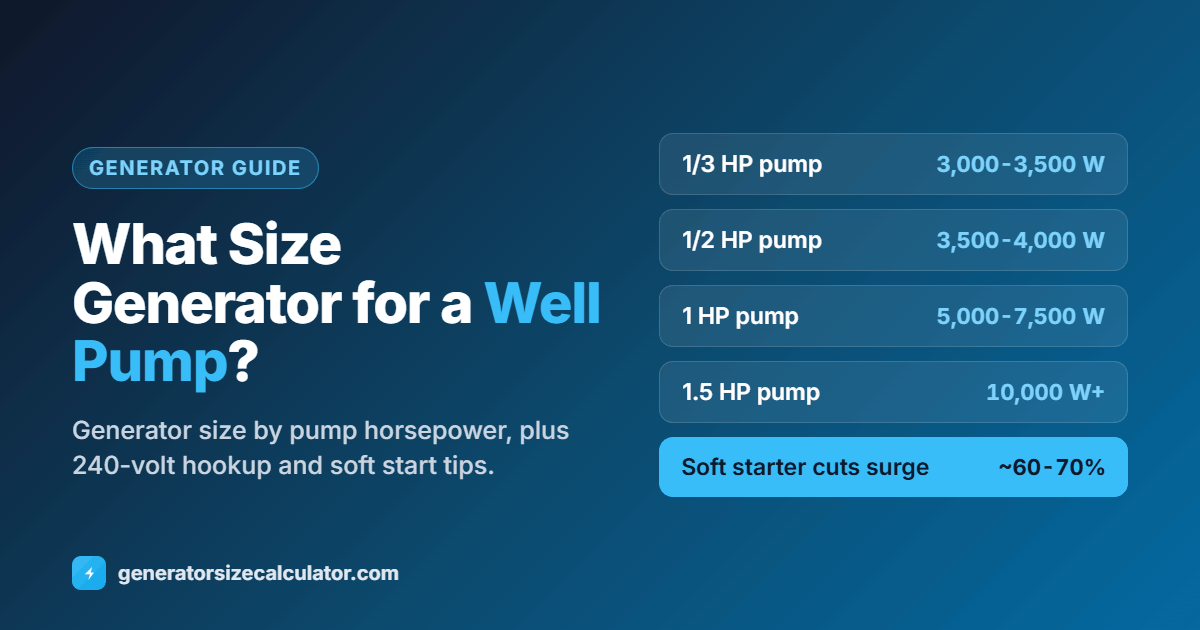
Quick answer: A typical 1/3 HP well pump needs about 1,000 running watts and 3,000 starting watts, so a 3,000 to 3,500-watt generator can run it alone. A 1/2 HP pump usually needs 3,500 to 4,000 watts, a 1 HP pump 5,000 to 7,500 watts, and a 1.5 HP pump 10,000 watts or more. Add 1,000 to 2,000 watts if you also want a refrigerator, lights and a TV, and check whether your pump is 240 volts, since that decides which generator outlet you need.
Why well pumps need extra headroom
A well pump has to push water up from deep underground or pull it from a shallow source, and its motor works hard to start. Two numbers decide the generator size:
- Running watts: what the pump draws once it is spinning, usually 1,000 to 3,000 watts depending on horsepower.
- Starting watts: a surge of roughly three times (sometimes up to five times) the running watts for a moment each time the pump cycles on.
The pump cycles whenever the pressure tank drops to its low setting, so you'll see that surge several times an hour while water is in use. A generator that handles the running load but not the surge will bog down or trip its breaker the first time you open a tap.
Step 1: find your pump's horsepower and voltage
On a deep well, the pump sits in the casing, so you can't read its nameplate directly. Try these instead:
- The control box near the pressure tank (on 3-wire submersible pumps) or the pump's paperwork from installation.
- The breaker in your panel labeled "well" or "pump". Most deep well pumps are fed from a 240-volt double-pole breaker.
- The label on a jet pump above ground, which lists horsepower, volts and amps.
- A well contractor or the original installer if none of that is available.
If a label gives volts and amps instead of watts, multiply them: 240 V × 6.5 A is about 1,560 watts running.
Step 2: generator size by well pump horsepower
The first row uses figures from a utility generator sizing guide (1,000 running and 2,000 extra starting watts). The other rows are typical ranges from pump and generator sizing guides, which vary by pump make and age, so treat them as ballpark figures and let your nameplate decide.
| Pump size | Running watts | Starting watts | Generator for the pump alone | With fridge, lights and TV |
|---|---|---|---|---|
| 1/3 HP | 1,000 | 3,000 | 3,000-3,500 W | 4,000-5,000 W |
| 1/2 HP | 1,000-1,500 | 2,000-3,000 | 3,500-4,000 W | 5,000 W |
| 1 HP | 1,500-2,000 | 3,750-6,000 | 5,000-7,500 W | 7,500 W |
| 1.5 HP | about 3,000 | 7,500-10,000 | 10,000 W or more | 12,000 W or more |
"With fridge, lights and TV" adds about 1,175 watts of running load (a 700-watt fridge plus 475 watts of lights, TV and Wi-Fi) and the largest start-up surge. Our 5000-watt guide and 7500-watt guide list what else those generators can power.
Example: a 1/3 HP well pump plus the essentials
A home on well water during a winter outage, with a gas furnace:
| Load | Running watts | Extra watts to start |
|---|---|---|
| Well pump, 1/3 HP | 1,000 | 2,000 |
| Furnace fan, ⅓ HP | 1,000 | 800 |
| Refrigerator | 700 | 1,500 |
| TV, lights, Wi-Fi, chargers | 475 | 0 |
| Total | 3,175 | Largest: 2,000 |
The running load is 3,175 watts. Add the largest single start-up surge, the pump's 2,000 extra watts, and the peak is 5,175 watts. A 5,000-watt generator (typically about 6,250 starting watts) fits, with the running load at about 63% of its rating.
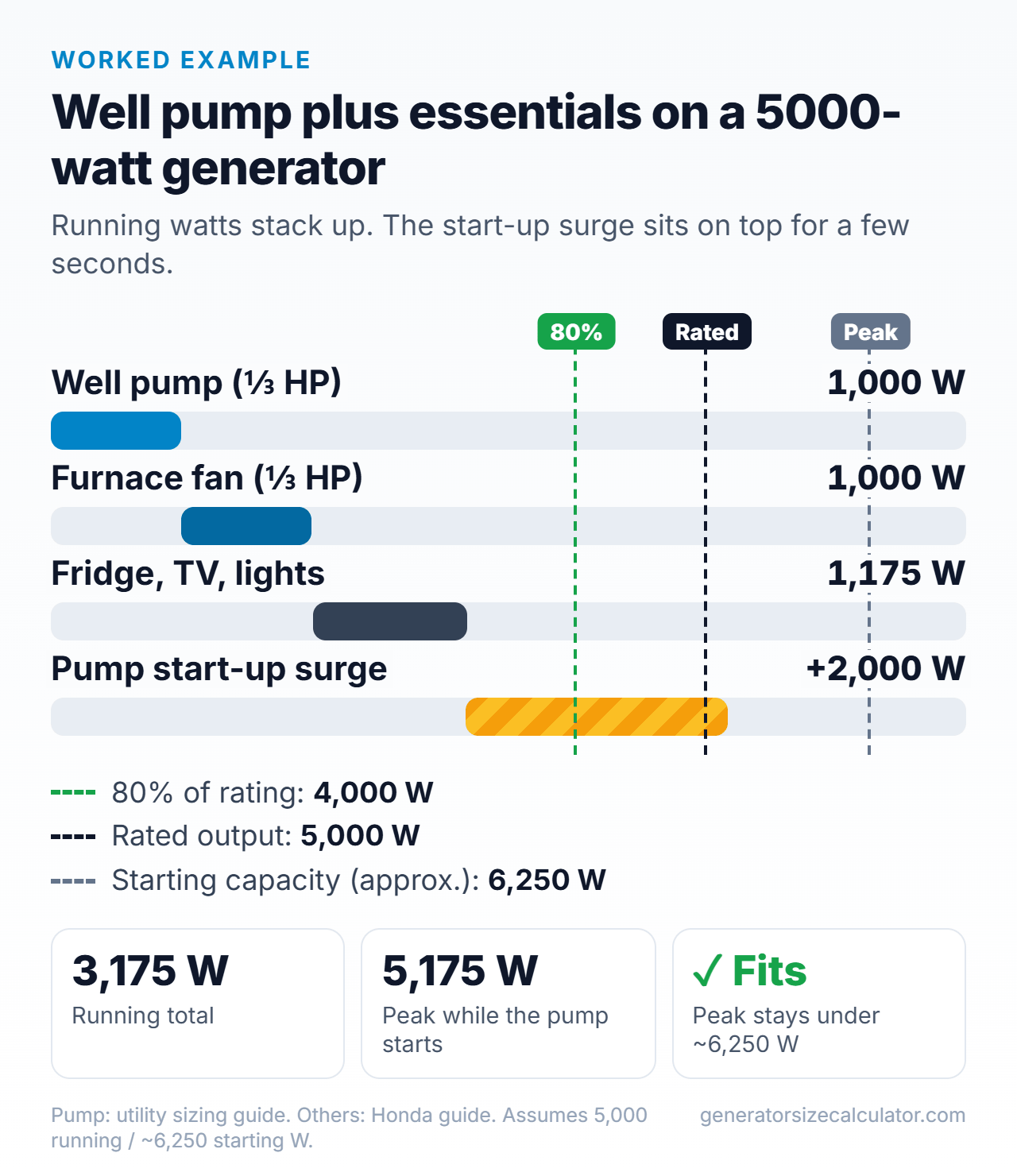
A 3,500-watt unit would run the pump alone, but this household would be better served by 5,000 watts so the fridge and furnace can run at the same time.
Add your pump and other appliances to see total running and starting watts.
Soft starters and other ways to go smaller
A pump soft starter ramps the motor gradually. Guides commonly report that it cuts the starting surge by about 60 to 70%, which can let a smaller generator start the pump. Running watts don't change, so the generator still has to cover the pump's steady draw. A well technician can fit one.
You can also reduce the load by skipping other big appliances while the pump runs. Let the pump fill the pressure tank, then run the tap only when needed.
Connecting a 240-volt well pump to a generator
Most deep well pumps are hardwired at 240 volts, so you can't plug them into a normal outlet. The safe setups are:
- A generator with a 240-volt outlet such as an L14-30, matched with a transfer switch or interlock kit that feeds the pump circuit. Use the transfer switch calculator to pick a size.
- A dedicated generator inlet and circuit for the pump, installed by a licensed electrician.
- For a small 120-volt shallow-well or jet pump, a heavy-duty outdoor cord from the generator can be enough. Check the gauge with the extension cord calculator.
Never backfeed the house through a wall or dryer outlet. It can send power into the grid and endanger line workers. Start the generator first and let it settle, then switch the pump circuit on.
Tips for running a well on a generator
- Fill containers early. Fill a few jugs or the bathtub while the generator is running, then switch the pump off between uses to save fuel.
- Start the pump first when the generator is lightly loaded, then add the fridge and furnace fan.
- Keep the pressure tank in good shape. A waterlogged tank makes the pump cycle more often, which means more surges.
- Watch fuel. The generator runtime calculator estimates how long a tank lasts at your load.
Safety rules
Keep the generator outdoors and away from the well house, garage and crawl space. Carbon monoxide can build up in enclosed spaces within minutes. The CDC advises at least 20 feet from the home with the exhaust pointed away from doors, windows and vents.
- Keep the generator and all connections dry, and never use it in standing water or near a flooded well pit.
- Turn the pump breaker or switch off before connecting or disconnecting the generator.
- Install battery-powered carbon monoxide alarms on every level of your home.
Frequently asked questions
What size generator do I need for a 1/2 HP well pump?
A 1/2 HP pump typically draws 1,000 to 1,500 running watts and 2,000 to 3,000 starting watts, so a 3,500 to 4,000-watt generator runs it alone. For a fridge, lights and TV as well, plan on about 5,000 watts.
What size generator do I need for a 1 HP well pump?
A 1 HP pump typically needs 1,500 to 2,000 running watts and 3,750 to 6,000 starting watts. A 5,000 to 7,500-watt generator is the usual range, and 7,500 watts if you also want other loads.
Can a 3500-watt generator run a well pump?
Yes for a 1/3 HP pump and usually a 1/2 HP pump, as long as the generator has a 240-volt outlet and you aren't running much else. See what a 3500-watt generator can run.
Can a 2000-watt inverter generator run a well pump?
Usually not. A 1/3 HP deep well pump needs about 3,000 starting watts, more than a 2000-watt inverter can deliver, and many small inverters have no 240-volt outlet. A small 120-volt shallow-well pump may work.
Do I need a transfer switch to run a well pump on a generator?
If the pump is hardwired at 240 volts, yes, or an interlock kit, so the pump circuit can be fed from the generator safely. Have a licensed electrician install it.
Does a water softener or pressure tank add much load?
Very little. A softener or water treatment system typically draws a few hundred watts at most, and a pressure tank draws nothing itself. The pump is the load to size for.
Related calculators
Sources: 1/3 HP well pump figures from Eugene Water & Electric Board's generator sizing guide; other horsepower ranges and soft starter reduction from well pump and generator sizing guides (published figures vary by manufacturer, so verify with your pump's data plate); refrigerator and household loads from Honda Power Equipment's generator wattage guide; carbon monoxide guidance from the U.S. Centers for Disease Control and Prevention. Generator-size columns are estimates; consult a licensed electrician before connecting a generator to your home's wiring.