What Size Generator Do You Need to Run an RV Air Conditioner?
By the Generator Size Calculator Team · Updated · 6 min read
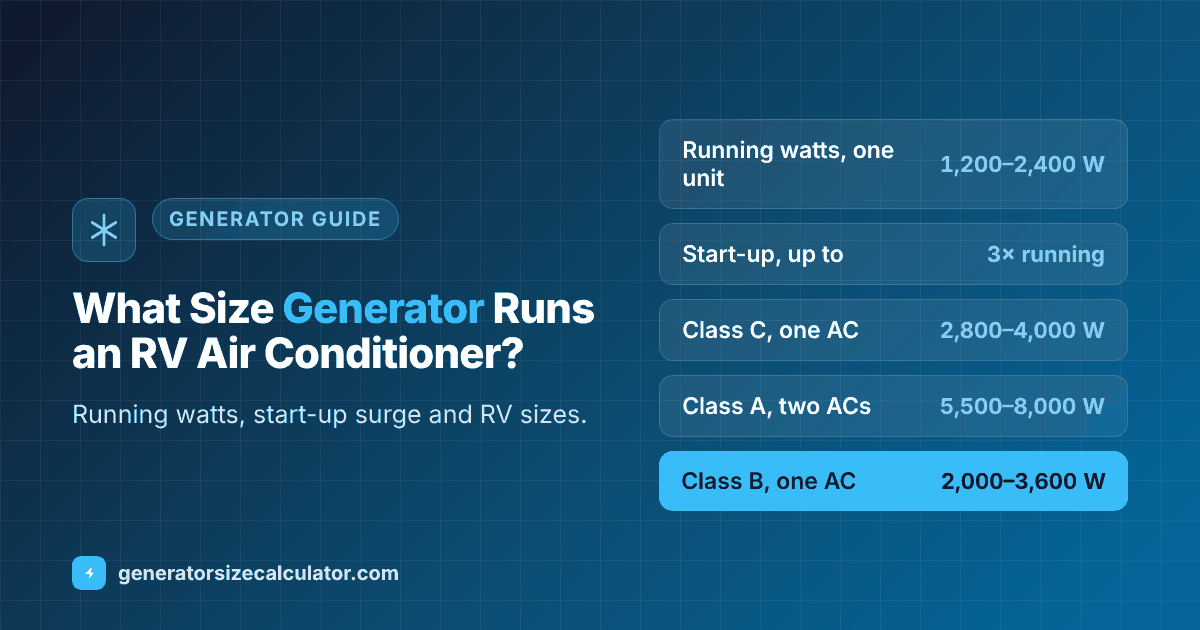
Quick answer: Cummins says a typical RV air conditioner (13,500 to 15,000 BTU) needs 1,200 to 2,400 running watts and can draw up to three times that for the first few seconds. For one air conditioner Cummins suggests 2,000 to 3,600 watts for a Class B van and 2,800 to 4,000 for a Class C. Two 15,000 BTU units need about 5,500 to 8,000 watts. A soft starter can cut the surge.
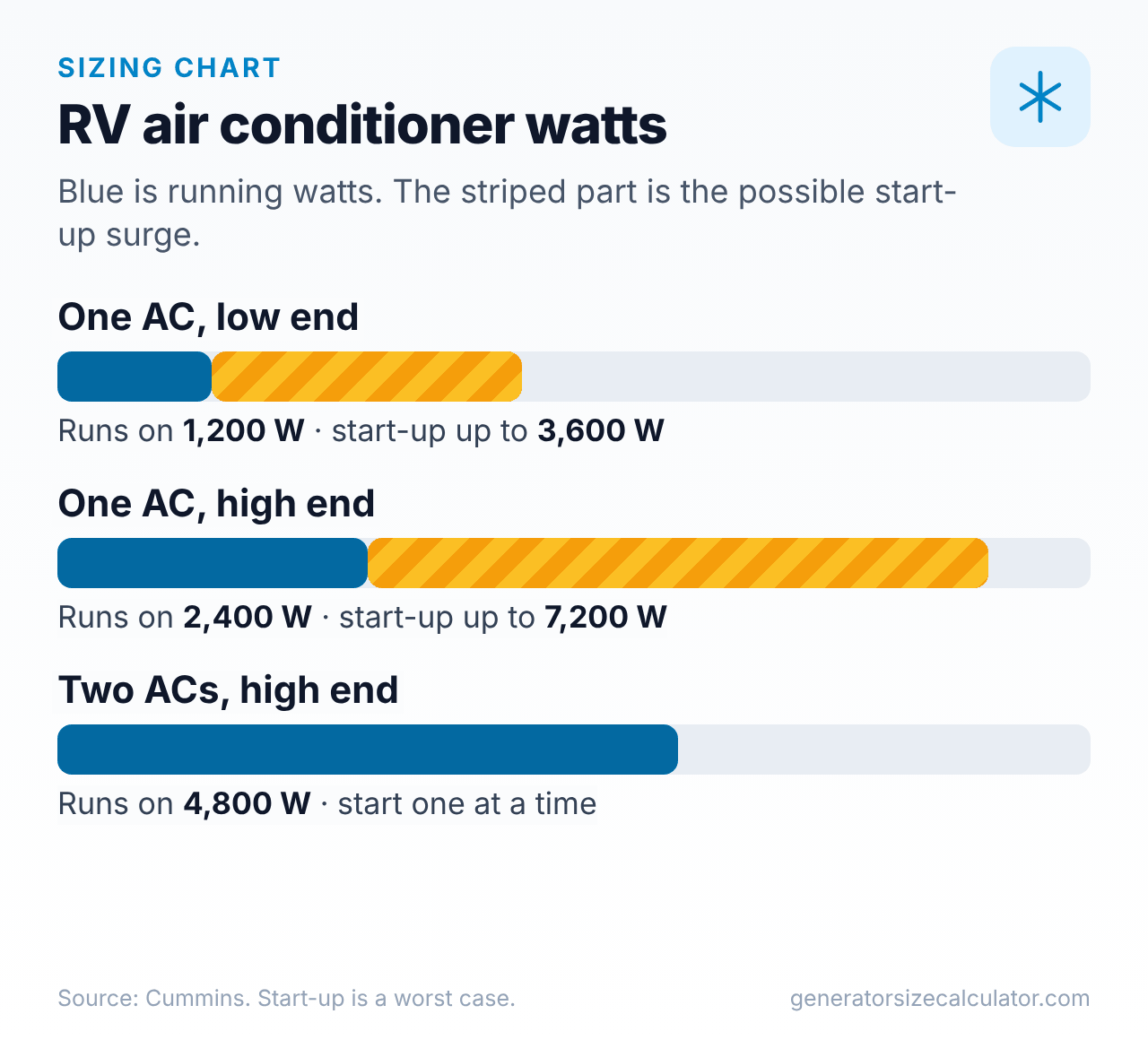
RV air conditioner watts
| Item | Cummins figure |
|---|---|
| Running watts, one air conditioner (13,500 to 15,000 BTU) | 1,200 to 2,400 W |
| Start-up draw for the first few seconds | Up to 3 times running watts |
The real number depends on the unit, its age and the heat outside. The label on the roof unit, or a plug-in watt meter at the RV's inlet, gives the true figure. Compare with a home unit in what size generator runs a window AC.
Which generator size to choose
| RV | Air conditioners | Cummins generator range |
|---|---|---|
| Class B van | One | 2,000 to 3,600 W |
| Class C RV | One | 2,800 to 4,000 W |
| Class A RV | Two (15,000 BTU) | 5,500 to 8,000 W |
| Fifth wheel | Two | 5,500 to 7,000 W |
Cummins adds that these ranges change with your equipment and that a 2,500 to 2,800-watt generator is often a good minimum for a 30 amp RV with air conditioning. See what size generator a 30 amp RV needs and a 50 amp RV.
Why start-up matters
The compressor needs a big burst of current to start. If an air conditioner runs at 2,400 watts, three times that is 7,200 watts for a moment. A generator that carries the running load but not the surge will bog down or trip. Two things help:
- A soft starter or soft-start kit, sold for many roof units, lowers the surge so a smaller generator copes. Check with the maker of your unit.
- Turn everything else off first, start the air conditioner, then add other loads once it has settled.
Add your air conditioner and other loads.
Tips for running air conditioning
- Pre-cool in the morning before the day heats up, so the air conditioner works less.
- Park in shade and use window covers to cut the load.
- Check the AC's LRA with the AC LRA calculator if you have the locked-rotor amps.
- Two inverters in parallel can be an alternative to one big generator. See the parallel generator calculator.
Run the generator outdoors, well away from the RV's doors, windows and vents. Carbon monoxide can build up inside a camper even with a window open. See how far a generator should be from a building.
Frequently asked questions
How many watts does an RV air conditioner use?
Cummins says a typical 13,500 to 15,000 BTU unit uses 1,200 to 2,400 running watts, with up to three times that at start-up.
Can a 2000-watt generator run an RV air conditioner?
Cummins lists 2,000 watts as the low end for a Class B van with one air conditioner. A soft starter helps. Without one, a normal unit may struggle to start.
What size generator runs a 13500 BTU RV air conditioner?
Cummins suggests roughly 2,800 to 4,000 watts for a Class C with one air conditioner. A 3,000 to 3,600-watt generator is a common choice.
Can a 3500-watt generator run two RV air conditioners?
Not normally. Cummins suggests 5,500 to 8,000 watts for two 15,000 BTU units.
What is a soft starter?
A device that eases the compressor start so the start-up surge is lower. It lets a smaller generator run the unit.
Related calculators
Sources: Cummins, What size generator do I need to power an RV? (air conditioner wattage and generator ranges by RV type); Cummins, RV generator electricity basics (1,200 to 2,400 running watts, up to three times at start-up). Soft-starter behavior is general guidance, so check your air conditioner's maker.