What Size Generator Do You Need to Run a Window AC Unit?
By the Generator Size Calculator Team · Updated · 7 min read
Quick answer: A window air conditioner typically draws about 600 to 1,500 running watts (Bob Vila), roughly 500 watts for 5,000 BTU, 1,000 for 10,000 and 1,500 for 15,000 (Renogy). The compressor also needs a start-up surge, so allow about 1.5 times running watts. A 2,000-watt inverter usually handles a 5,000 to 10,000 BTU unit, and a 2,500-watt generator a 15,000 BTU unit. Your unit's label has the real number.
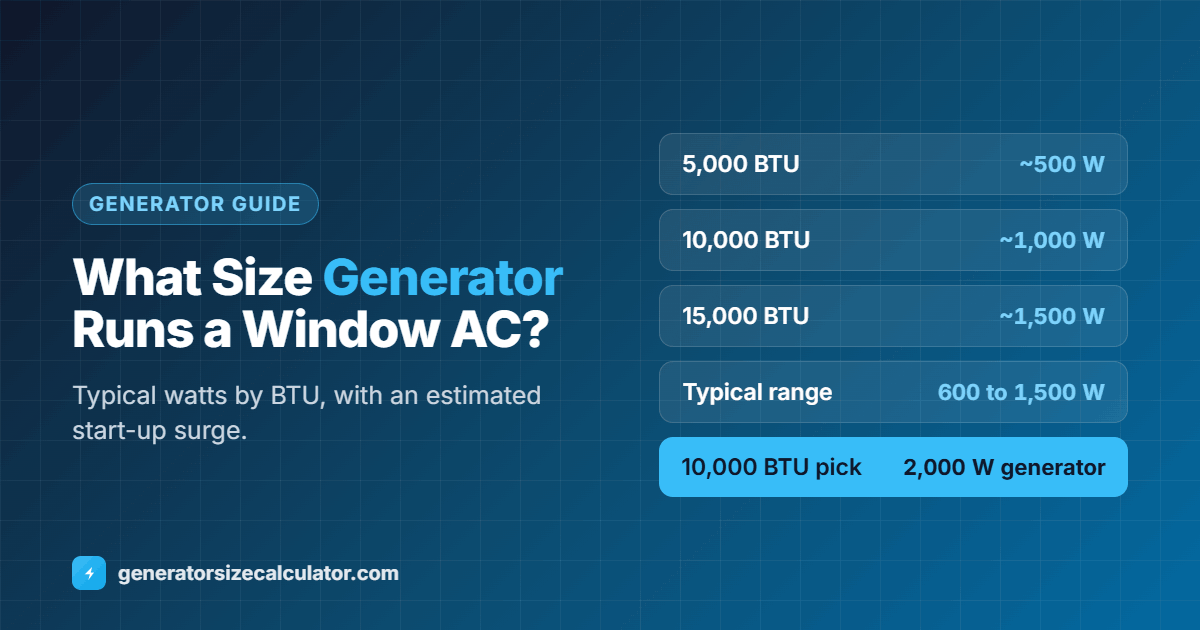
Window AC watts by size
Window air conditioners vary a lot with efficiency and age. Bob Vila lists them at about 600 to 1,500 running watts. Renogy's practical figures are below. These are typical values, not guarantees.
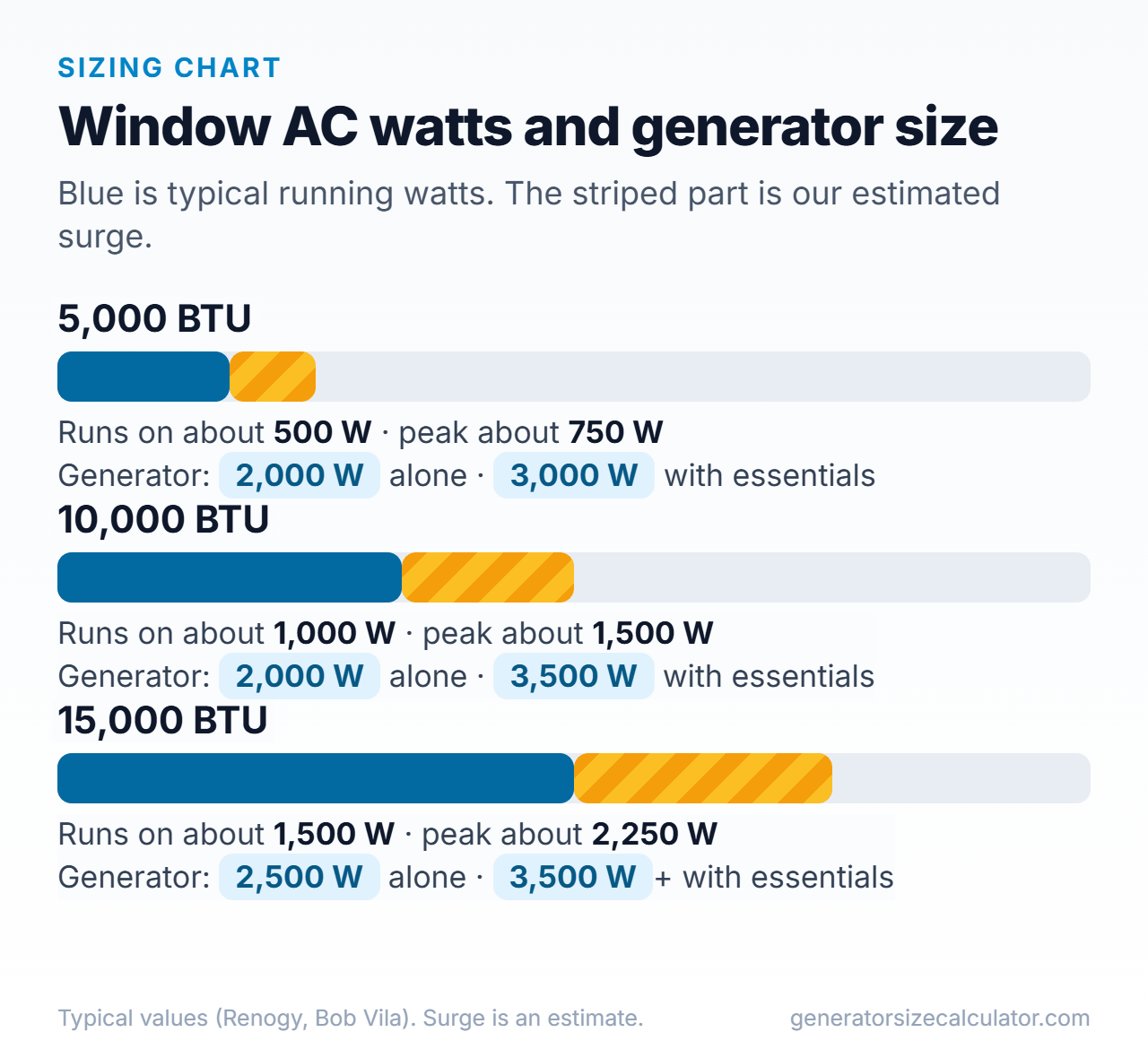
| Window AC | Typical running watts | Estimated start-up peak |
|---|---|---|
| 5,000 BTU | 500 | About 750 |
| 10,000 BTU | 1,000 | About 1,500 |
| 15,000 BTU | 1,500 | About 2,250 |
Window AC starting watts are not published in the sources we checked, so the peak column is our estimate of about 1.5 times running watts. Honda's guide shows a 10,000 BTU central AC at 1,500 running and 2,200 starting watts, a similar ratio. See what size generator runs a central AC.
Which generator size to choose
| Unit | AC alone | AC, fridge and essentials |
|---|---|---|
| 5,000 BTU | 2,000 W | 3,000 W |
| 10,000 BTU | 2,000 W | 3,500 W |
| 15,000 BTU | 2,500 W | 3,500 to 5,000 W |
The "essentials" column adds a fridge, TV, lights and Wi-Fi (about 1,175 running watts) and the fridge's start-up surge. Sizes keep the running load under 80% of rating. Our AC locked-rotor amps calculator helps if you know the compressor's locked-rotor amps.
Find your unit's real watts
Look for the rating label on the side or back of the AC, or in the manual. It shows amps, and sometimes watts. Multiply amps by 120 volts. A 8-amp unit is about 960 watts. A plug-in watt meter shows the true draw. Inverter-style or "smart" window units often draw less. Use the generator amps calculator to convert.
Combine the AC, fridge and lights for one generator size.
Tips to run an AC on a generator
- Start the AC first, with nothing else running, then add the fridge and lights.
- Plug it into a heavy cord or directly into the generator. See the extension cord calculator.
- Set the thermostat higher. The compressor cycles on and off less often and uses less fuel. See fuel consumption.
- Seal gaps and close the blinds so the AC works less.
- Mind the altitude and heat. Output drops in hot weather. See the derating calculator.
Run the generator outdoors, at least 20 feet from doors, windows and vents. Never in a garage or shed, even with the door open. See how far a generator should be from your house.
Frequently asked questions
How many watts does a window air conditioner use?
Bob Vila lists window units at about 600 to 1,500 running watts. As a typical guide, 5,000 BTU is about 500 watts, 10,000 BTU about 1,000 and 15,000 BTU about 1,500.
Can a 2000-watt generator run a window AC?
Usually a 5,000 to 10,000 BTU unit on its own, if the generator's peak rating covers the start-up surge. Check your AC's label.
Can a 3500-watt generator run a window AC and a fridge?
Yes for a 10,000 BTU unit, with a fridge, TV and lights, as the total stays under the 80% mark.
Why does a window AC need extra power to start?
The compressor motor draws a surge of power as it starts. This can be around 1.5 times the running watts or more.
Will a generator damage my air conditioner?
A properly sized generator with a steady output will not. Use a cord rated for the load and avoid overloading the generator.
Related calculators
Sources: Window AC running watts from Bob Vila (about 600 to 1,500) and Renogy's practical BTU table; central AC starting-to-running ratio from the Honda generator wattage guide. Window AC starting watts and generator sizes are our estimates (about 1.5 times running, 80% rule), so check your own unit's label.