What Size Generator Do You Need for a 50 Amp RV?
By the Generator Size Calculator Team · Updated · 6 min read
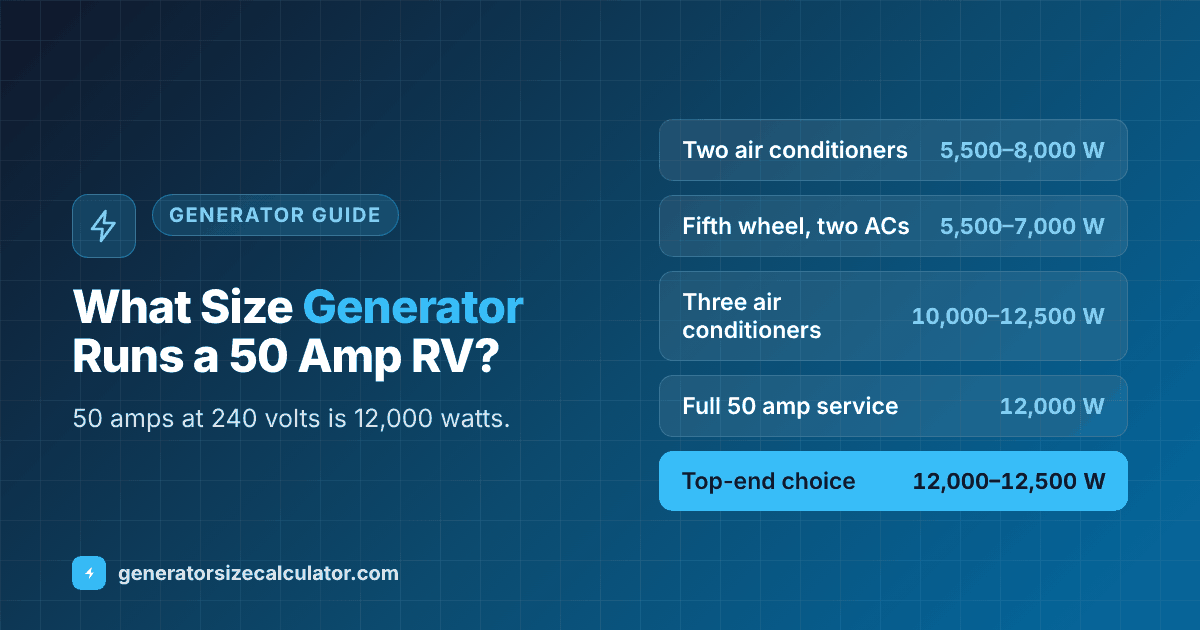
Quick answer: A 50 amp RV service is 50 amps at 240 volts, or 12,000 watts across two 120-volt legs. Cummins says 12,000 to 12,500 watts is the top-end choice, but most rigs need less: 5,500 to 8,000 watts for a Class A with two air conditioners and 10,000 to 12,500 for three. Add up your loads first, since the service rating is a ceiling and not a target.
The 12,000-watt limit
Watts equal volts times amps. A 50 amp RV service is 50 amps on each of two 120-volt legs, which is 240 volts, so 50 × 240 = 12,000 watts in total, or 6,000 watts per leg. Cummins gives the same 12,000-watt figure. That number is what the service can carry, not what your RV uses, and most rigs use a small part of it.
Because the load splits across two legs, balance matters: all the air conditioners on one leg can trip a breaker while the other leg sits idle. See the generator amps calculator.
Which generator size to choose
| RV setup | Cummins generator range |
|---|---|
| Class A, two 15,000 BTU air conditioners | 5,500 to 8,000 W |
| Fifth wheel, two air conditioners | 5,500 to 7,000 W |
| Class A, three 15,000 BTU air conditioners | 10,000 to 12,500 W |
| Full 50 amp service | 12,000 to 12,500 W |
Cummins also notes that these ranges change with your equipment. A 12,000-watt generator is large and heavy, so many owners size to what they actually run. Compare the single-unit sizes in what size generator a 30 amp RV needs and the house-sized options in what a 10,000-watt generator runs.
A load budget on 50 amp service
| Load | Running watts | Cummins range |
|---|---|---|
| Air conditioner (13,500 to 15,000 BTU), each | 1,800 | 1,200 to 2,400 |
| Refrigerator | 500 | 400 to 1,000 |
| Microwave | 1,000 | 750 to 1,500 |
| TV | 150 | 43 to 600 |
| Basics (fridge, microwave, TV) | 1,650 |
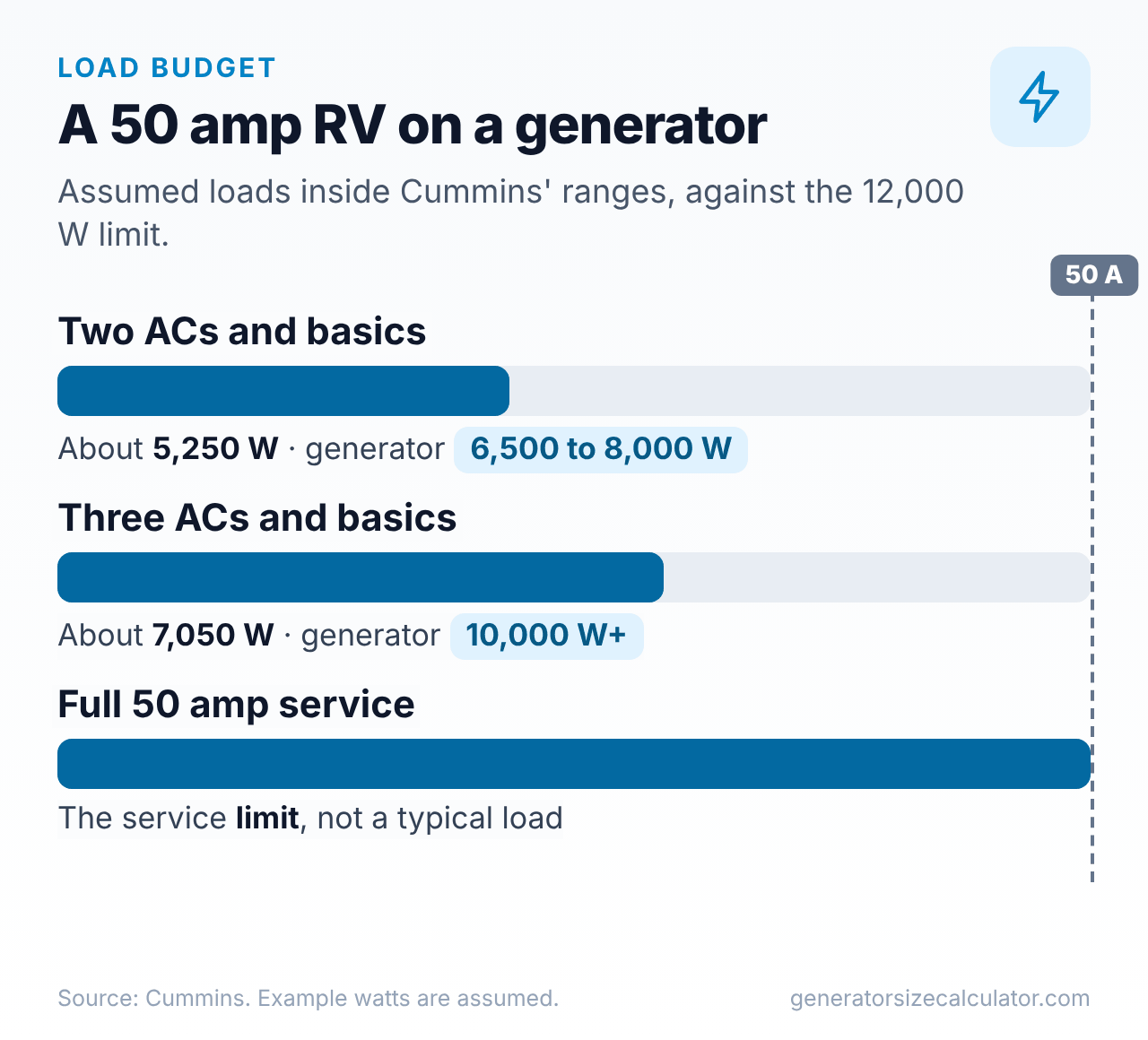
With the assumed values above, the basics add up to about 1,650 watts. Two air conditioners plus the basics is about 5,250 watts and three plus the basics is about 7,050 watts. At the 80% rule, that points to roughly 6,500 and 8,800 watts of rating, which lines up with Cummins' ranges of 5,500 to 8,000 and 10,000 to 12,500 watts once you allow for air conditioner start-up.
Add every air conditioner, appliance and light.
Tips for big rigs
- Start the air conditioners one at a time, a minute apart.
- Use the right cable and adapter. A 30-amp-to-50-amp adapter changes the plug, not the power available.
- Plan the fuel. A big generator burns a lot. See the fuel consumption calculator.
- Think about a built-in generator. Many Class A coaches have an onboard unit sized for the coach.
Run the generator outdoors, well away from the RV's doors, windows and vents. Carbon monoxide can build up inside a camper even with a window open. See how far a generator should be from a building.
Frequently asked questions
How many watts is a 50 amp RV?
50 amps at 240 volts is 12,000 watts, or 6,000 watts on each of two 120-volt legs.
What size generator do I need for a 50 amp RV?
It depends on what you run. Cummins suggests 5,500 to 8,000 watts for two air conditioners and 10,000 to 12,500 watts for three, with 12,000 to 12,500 as the top end.
Can a 5000-watt generator run a 50 amp RV?
A light setup, yes. It cannot run two air conditioners plus a microwave and other appliances at once.
Can I run two air conditioners on a 7000-watt generator?
Cummins lists 5,500 to 7,000 watts for a fifth wheel with two air conditioners, so yes, with the air conditioners started one at a time.
Do I need a 12000-watt generator for a 50 amp RV?
Only if you run three air conditioners and a lot of other loads. Most people do not.
Related calculators
Sources: Cummins, What size generator do I need to power an RV? (50 amp RV, 12,000 and 12,500-watt generators, Class A and fifth wheel ranges, appliance ranges); Cummins, RV generator electricity basics. The 80% rule is a common rule of thumb. The watt values in the load budget are assumed examples within Cummins' ranges. The 240-volt, two-leg explanation is standard electrical practice.