What Size Generator Do You Need to Run an Electric Water Heater?
By the Generator Size Calculator Team · Updated · 7 min read
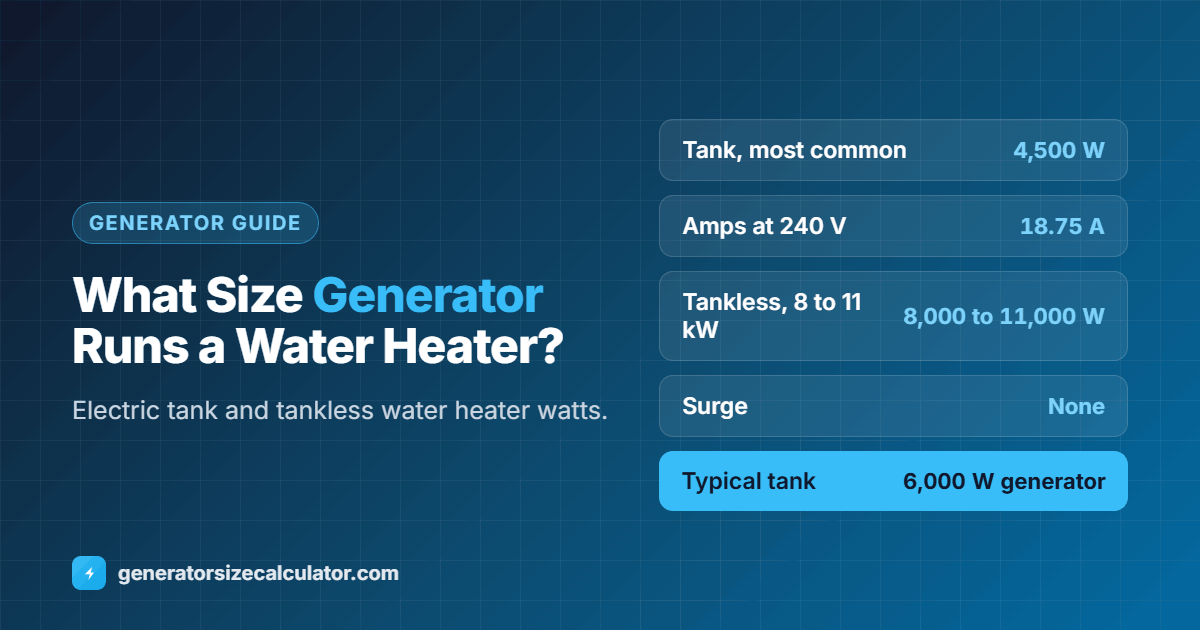
Quick answer: Most electric tank water heaters have a 4,500-watt element (about 18.75 amps at 240 volts), and tank units range from about 3,000 to 5,500 watts. Because the thermostat usually runs only one element at a time, a 6,000-watt generator with a 240-volt output runs a typical tank heater, and about 10,000 to 14,000 watts a small electric tankless unit. Larger tankless units draw far more than a portable generator can supply.
Water heater watts
| Water heater | Running watts | Amps at 240 V |
|---|---|---|
| Tank, small element | 3,000 to 3,500 | 12.5 to 14.6 |
| Tank, most common | 4,500 | 18.75 |
| Tank, large element | 4,000 to 5,500 | 16.7 to 22.9 |
| Tankless, 8 to 11 kW | 8,000 to 11,000 | 33 to 46 |
| Tankless, 13 to 18 kW | 13,000 to 18,000 | 54 to 75 |
These figures come from HVACBase, and Bob Vila lists a water heater at about 3,000 to 4,500 watts. The heater runs on 240 volts and a resistive element has no start-up surge. Most tanks have two elements, but the thermostat energizes only one at a time, so you size for a single element. Some commercial or high-recovery units run both at once, so check the nameplate.
Which generator size to choose
| Water heater | Load | Generator at 80% |
|---|---|---|
| Tank, 3,500 W element | 3,500 W | About 4,500 W |
| Tank, 4,500 W element | 4,500 W | About 6,000 W |
| Tank, 5,500 W element | 5,500 W | About 7,500 W |
| Tankless, 8 kW | 8,000 W | About 10,000 W |
| Tankless, 11 kW | 11,000 W | About 14,000 W |
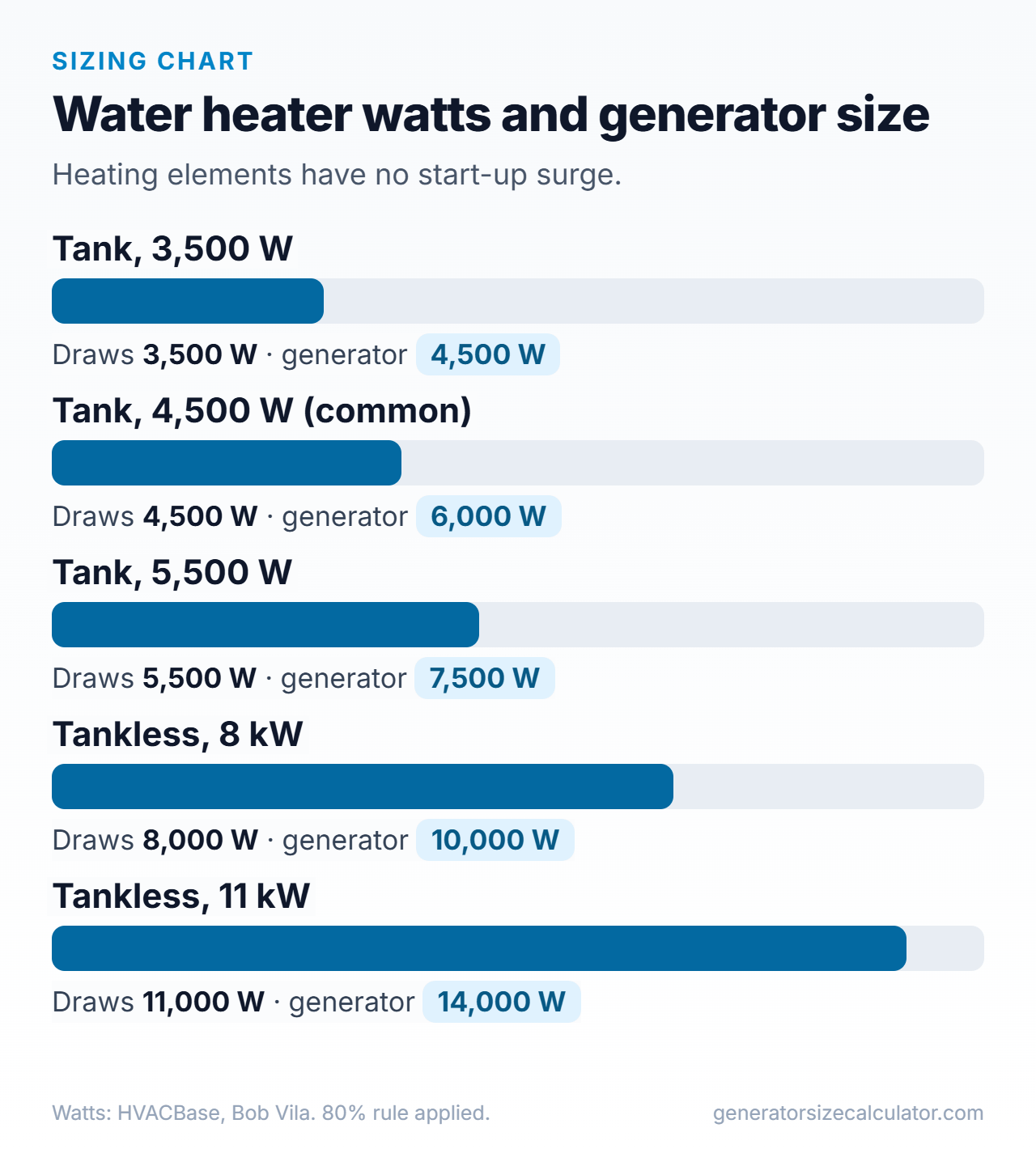
These are the water heater alone. Add the fridge, furnace fan and lights and the size climbs. For the whole-home picture, see what size generator runs a whole house.
How it connects
A water heater is hardwired to a 240-volt circuit. Powering it needs a transfer switch or interlock with a generator that has a 240-volt output, installed by a licensed electrician, not an extension cord. Read how to connect a generator to your house and use the transfer switch calculator.
See what the water heater does to your generator size.
Ways to use less
- Heat water in short bursts. The tank holds hot water, so you can run the heater for a short time, then turn its breaker off.
- Don't run it with central AC or an electric dryer on a smaller generator.
- Skip it for a short outage. A full tank stays warm for hours.
- Consider a tankless gas unit if you are replacing yours, since it needs very little electricity.
Run the generator outdoors, at least 20 feet from doors, windows and vents. Never in a garage or shed, even with the door open. See how far a generator should be from your house.
Frequently asked questions
How many watts does an electric water heater use?
Most tank heaters use a 4,500-watt element (18.75 amps at 240 volts), with a range of about 3,000 to 5,500 watts. Tankless electric units start around 8,000 watts.
Can a 5000-watt generator run a water heater?
A 3,500-watt element, yes. A 4,500-watt element is at about 90% of a 5,000-watt rating, which is above the 80% guideline, so a 6,000-watt generator is a better fit.
Do both elements run at once?
Usually not. The thermostat typically energizes one element at a time. Some commercial units run both, so check the nameplate.
Can a portable generator run a tankless water heater?
A small one (8 to 11 kW) needs a 10,000 to 14,000-watt generator. Larger units are beyond a portable generator.
Does a water heater have a starting surge?
No. It is a resistive heating element and draws the same watts at start-up as when running.
Related calculators
Sources: Tank and tankless electric water heater watts, amps and the one-element-at-a-time note from HVACBase; the 3,000 to 4,500-watt range from Bob Vila. Generator sizes apply the 80% running-load rule. Check your heater's nameplate.