What Size Generator Do You Need to Run a Refrigerator?
By the Generator Size Calculator Team · Updated · 7 min read
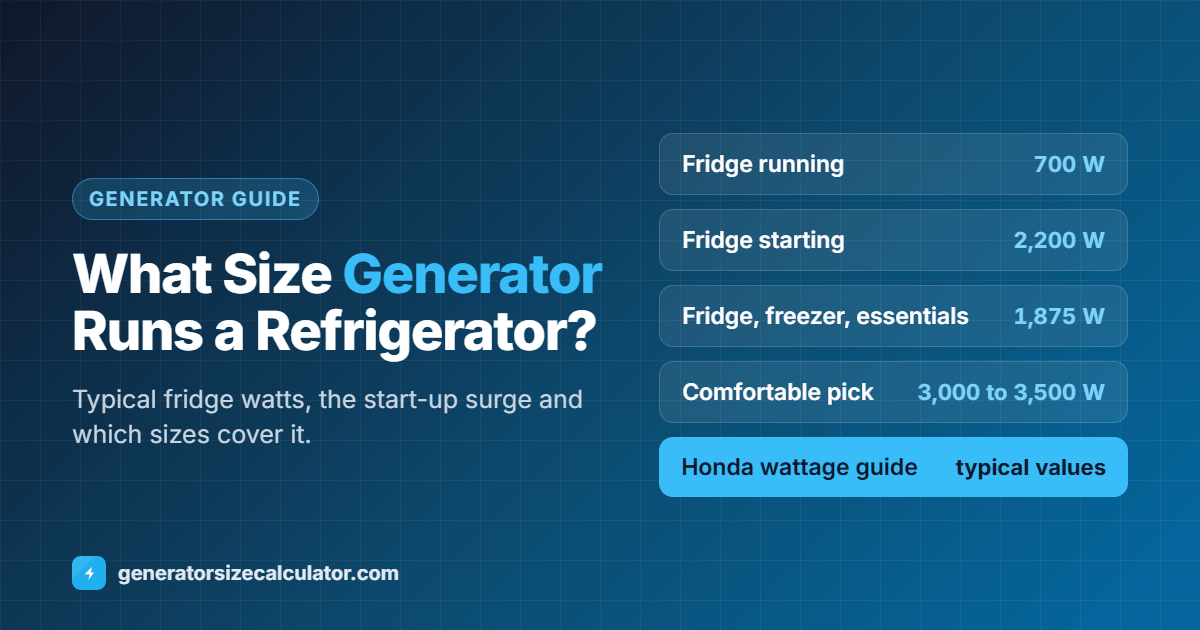
Quick answer: A typical refrigerator uses about 700 running watts and needs up to 2,200 starting watts for a moment when the compressor kicks on (Honda's wattage guide). A 3,000 to 3,500-watt generator is a comfortable choice for a fridge, a freezer and a few essentials. A 2,000-watt inverter can run one fridge if its peak rating covers the start-up surge, but that is a close call, so check your fridge's label first.
How many watts a refrigerator uses
A refrigerator has two numbers that matter. Running watts are what it draws while the compressor is working. Starting watts are the brief surge when the compressor starts, often a few times higher. Honda's generator wattage guide lists a refrigerator or freezer at about 700 running watts and 2,200 starting watts.
| Appliance | Running watts | Starting watts |
|---|---|---|
| Refrigerator or freezer | 700 | 2,200 |
| Color television | 300 | 300 |
| Microwave oven (625 W) | 625 | 800 |
| Furnace fan, 1/3 HP | 1,000 | 1,800 |
These are typical figures. Your own fridge may be lower or higher, and the surge lasts only a second or two. Our starting vs running watts calculator explains the difference in more detail.
Which generator sizes work
| Generator | One fridge | Fridge, freezer and essentials |
|---|---|---|
| Small inverter, about 2,000 W (typically 1,600 running, 2,000 peak) | Close call | Too tight |
| 3,000 W | Yes | Yes, with room to spare |
| 3,500 W | Yes | Yes |
| 5,000 W | Yes | Yes, plus a furnace fan or sump pump |
The ratings in this table are typical for each class, and manufacturers differ, so confirm the running and starting watts on your own generator. A 2,000-watt inverter's peak rating sits right at the 2,200-watt figure above. Many fridges start lower than that, but if yours doesn't, the generator may shut down on overload. For more on bigger units see what a 3500-watt generator can run and what a 5000-watt generator can run.
Example: fridge, freezer and essentials
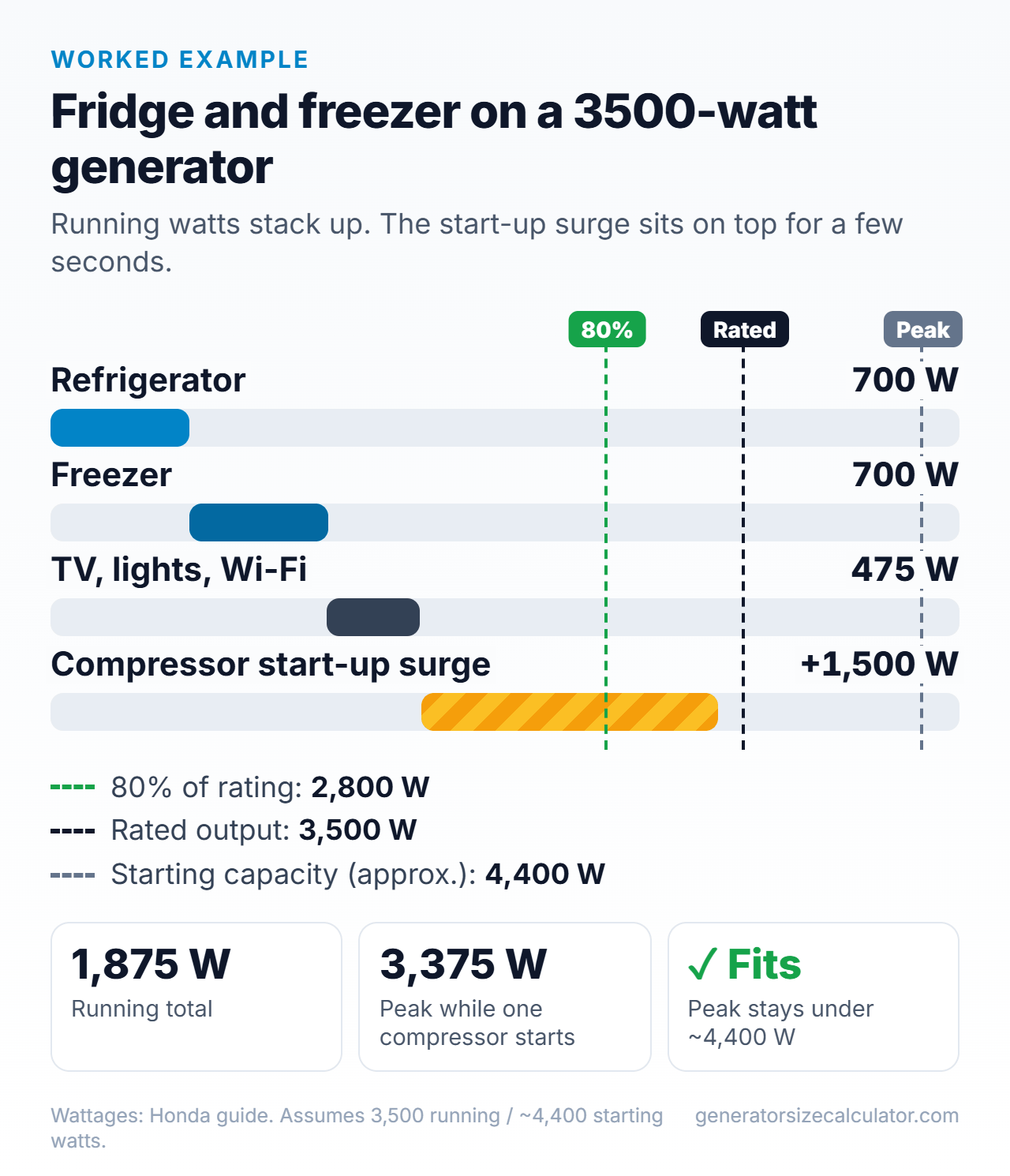
Suppose you want to run a refrigerator, a chest freezer, and a TV, lights and Wi-Fi router together on a 3,500-watt generator.
| Load | Running watts |
|---|---|
| Refrigerator | 700 |
| Freezer | 700 |
| TV, lights, Wi-Fi | 475 |
| Running total | 1,875 |
The start-up surge adds roughly 1,500 watts on top (2,200 minus 700) for one compressor at a time, so the peak is about 3,375 watts. The generator carries 1,875 running watts, well under 80% of its 3,500-watt rating (2,800 watts), and the peak stays under its approximate 4,400-watt starting capacity. Staying under 80% keeps the engine from running flat out for hours.
List your appliances and see the running and peak watts in one step.
Find your own fridge's numbers
Look for the rating label inside the fridge, usually on a wall or the door frame. It lists amps. Multiply amps by 120 volts to estimate running watts. For example, a 5-amp fridge is about 600 watts. The starting surge isn't printed, so allow two to three times the running watts, the same ratio as the guide's figures above, or use a plug-in watt meter to measure it. Our generator amps calculator converts amps and watts for you.
How long food stays cold
With the doors kept closed, the CDC says food stays safe for about 4 hours in a refrigerator, 48 hours in a full freezer and 24 hours in a half-full freezer. The refrigerator should be at 40°F or below and the freezer at 0°F or below. This is the reason you often don't need to run a generator all day for food. You can run it for a few hours at a time, keep the doors shut in between, and save fuel. Use the generator runtime calculator to see how long your tank will last.
Tips for running a fridge on a generator
- Start the generator first, with nothing plugged in, then connect the fridge, then the freezer. This staggers the surges.
- Keep the doors closed as much as you can. Every opening lets cold air out.
- Use a heavy-duty, outdoor-rated extension cord that is long enough to reach the generator without bringing it near the house. The extension cord calculator shows what gauge to use.
- Plug the fridge straight into the cord, not through a cheap multi-outlet adapter that can overheat.
- Add loads gradually, largest motor loads first, and watch the generator's load indicator if it has one.
Safety rules
Run the generator outdoors, at least 20 feet from doors, windows and vents. Never in a garage, shed or crawl space, even with the door open. See how far a generator should be from your house.
- Install battery-powered carbon monoxide alarms on every level of the home.
- Turn the generator off and let it cool before you refuel it.
- Don't plug a generator into a wall outlet. For hardwired loads, see our guide to connecting a generator to your house.
Frequently asked questions
How many watts does a refrigerator need to start?
Honda's wattage guide lists a refrigerator or freezer at about 700 running watts and 2,200 starting watts. Your own fridge may be lower or higher, so check the label or measure it with a watt meter.
Can a 2000-watt generator run a refrigerator?
Sometimes. A typical 2,000-watt inverter delivers about 1,600 running and 2,000 peak watts, which covers the running load but sits close to the 2,200-watt starting figure. Check your fridge's label, and expect a tight fit if you add anything else.
Can a 3500-watt generator run a fridge and a freezer?
Yes. A refrigerator, a freezer and a TV, lights and router add up to about 1,875 running watts and a peak near 3,375 watts, which fits a 3,500-watt generator with room to spare.
How long can a refrigerator go without power?
The CDC says food stays safe for about 4 hours in a closed refrigerator, 48 hours in a full freezer and 24 hours in a half-full freezer.
Do I need to run the generator all day for a fridge?
Usually not. Run it for a few hours, keep the doors shut in between and watch the temperatures. This saves fuel. See how long a generator runs on a tank of gas.
Related calculators
Sources: Refrigerator, freezer and other appliance running and starting watts from the Honda generator wattage guide; food safety times and temperatures from the U.S. Centers for Disease Control and Prevention; outdoor placement guidance from the U.S. Consumer Product Safety Commission. Generator ratings in the size table are typical for each class, so confirm yours on the nameplate.