What Size Generator Do You Need to Run a Furnace?
By the Generator Size Calculator Team · Updated · 6 min read
Quick answer: A gas or oil furnace only needs power for the blower fan and controls. Honda lists a furnace fan at 750 running and 1,500 starting watts for 1/6 HP, 1,000 and 1,800 for 1/3 HP and 1,200 and 2,500 for 1/2 HP. A 2,000 to 3,000-watt generator usually covers the fan alone. An electric furnace is different: it can draw 5,000 to 25,000 watts and generally needs a very large generator.
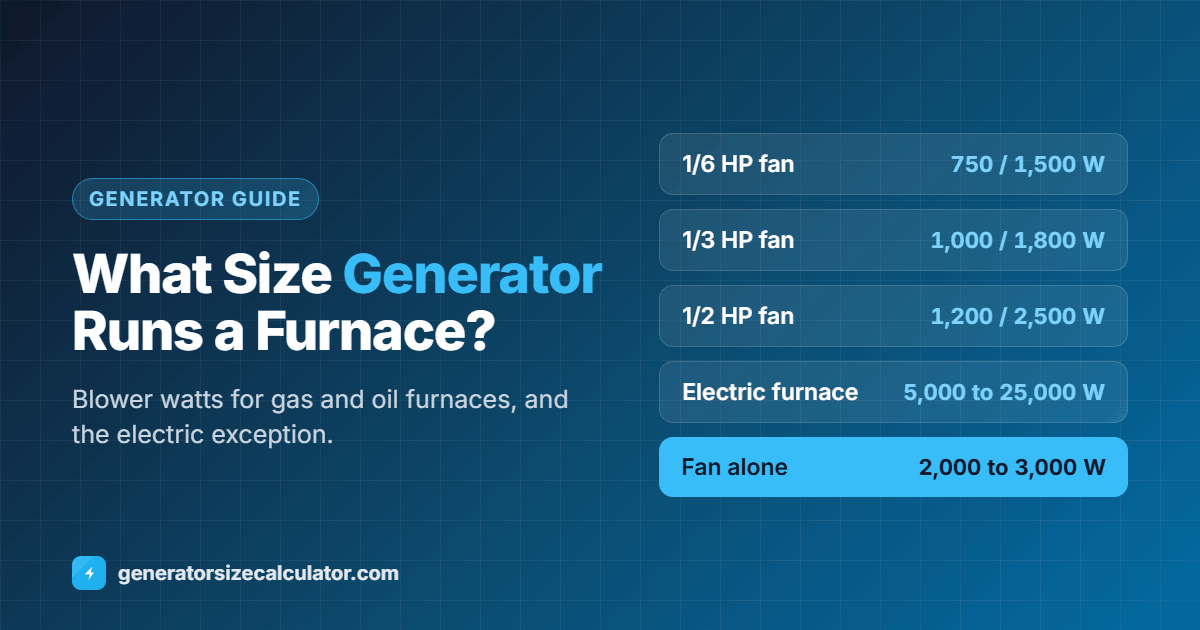
Gas and oil furnaces
A gas or oil furnace makes heat by burning fuel, so the electricity only runs the blower motor, the igniter, the control board and the thermostat. That is a modest load, which is why a small generator can keep a house warm during a winter outage. The blower motor is the part with a start-up surge.
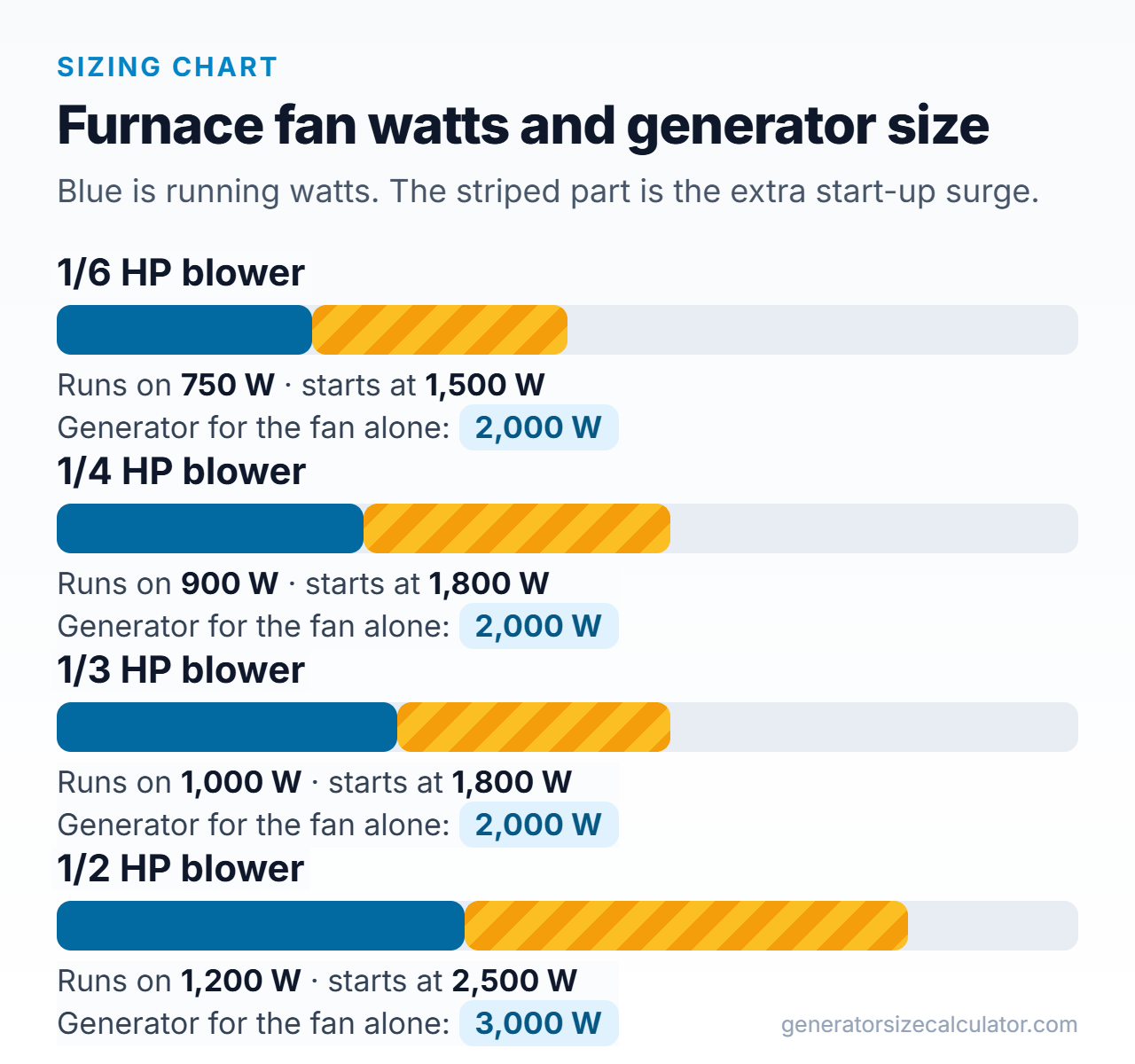
Blower watts by horsepower
| Furnace fan motor | Running watts | Starting watts | Generator for the fan alone |
|---|---|---|---|
| 1/6 HP | 750 | 1,500 | 2,000 W |
| 1/4 HP | 900 | 1,800 | 2,000 W |
| 1/3 HP | 1,000 | 1,800 | 2,000 W |
| 1/2 HP | 1,200 | 2,500 | 3,000 W |
The fan watts are from Honda's wattage guide. The generator sizes are our estimates for a typical unit, keeping the running load under 80% of rating and the surge under a starting capacity of about 125% of rating. Check the horsepower on your blower's label, and confirm your generator's own ratings.
Example: furnace, fridge and essentials
| Load | Running watts |
|---|---|
| Furnace fan, 1/3 HP | 1,000 |
| Refrigerator | 700 |
| TV, lights, Wi-Fi | 475 |
| Running total | 2,175 |
If the fridge compressor starts while the rest is running, the peak is about 2,175 plus 1,500, or 3,675 watts. A 3,500-watt generator carries 2,175 running watts under its 80% mark (2,800 watts) and has about 4,400 starting watts. A 2,000-watt unit would be too small for this combined list.
List the furnace and everything else you want to keep running.
Electric furnaces
An electric furnace turns electricity directly into heat, and the load is large. Bob Vila lists an electric furnace at roughly 5,000 to 25,000 running watts, depending on size. That is often more than a portable generator can supply, so most people with electric heat use a standby unit, run a few space heaters instead or use a wood stove. See what size generator runs a whole house.
How to connect a furnace
Most furnaces are hardwired. A hardwired furnace should be powered through a transfer switch or interlock installed by a licensed electrician, not by plugging into an outlet. Read how to connect a generator to your house and size the switch with the transfer switch calculator.
Run the generator outdoors, at least 20 feet from doors, windows and vents. Never in a garage or shed, even with the door open. Install battery-powered carbon monoxide alarms too. See how far a generator should be from your house.
Frequently asked questions
How many watts does a furnace fan use?
Honda lists furnace fans at 500 to 1,200 running watts and 1,000 to 2,500 starting watts, depending on horsepower. A 1/3 HP blower is 1,000 running and 1,800 starting.
Can a 2000-watt generator run a furnace?
Usually a gas or oil furnace with a blower up to about 1/3 HP, if nothing else is on the generator. Check your blower label and the generator's peak rating.
Can a generator run an electric furnace?
Only a very large one. Electric furnaces are typically 5,000 to 25,000 watts, which is beyond most portable generators.
Can I plug my furnace into a generator?
Most furnaces are hardwired and need a transfer switch or interlock installed by an electrician. Never backfeed through a wall outlet.
What else can run with the furnace?
A 3,500-watt generator can run a 1/3 HP furnace fan, a refrigerator and a TV, lights and Wi-Fi together. See generator size for a refrigerator.
Related calculators
Sources: Appliance and tool running and starting watts from the Honda generator wattage guide (furnace fan sizes); electric furnace range from Bob Vila. Generator sizes in the table apply the 80% running rule and an assumed starting capacity about 25% above the running rating.