Inverter Generator vs Conventional Generator: Which Is Better?
By the Generator Size Calculator Team · Updated · 7 min read
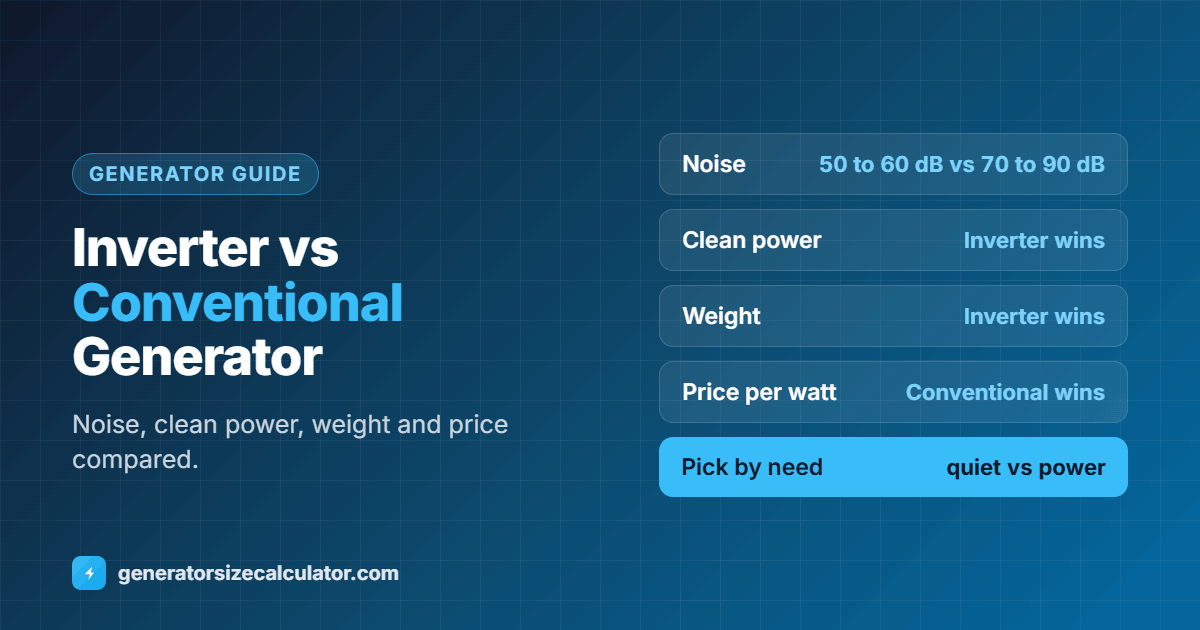
Quick answer: Choose an inverter generator if you want quiet running, clean power for laptops and electronics, low weight and good fuel economy at light loads. Choose a conventional (open-frame) generator if you need a lot of power for the price, such as 7,500 watts or more for a well pump, central AC or a workshop. Inverters usually cost more per watt, while conventional units are louder and heavier.
The basic difference
A conventional generator runs its engine at a constant speed to keep the electrical frequency steady, whatever the load. An inverter generator makes alternating current, converts it to direct current, and then electronically "inverts" it back to clean AC. Because the electronics control the output, the engine can speed up and slow down with the load.
That one design difference explains most of what follows: quieter running, lighter weight and better fuel economy at light loads for inverters, and lower cost per watt for conventional units.
Side-by-side comparison
| Feature | Inverter generator | Conventional generator |
|---|---|---|
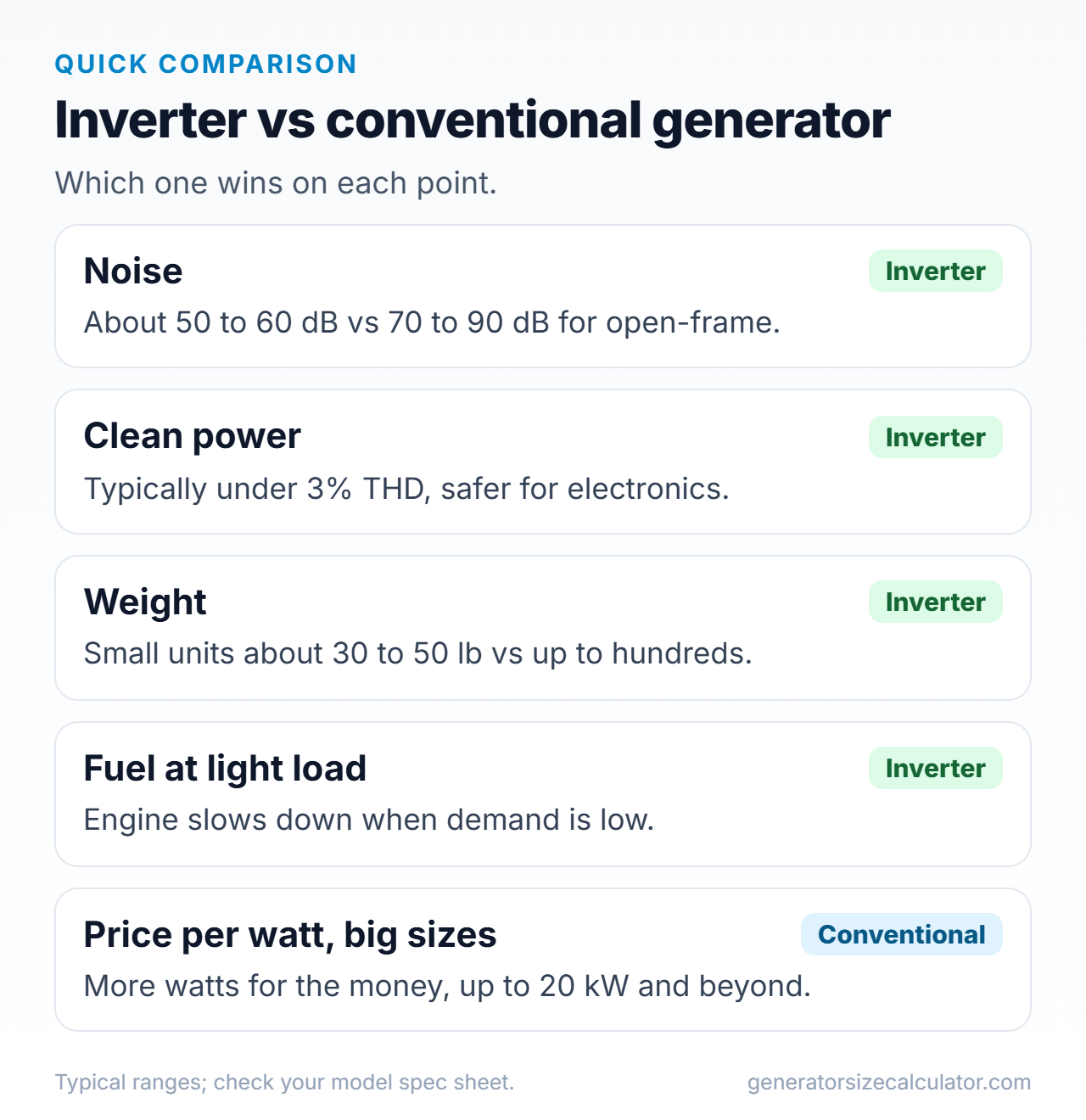
| Noise | Quieter, about 50 to 60 dB at typical load | Louder, often 70 to 90 dB |
| Power quality | Yes, typically under 3% THD | Fine for tools and lights, less clean |
| Weight | Yes, small units about 30 to 50 lb | Heavier, up to several hundred lb |
| Fuel use at light load | Yes, engine slows down | Runs at full speed |
| Price per watt | Higher | Yes, usually lower |
| Largest sizes | Mostly up to about 7,000 W | Yes, up to 20,000 W or more |
| Parallel two units | Yes, many models | Rare |
The noise, weight and THD figures are typical ranges from manufacturers, not guarantees, so check the spec sheet of the model you are considering. For decibel numbers on specific sizes, see the generator noise calculator.
Noise
Inverter models are built to be quiet, and because the engine slows down at light load, they often run at about 50 to 60 dB, roughly a normal conversation. Open-frame conventional generators more often sit around 70 to 90 dB, closer to a vacuum cleaner or louder. For camping, tailgating, a neighborhood outage or a campground with quiet hours, that difference matters a great deal.
Clean power and sensitive electronics
Laptops, phones, TVs, routers and modern furnace controls run on circuit boards that prefer a smooth sine wave. Honda notes that inverter generators give the cleanest power for sensitive electronics. A conventional generator is perfectly fine for lights, heaters, saws and most motors, but its output wanders a little more with the load. If you plan to power electronics a lot, an inverter, or a conventional unit with a documented low THD, is the safer choice. Learn more in our inverter generator calculator.
Power output and price
Inverters shine up to about 3,500 or 4,500 watts. Above that the price climbs quickly, and choices narrow. If you need to run central AC, a well pump and a fridge together, you are usually into conventional or standby territory. Two smaller inverters can be linked with a parallel kit, which is covered in the parallel generator calculator.
Add up your appliances first, then decide between inverter and conventional.
Which one should you buy?
- Camping, RVs, tailgating, small outages: inverter, for the low noise and light weight.
- Laptops, medical-grade comfort devices, smart appliances: inverter, for clean power.
- Whole-home backup of heavy loads: conventional portable or a standby unit. See what size generator runs a whole house.
- Job sites and workshops on a budget: conventional, for the lower cost per watt.
- Best of both: some conventional models list low THD, and some inverters offer 240 volts. Read the spec sheet.
Both types make carbon monoxide. Run either one outdoors, at least 20 feet from doors, windows and vents, and never in a garage. See how far a generator should be from your house.
Frequently asked questions
What is the main difference between an inverter and a conventional generator?
A conventional generator runs its engine at a fixed speed. An inverter generator converts its output to clean AC electronically, so the engine speeds up and slows down with the load.
Are inverter generators really quieter?
Usually, yes. Manufacturers typically list inverters in the 50 to 60 dB range at typical load, while open-frame conventional units are often 70 to 90 dB. Check the rating for your exact model.
Are inverter generators safe for laptops and phones?
Yes. Inverters generally have low total harmonic distortion, often under 3%, and Honda says they give the cleanest power for sensitive electronics.
Why are inverter generators more expensive?
The extra electronics and quieter, more compact design add cost, so you typically pay more per watt than for a conventional unit.
Can an inverter generator run a home?
A large inverter or two paralleled inverters can run essentials like a fridge, lights and a furnace fan. For central AC and heavy loads you generally need a bigger conventional or standby generator.
Related calculators
Sources: Inverter and conventional generator characteristics from manufacturer and retailer guides, including Honda and Renogy; noise, weight and distortion figures are typical ranges and vary by model. Outdoor placement guidance from the U.S. Consumer Product Safety Commission.