How to Ground a Portable Generator: Do You Need a Ground Rod?
By the Generator Size Calculator Team · Updated · 8 min read
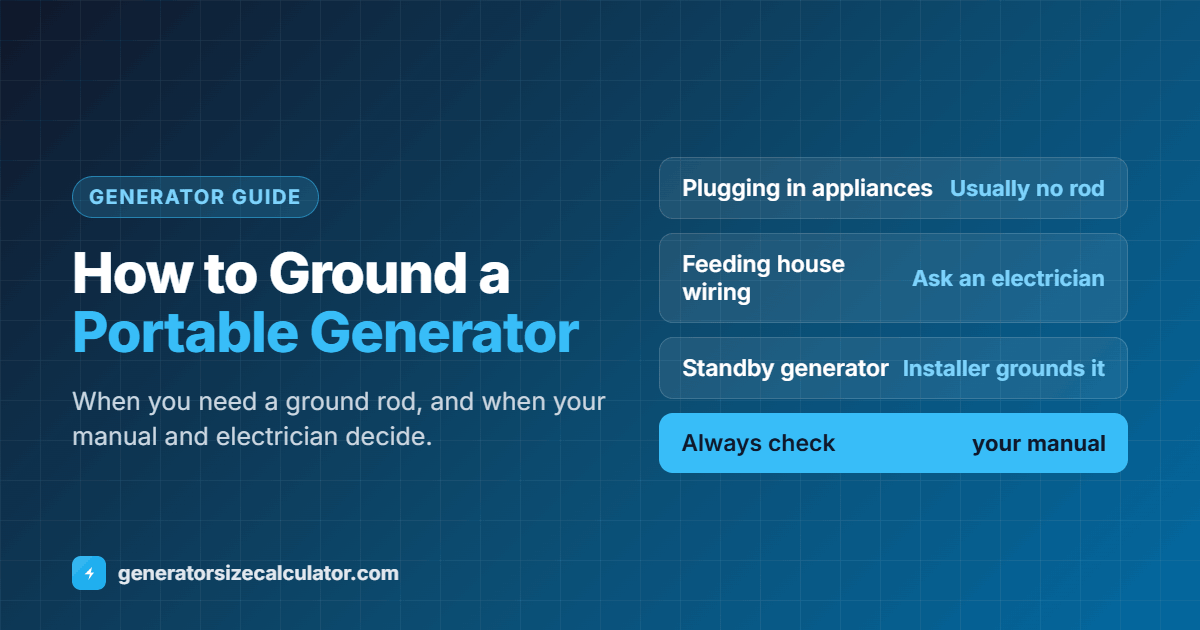
Quick answer: Often you don't need a ground rod. Under the National Electrical Code, a portable generator that powers only equipment mounted on it, or cord-and-plug equipment plugged into its own outlets, can use its metal frame as the grounding point when the frame is connected to the outlets' ground terminals. A ground rod and different bonding rules usually come into play when the generator feeds your home's wiring through a transfer switch or interlock, and then an electrician should decide. Always follow your generator's manual first.
What grounding and bonding mean
Two terms get mixed up in generator talk:
- Grounding connects the system to the earth, usually through a metal rod driven into the ground. It gives stray electricity a path to the soil.
- Bonding connects metal parts to each other, such as the generator frame and the neutral conductor, so a fault trips a breaker instead of energizing the frame.
On most portable generators the manufacturer has already bonded the frame to the outlets' ground terminals. Many also bond the neutral to the frame, while some leave the neutral "floating". Your manual says which one you have.
When a portable generator needs grounding
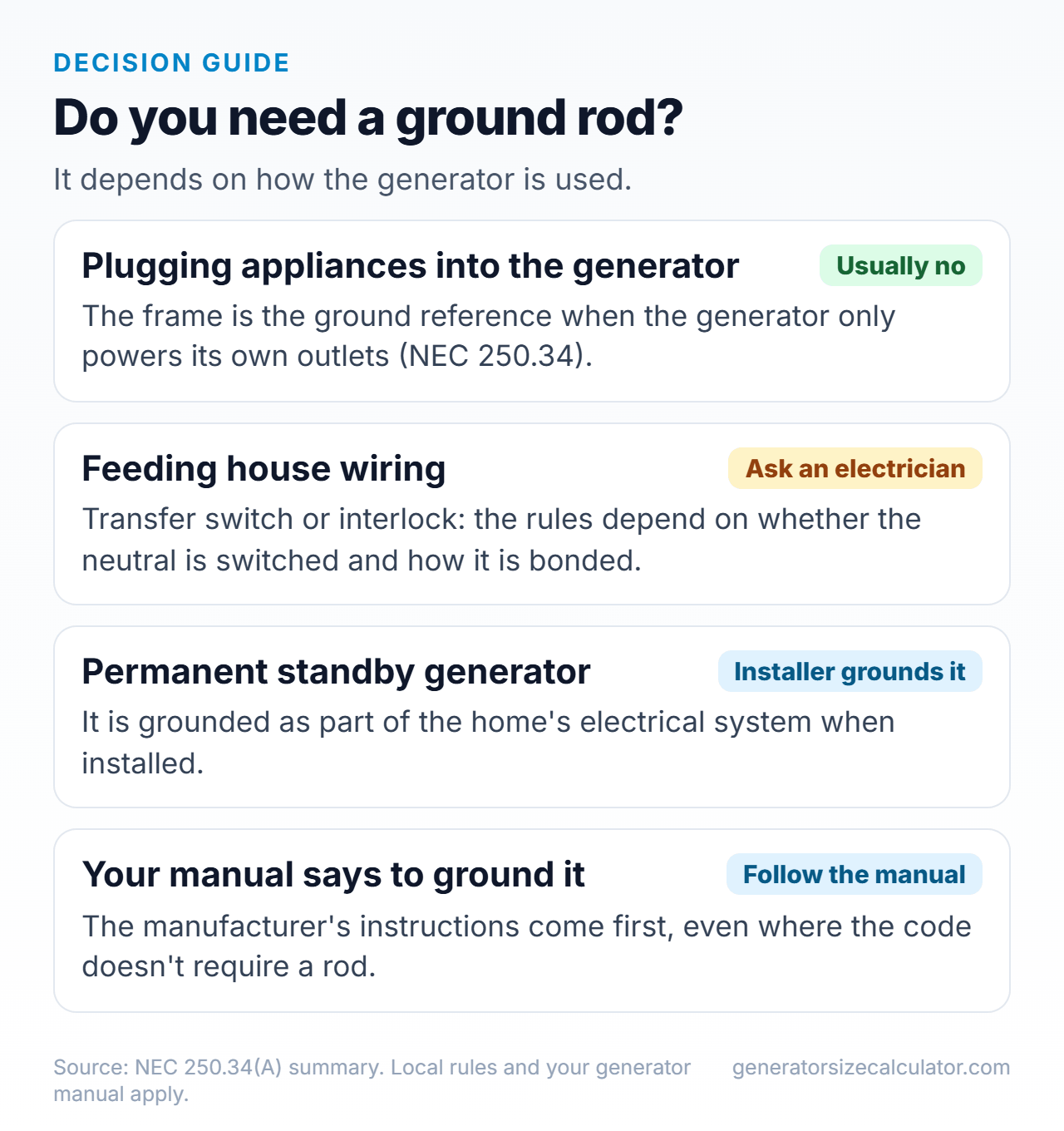
Section 250.34(A) of the National Electrical Code covers portable generators. In plain terms, no separate grounding electrode (ground rod) is required when the generator only supplies equipment mounted on it, only supplies cord-and-plug equipment through receptacles on the generator, or both, and the generator frame is connected to the receptacles' ground terminals and the other non-current-carrying metal parts. In that case the frame acts as the grounding point.
| How you use the generator | Ground rod needed? | Why |
|---|---|---|
| Plugging appliances or cords into the generator's own outlets | Usually no | The frame is the ground reference under NEC 250.34(A), if it is bonded to the outlet grounds |
| Feeding house wiring through a transfer switch or interlock | Ask an electrician | It matters whether the transfer equipment switches the neutral and how the neutral is bonded |
| Permanently installed standby generator | Yes, by the installer | It is installed as part of the home's grounding system |
| Your manual calls for an earth ground | Yes, follow the manual | The manufacturer's instructions are part of the listing |
Even where the code doesn't require a ground rod, some manufacturers still recommend one. If your manual says to ground the generator, do it.
How to ground a generator when it is required
If your manual or electrician calls for a ground rod, the setup generally looks like this:
- Use a proper ground rod. A copper-clad steel rod driven into the soil, with the top flush or just above the surface, is the common choice. Your manual or local code gives the length.
- Use the wire size in your manual. Many manuals specify a heavy solid copper conductor; use the gauge it names.
- Connect to the ground terminal on the frame (marked with the ground symbol) with a secure clamp or lug, and keep the run short and straight.
- Connect the other end to the rod with a listed ground clamp.
- Inspect it before each use. Corroded or loose connections defeat the purpose.
Don't improvise by clamping to a water pipe, a fence or a gas line. If you are unsure, ask an electrician.
What changes with a transfer switch or interlock
When a generator feeds a home through a transfer switch or interlock kit, grounding and bonding get more subtle. Your house already has its neutral bonded to ground at the main panel. If the transfer equipment does not switch the neutral, the generator is not a separately derived system, and the generator's own neutral-to-frame bond can create a second, unwanted bond. If the equipment does switch the neutral, the generator is a separately derived system and must be bonded and grounded accordingly.
The correct setup depends on your generator model and the transfer equipment. This is electrician work. Use the checklist in our guide to connecting a generator to your house, and have the installer confirm the grounding and bonding before first use.
Wet locations and GFCI protection
Grounding doesn't replace shock protection. In damp or outdoor locations, plug cords into a GFCI-protected outlet, or use a GFCI cord or adapter, so the circuit shuts off quickly if current leaks. Many newer generators include GFCI outlets, and a tripped GFCI is a signal to unplug and inspect, not to bypass it. If you run a generator in wet weather, read our guide to running a generator in the rain.
Check the right gauge and length before you run power to your appliances.
Common mistakes
- Bonding a neutral twice when feeding a house, which can send current on the wrong paths.
- Assuming every generator is bonded the same way. Check the manual.
- Using a three-prong cord with the ground pin removed, which takes away the protection.
- Running the generator with a damaged cord or loose ground lug.
- Skipping the permit when connecting to house wiring.
Safety rules
Grounding doesn't make indoor operation safe. Carbon monoxide kills in minutes. Keep the generator outdoors, at least 20 feet from doors, windows and vents, and never in a garage, shed or crawl space.
- Dry your hands and stand on a dry surface before touching the generator.
- Use heavy-duty, outdoor-rated cords with all three prongs.
- Install battery-powered carbon monoxide alarms on every level.
Frequently asked questions
Do I need a ground rod for a portable generator?
Often no. If the generator only powers its own outlets and equipment plugged into them, the NEC lets the frame serve as the grounding point when it is bonded to the outlet grounds. If your manual calls for a ground rod, or you connect the generator to house wiring, follow the manual and ask an electrician.
What size ground rod and wire do I need?
Use what your generator's manual or your electrician specifies. Copper-clad steel rods and a heavy copper conductor are common, but the exact length and gauge vary by manufacturer and local code.
Does a generator need to be grounded when I use a transfer switch?
The setup depends on whether the transfer equipment switches the neutral and how the generator's neutral is bonded. A licensed electrician should decide and install it.
What is a bonded neutral generator?
It is a generator whose neutral conductor is connected to the frame. Many portable generators are built this way. Check your manual to see whether yours is bonded or floating before you connect it to a house.
Is it safe to ground a generator to a water pipe?
No. Don't use plumbing, fences or gas lines as improvised grounds. Use a proper ground rod and the connections your manual or electrician specifies.
Related calculators
Sources: Portable generator grounding rules from NEC Section 250.34(A), as summarized in an electrical code reference; outdoor use, cord and carbon monoxide guidance from the U.S. Consumer Product Safety Commission. Neutral bonding and rod specifications vary by generator and location; follow your manual and use a licensed electrician for any connection to house wiring.