How to Calculate What Size Generator You Need
By the Generator Size Calculator Team · Updated · 8 min read
Quick answer: To size a generator: 1) list what you want to run, 2) add up the running watts, 3) add the single biggest start-up surge, and 4) leave about 20 to 25% headroom. Bob Vila gives the core formula: total running watts plus the highest starting watts. For example, 3,000 running watts plus a 1,500-watt surge needs at least a 4,500-watt generator, and you should keep the running load under about 80% of the rating.
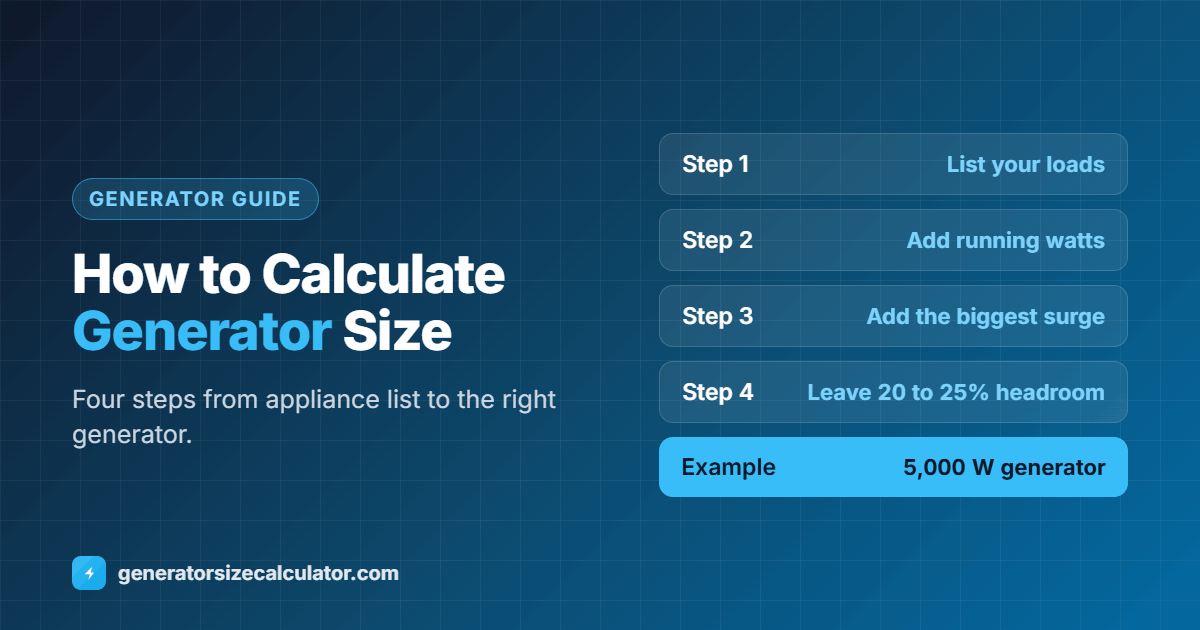
The four steps
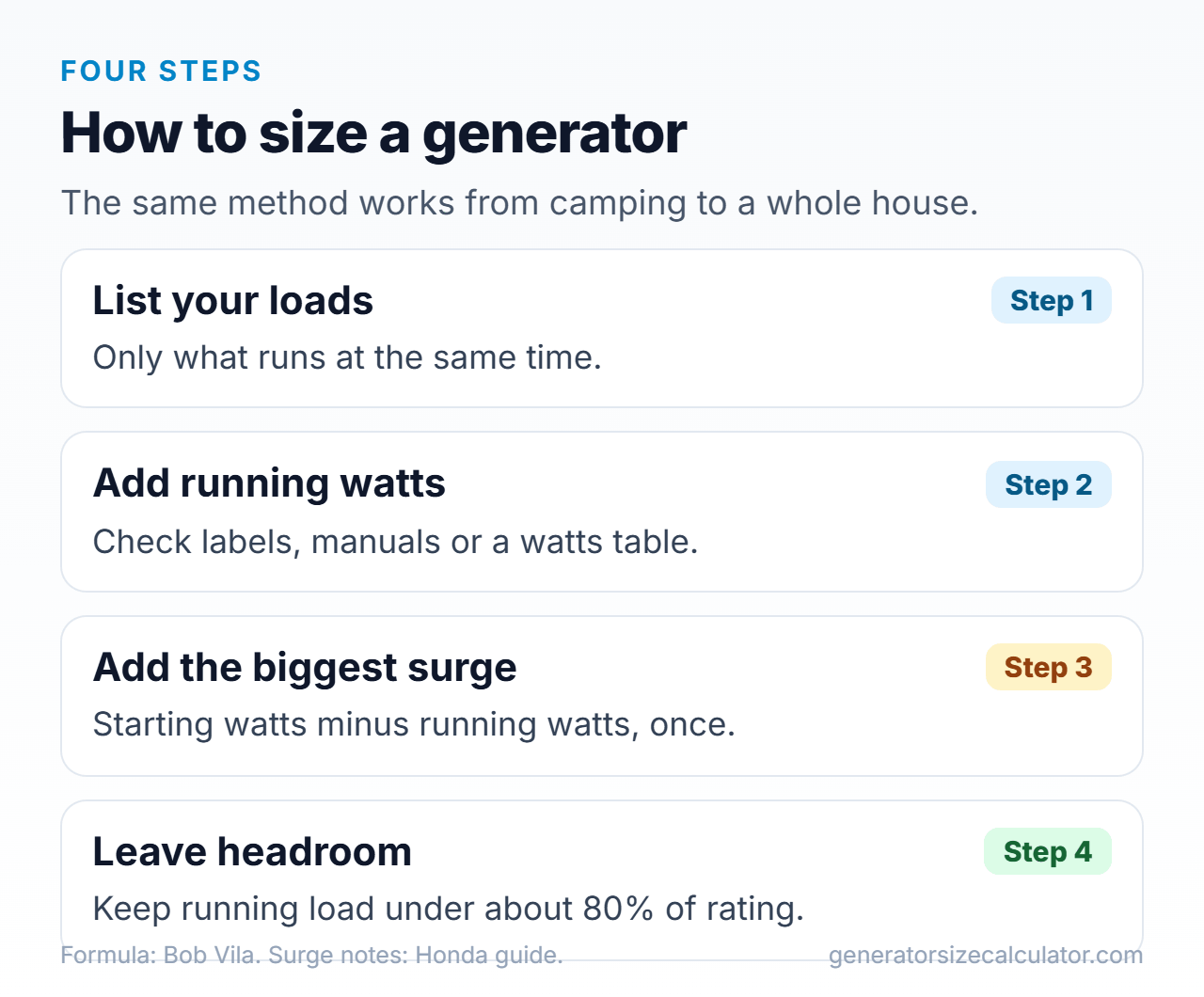
- List everything you want to run at the same time. Not everything in the house, only what you will use together. Honda's guide notes that all appliances are seldom running at once.
- Find the running watts of each. Look on the label, in the manual or in a table such as our starting vs running watts calculator. If a label shows only amps, multiply by volts.
- Add the biggest start-up surge. Motors like fridges, pumps and AC compressors draw extra for a moment. You only need to add the largest single surge, because motors rarely start at the same instant. The surge is the starting watts minus the running watts.
- Leave headroom. Keep the running load under about 80% of the generator's rated output, so the engine is not at its limit for hours.
Bob Vila's version of the formula is "Total Generator Size = Total Running Watts + Highest Starting Watts". Their example: 3,000 running watts plus a 1,500-watt start-up surge needs at least 4,500 watts. Staying under 80% adds a margin on top of that.
A worked example
| Load | Running watts | Extra surge |
|---|---|---|
| Refrigerator | 700 | 1,500 |
| Furnace fan, 1/3 HP | 1,000 | 800 |
| Sump pump, 1/2 HP | 1,000 | 1,100 |
| TV, lights, Wi-Fi | 475 | 0 |
| Running total | 3,175 |
Running total: 3,175 watts. The biggest single surge is the fridge at about 1,500 watts, so the peak is about 4,675 watts. At the 80% rule, the running load needs a generator of at least 3,175 divided by 0.8, or about 3,970 watts, and the peak needs a starting capacity of at least 4,675. A 5,000-watt generator covers both. Use the generator wattage calculator for your own list.
Add your appliances and see running watts, peak watts and a recommended size.
If you only know amps or volts
Watts equal volts times amps. A 120-volt appliance that draws 5 amps uses about 600 watts. Honda's guide uses the same method for start-up: for a motor, estimate starting amps at about three times running amps. Our generator amps calculator converts both ways.
Common mistakes
- Using only running watts. The start-up surge can trip an undersized generator.
- Adding every surge. Only the largest one matters at once.
- Forgetting heating appliances. Toasters, kettles and dryers draw a lot and have no surge.
- Running at 100%. It is noisy, burns fuel quickly and shortens engine life.
- Ignoring the altitude and heat. Output drops at altitude and in hot weather. See the generator derating calculator.
What to do next
Match your total to a size. Our guides cover 3500 watts, 5000 watts and 7500 watts. For a house see whole house sizing. If you are unsure of your own numbers, an electrician can measure them or run a proper load calculation.
Run the generator outdoors, at least 20 feet from doors, windows and vents. Never in a garage or shed, even with the door open. See how far a generator should be from your house.
Frequently asked questions
How do I calculate what size generator I need?
List the loads you run together, add their running watts, add the largest start-up surge, and make sure the running load stays under about 80% of the generator rating.
Do I add up all the starting watts?
No. Motors rarely start at the same moment, so add only the single largest surge, which is starting watts minus running watts, on top of the total running watts.
What is the 80% rule for generators?
Keep the running load under about 80% of the rated output so the engine is not at its limit for hours. It leaves headroom and extends the life of the engine.
How do I turn amps into watts?
Multiply amps by volts. A 120-volt appliance drawing 5 amps uses about 600 watts.
Should I round up or down?
Round up to the next common size. A slightly larger generator runs cooler and quieter and leaves room for another appliance.
Related calculators
Sources: Core sizing formula (total running watts plus highest starting watts) and example from Bob Vila; reactive load, starting amp and simultaneous-use notes from the Honda generator wattage guide; appliance watts from the same Honda guide. The 80% running-load rule is a common practical guideline, not a universal standard.