Can You Run a Generator in a Garage?
By the Generator Size Calculator Team · Updated · 5 min read
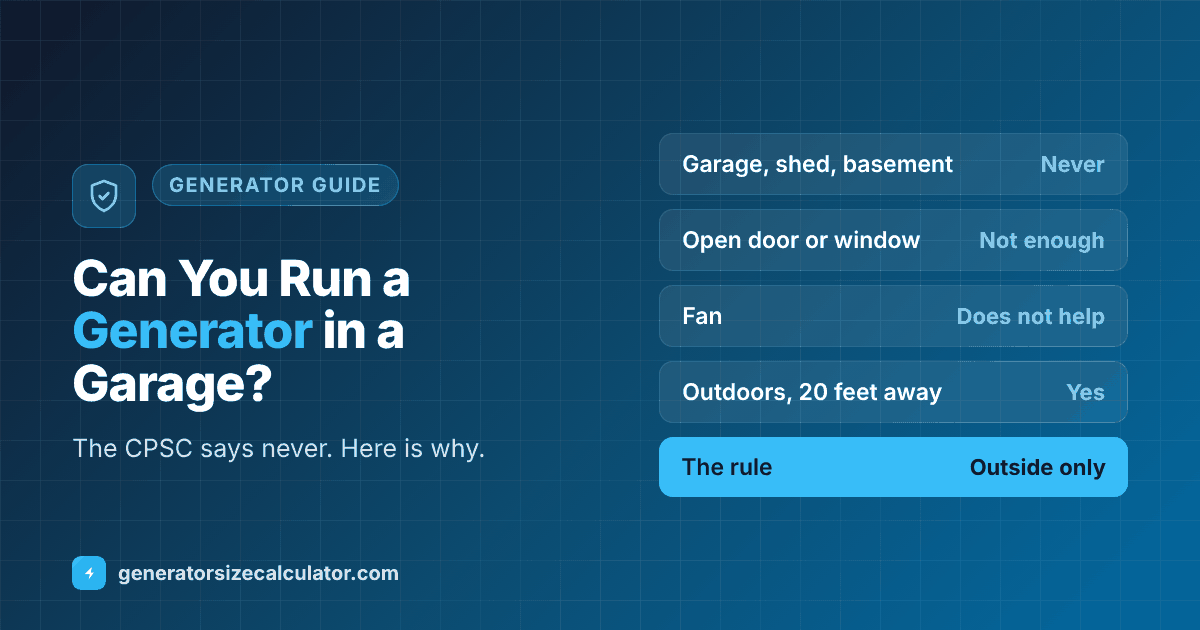
Quick answer: No. The U.S. Consumer Product Safety Commission says to never run a portable generator inside a home, garage, basement, crawlspace or shed and to run it outdoors only, at least 20 feet from the home with the exhaust pointed away from buildings. It also says opening doors or windows will not provide enough ventilation to stop lethal carbon monoxide from building up. FEMA adds that fans do not prevent it either.
The short answer
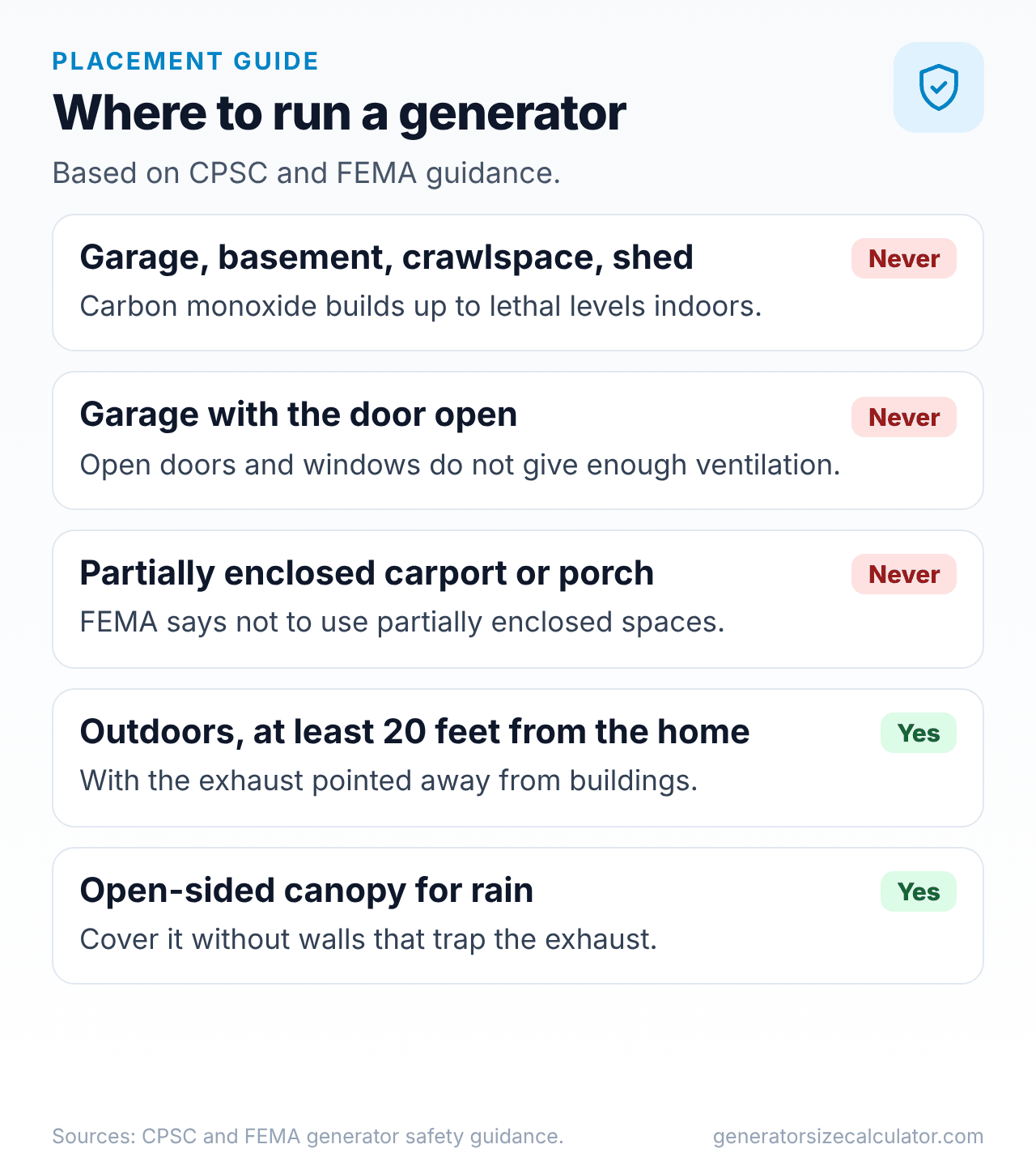
No. The CPSC's guidance is blunt: use portable generators outside only, at least 20 feet from the home, with the exhaust pointed away from any nearby building. It says to never operate one inside a home, garage, basement, crawlspace or shed. FEMA gives the same direction and says not to use a generator in partially enclosed spaces.
Why a garage is dangerous
A gasoline engine makes carbon monoxide (CO), a gas with no smell or color that can build up to lethal levels in an enclosed space within minutes. A garage is attached to the house, so the gas can drift in through shared walls, doors and ducts. The CPSC's report covering 2009 to 2019 estimates that portable generators were linked to 765 non-fire CO poisoning deaths, about 40% of consumer product CO deaths it covers. See generator carbon monoxide statistics.
Why open doors and fans do not help
The CPSC says that opening doors or windows will not provide enough ventilation to prevent a lethal buildup of CO. FEMA says fans do not prevent it. A generator running with the garage door up is still too close to the house, since exhaust can flow back inside. A shed or carport with walls on two or three sides is still partially enclosed.
What to do instead
- Move it outdoors, at least 20 feet from the home, with the exhaust pointing away from windows, doors and vents.
- Protect it from rain without enclosing it. Use an open-sided canopy made for generators. See can you run a generator in the rain.
- Run cords to the house, or have an electrician install a transfer switch. See how to connect a generator to your house.
- Install CO alarms on every level. See CO alarms and generators.
- Consider a model with a CO shut-off. See what a CO shut-off generator is.
Check cord length and loads before the outage.
Never run a generator in a garage, basement, crawlspace or shed, even with the door open. Carbon monoxide has no smell or color. If a carbon monoxide alarm sounds, or anyone feels dizzy, has a headache or feels sick while a generator is running, get to fresh air and call 911. See how far a generator should be from your house.
Frequently asked questions
Can you run a generator in a garage with the door open?
No. The CPSC says that opening doors or windows will not provide enough ventilation to prevent lethal carbon monoxide buildup.
Can you run a generator in a shed?
No. The CPSC lists sheds with garages, basements and crawlspaces as places to never run a portable generator.
How far should a generator be from the house?
At least 20 feet, with the exhaust pointed away from any nearby building, according to the CPSC.
Can a fan clear the carbon monoxide?
FEMA says fans do not prevent carbon monoxide buildup.
What if I only run it for a few minutes?
There is no safe time. Carbon monoxide can build up quickly, so run it outdoors every time.
Related calculators
Sources: U.S. Consumer Product Safety Commission, portable generator safety and carbon monoxide statistics (outside only, 20 feet, never in a home, garage, basement, crawlspace or shed, open doors and windows not enough, 765 deaths and 40% for 2009 to 2019); FEMA, generator safety (partially enclosed spaces, fans).