Do You Need a Carbon Monoxide Alarm When Using a Generator?
By the Generator Size Calculator Team · Updated · 5 min read
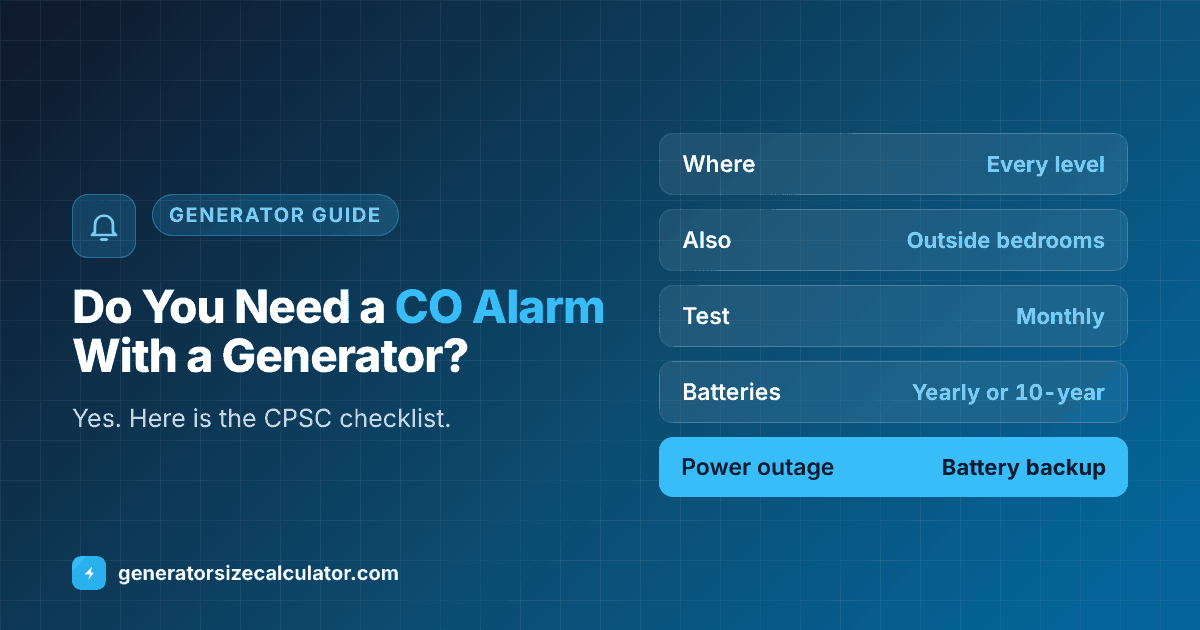
Quick answer: Yes. The CPSC says to install carbon monoxide alarms on every level of the home and outside sleeping areas, use interconnected alarms where possible, test them monthly and replace the batteries at least yearly, or use sealed 10-year batteries. FEMA says to use battery-operated alarms or plug-in models with battery backup, since the power may be out. An alarm is a backup. It does not make it safe to run a generator indoors.
Why you need alarms
Even a generator that is outdoors and 20 feet away can send exhaust toward the house if the wind changes or a window is open. A carbon monoxide alarm is the only thing that warns you, because the gas has no smell or color. The CPSC and FEMA both tell generator users to have working alarms. That matters most at night, when sleeping people cannot notice symptoms.
Where to put them
| Where | What the CPSC says |
|---|---|
| Every level of the home | Install an alarm on each level |
| Outside sleeping areas | Install one outside each sleeping area |
| Type | Interconnected where possible, so one sounds them all |
| Power | Battery-operated, or plug-in with battery backup |
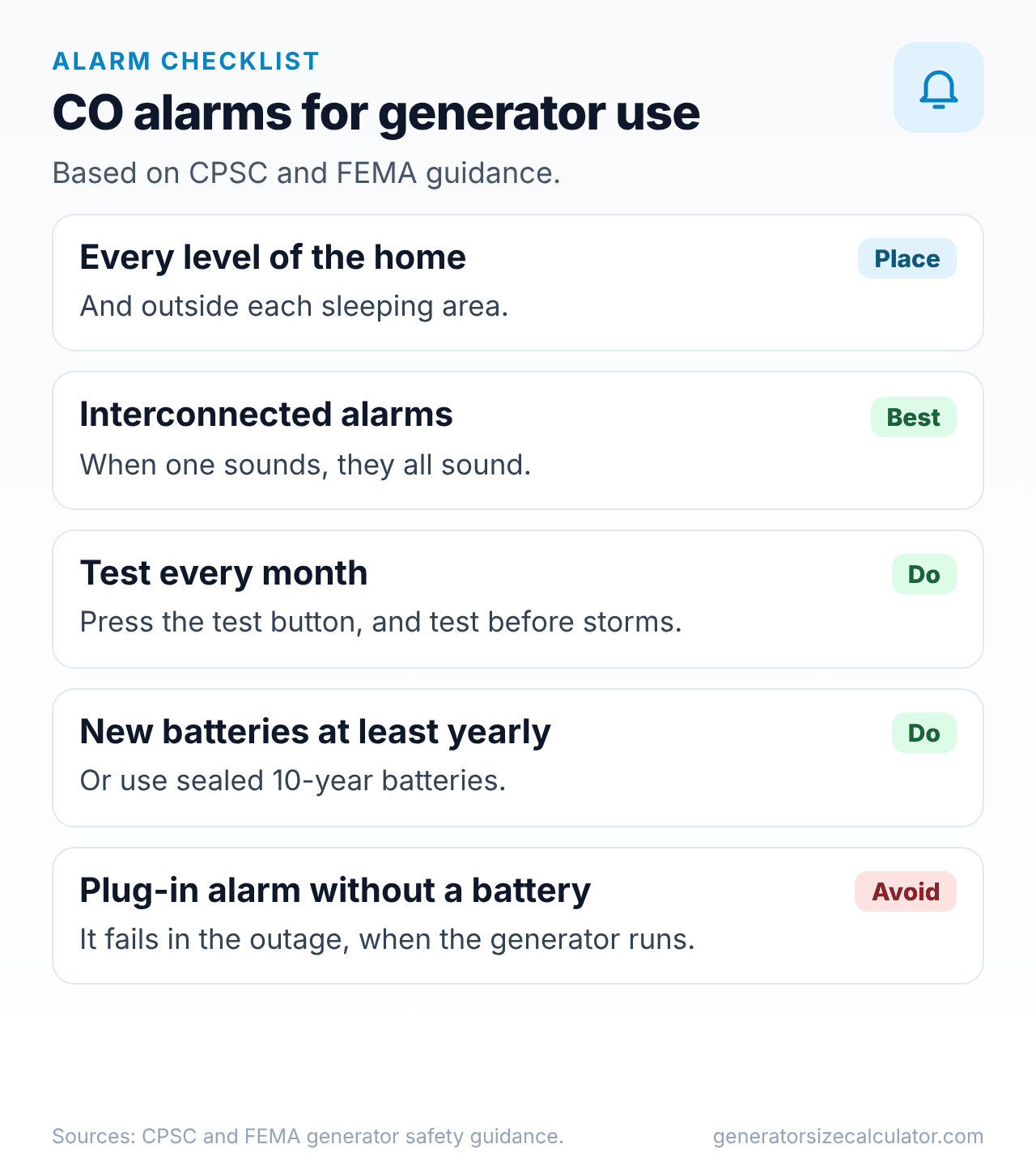
FEMA's wording is to install battery-operated or plug-in alarms with battery backup, following the manufacturer's instructions. A plug-in alarm without a battery does nothing in a power outage, which is exactly when a generator runs.
Testing and batteries
- Test monthly. Press the test button, and test before a storm if you can.
- Replace batteries at least yearly, or use alarms with sealed 10-year batteries, per the CPSC.
- Follow the maker's replacement date. Alarms wear out, and the date is printed on the unit.
- Pick up spare batteries before storm season.
What to do if one sounds
Take it seriously. Get everyone, including pets, into fresh air and call 911. Shut the generator off only from outside, and do not go back in until emergency crews say it is safe. Do not assume it is a false alarm. See can you run a generator in a garage for why the placement rules matter.
Plan cords and distance before the next outage.
Alarms are a backup. Always run a generator outdoors, at least 20 feet from the home. Carbon monoxide has no smell or color. If a carbon monoxide alarm sounds, or anyone feels dizzy, has a headache or feels sick while a generator is running, get to fresh air and call 911. See how far a generator should be from your house.
Frequently asked questions
Do I need a CO alarm if my generator is outside?
Yes. The CPSC and FEMA both recommend alarms, since exhaust can still drift toward the house.
Where should carbon monoxide alarms go?
On every level of the home and outside sleeping areas, according to the CPSC.
How often should I test a CO alarm?
Monthly, according to the CPSC, and replace the batteries at least yearly unless you use sealed 10-year batteries.
Do plug-in CO alarms work in a power outage?
Only with battery backup. FEMA says to use battery-operated alarms or plug-in alarms with battery backup.
Can a CO alarm make it safe to run a generator indoors?
No. The CPSC says never to run a portable generator in a home, garage, basement, crawlspace or shed.
Related calculators
Sources: U.S. Consumer Product Safety Commission, portable generator safety and carbon monoxide statistics (alarms on every level and outside sleeping areas, interconnected, test monthly, replace batteries yearly or use 10-year batteries, battery backup); FEMA, generator safety (battery-operated or plug-in with battery backup).