Can You Run a Generator in the Rain?
By the Generator Size Calculator Team · Updated · 7 min read
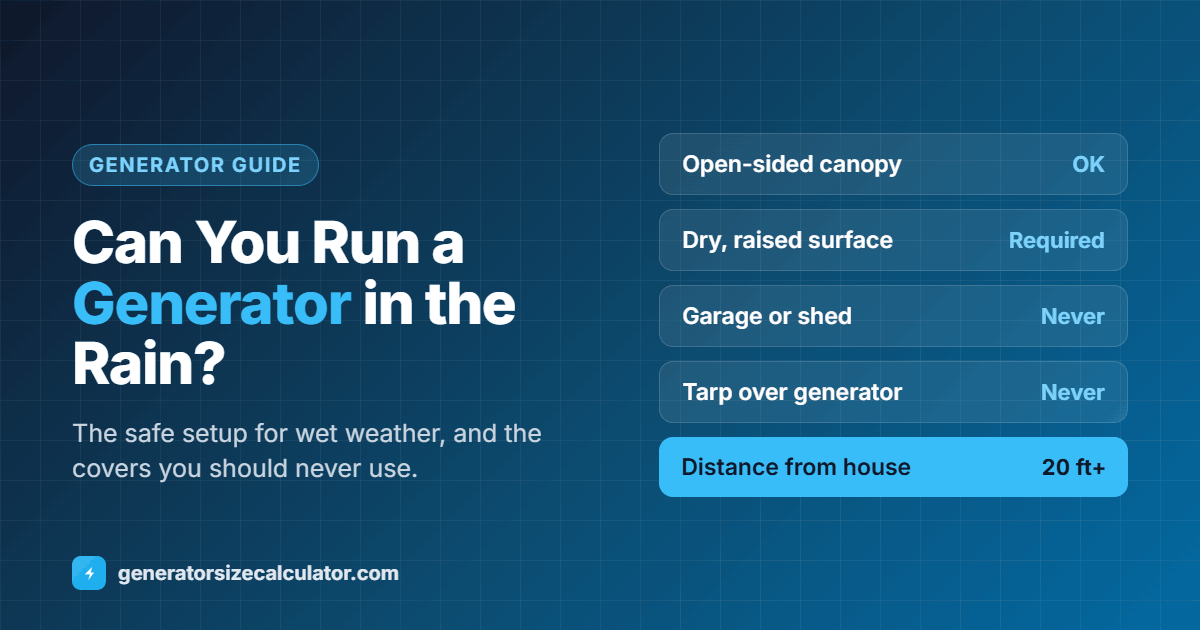
Quick answer: Not uncovered. Water and a running generator are a shock risk. If you must run one in wet weather, the U.S. Consumer Product Safety Commission says to place it under an open, canopy-like structure on a dry surface where water can't reach it or puddle under it, dry your hands before touching it, and never run it in an enclosed space. Keep it at least 20 feet from doors, windows and vents, because carbon monoxide is the bigger killer, and never put a tarp over a running unit.
The short answer
Most portable generators aren't built to sit in the rain. Their outlets are exposed, and water in the wrong place can cause a shock or damage the unit. The safe approach in a storm is to keep rain off the generator without enclosing it. The CPSC's guidance is to run the generator under an open, canopy-like structure on a dry surface, where water cannot reach it or puddle under it, and to dry your hands before touching it.
Everything else about portable generator safety still applies: stay outdoors, stay 20 feet from the house and never move it into the garage "just until it stops raining."
Why rain is a problem
- Electric shock. Wet outlets, plugs, cords and hands raise the risk of shock or electrocution.
- Damage to the generator. Moisture in the electrical parts can cause shorts and corrosion.
- The temptation to move it indoors. Rain pushes people to run the generator in a garage, shed or porch, which exposes them to carbon monoxide. This is the more deadly risk.
What kind of cover is safe
| Cover | Safe while running? | Notes |
|---|---|---|
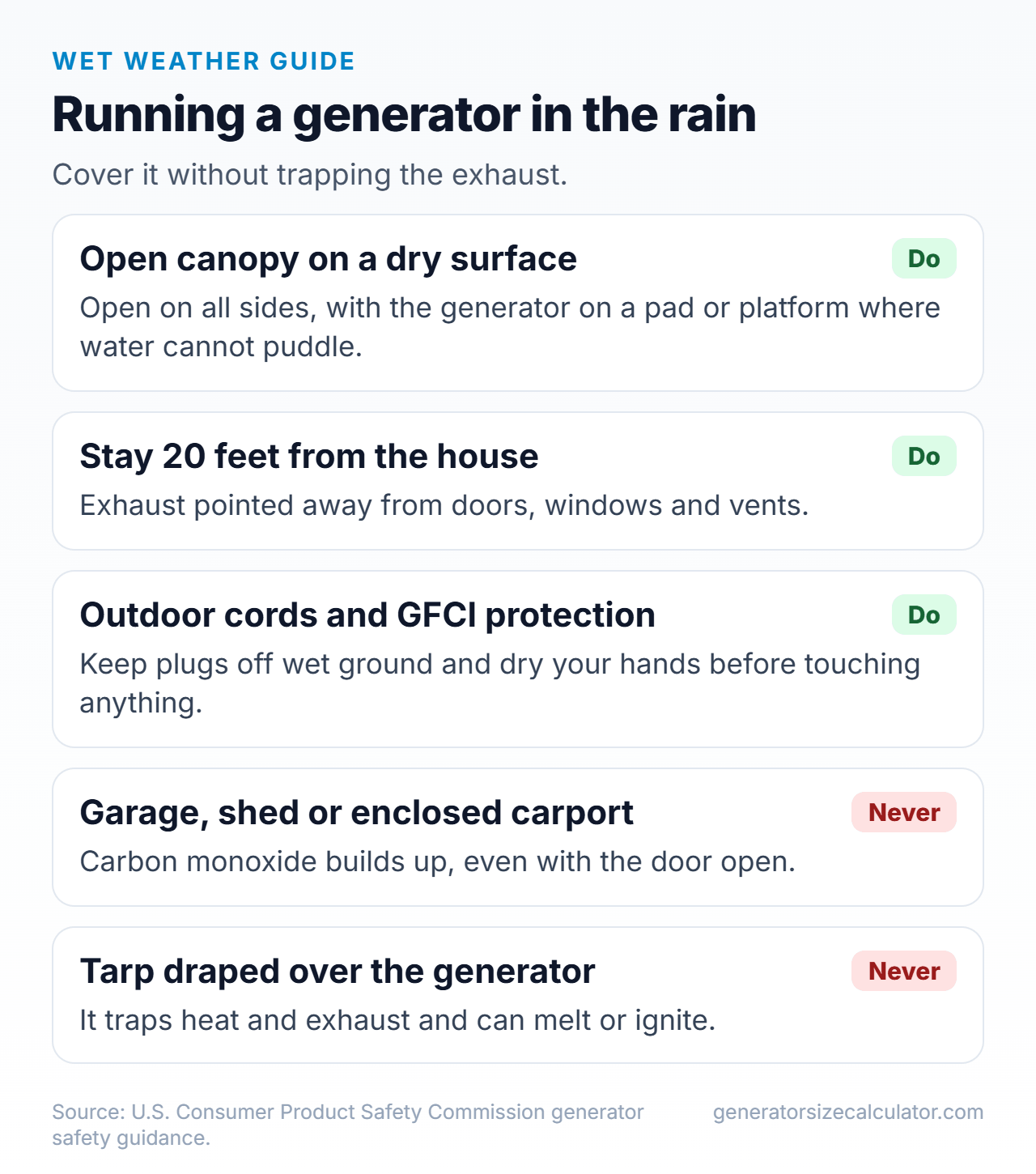
| Open-sided generator canopy or tent made for the job | Yes | Open on all sides so exhaust escapes and air can reach the engine |
| Homemade open frame with a roof (posts and a waterproof top) | Yes, if open on all sides | Keep the roof well above and clear of the engine and muffler |
| Tarp draped over the generator | No | Traps heat and exhaust and can melt or catch fire |
| Garage, shed or carport with walls | No | Carbon monoxide builds up even with the door open |
| Under a porch roof or eave attached to the house | No | Too close to the home, and exhaust can collect |
| Box or enclosure not made for running | No | Blocks ventilation unless the manufacturer approves it |
Generator covers sold for storage are for use when the engine is off. Don't leave them on while the generator runs.
How to set up in wet weather
- Choose the spot first. Pick a dry, level place at least 20 feet from doors, windows and vents, with the exhaust pointed away from the house. See how far a generator should be from your house.
- Make the surface dry. Use a concrete pad, patio blocks or a raised platform, so water can't puddle under or around the generator.
- Put up the canopy. Make sure rain can't blow in from the sides and that all sides stay open for airflow.
- Use outdoor-rated cords with all three prongs. Keep plugs and connections off wet ground, out of puddles and under cover. Check cords for cuts before use.
- Use GFCI protection. Plug into a GFCI outlet, or use a GFCI cord, so current leaking to ground trips quickly.
- Dry your hands before touching the generator, the cords or the plugs.
- Refuel safely. Turn it off and let it cool before adding fuel, and keep fuel away from the canopy's edges.
Plan your power use too. A smaller load burns less fuel and means fewer trips outside in bad weather. Our generator runtime calculator shows how long a tank will last.
Add up what you need so you only run the generator as much as necessary.
Flooding and standing water
If water is rising or pooling where the generator sits, shut it down and move it only after the water is gone and the unit is dry. Don't touch a generator, cord or plug while standing in water. A generator that has been submerged or soaked should be inspected by a qualified technician before use. Moisture inside the electrical parts can cause a shock even after the unit seems dry.
After the storm
- Let the generator cool, then wipe it down and let it dry fully before storing it.
- Inspect cords, plugs and outlets for damage or moisture.
- Check the oil and fuel for signs of water before the next run.
- Store fuel outside living areas in labeled, non-glass safety containers.
Rain is never a reason to run a generator in a garage, shed, basement or near open windows. Carbon monoxide can kill in minutes. Install battery-powered carbon monoxide alarms on every level of your home.
Frequently asked questions
Is it safe to run a generator in the rain?
Not uncovered. The CPSC says to place it under an open, canopy-like structure on a dry surface where water can't reach it or puddle, and to dry your hands before touching it. Never run it in an enclosed space.
Can I put a tarp over my generator while it is running?
No. A tarp traps heat and exhaust and can melt or ignite. Use an open-sided canopy or tent built for generators, or a homemade open frame with a roof.
Can I run a generator under a carport or porch?
Not if the space has walls, or if it is close to the house. Exhaust can collect under roofs and drift into the home. Keep the generator at least 20 feet from doors, windows and vents.
Do I need a GFCI outlet when it is raining?
GFCI protection is strongly recommended in wet conditions. Plug cords into a GFCI-protected outlet or use a GFCI cord or adapter, so a leak to ground shuts the circuit off quickly.
What do I do if my generator got wet?
Turn it off, stay out of any standing water and let it dry completely. If it was soaked or submerged, have a qualified technician inspect it before using it again.
Related calculators
Sources: Wet-weather operation, canopy, cord and carbon monoxide guidance from the U.S. Consumer Product Safety Commission and the ndresponse.gov generator safety sheet, which reproduces it. Follow your generator's manual, and call a qualified technician if the unit has been soaked or submerged.