What Size Generator Do You Need to Run a Space Heater?
By the Generator Size Calculator Team · Updated · 6 min read
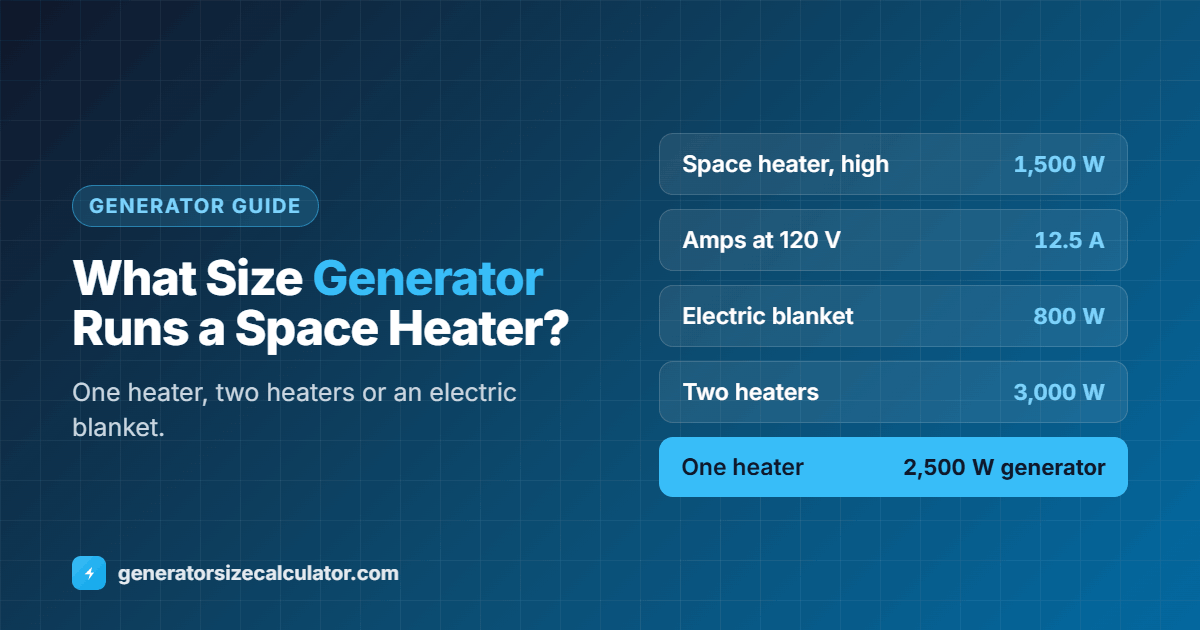
Quick answer: A typical space heater on high draws 1,500 watts (12.5 amps at 120 volts), and on low the draw can drop by as much as 60%. Heating elements have no start-up surge. Keeping the load under 80% of the rating suggests a 2,500-watt generator for one heater and about 4,000 watts for two. An electric blanket is far lighter at about 800 watts.
How many watts a space heater uses
Most portable electric heaters top out at 1,500 watts. At 120 volts that is 12.5 amps (1,500 divided by 120). On the low setting the current draw can fall by as much as 60%, per Lasko. Honda lists a queen electric blanket at 800 watts, and Bob Vila lists a radiant heater at about 1,300 watts.
| Heater | Running watts | Starting watts |
|---|---|---|
| Electric blanket (queen) | 800 | 800 |
| Radiant heater | 1,300 | 1,300 |
| Space heater, high | 1,500 | 1,500 |
| Space heater, low (about 40%) | 600 | 600 |
The low-setting figure is our estimate from the 60% reduction. Check your heater's label.
Which generator size to choose
| Setup | Running load | Generator at 80% |
|---|---|---|
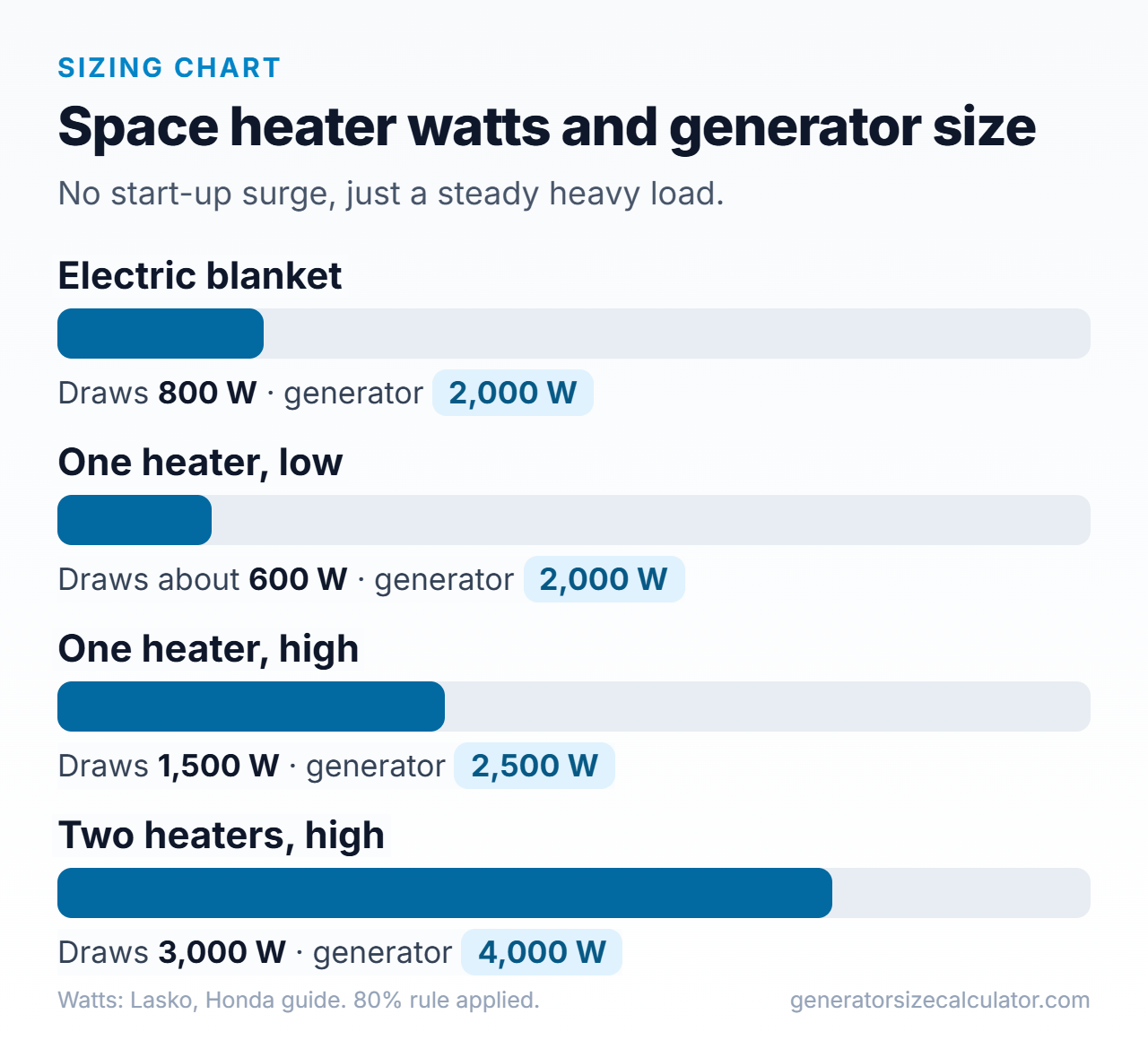
| Electric blanket | 800 W | 2,000 W |
| One heater, low | 600 W | 2,000 W |
| One heater, high | 1,500 W | 2,500 W |
| Two heaters, high | 3,000 W | 4,000 W |
Resistive heaters need no surge allowance, so the 80% rule decides the size. A 2,000-watt inverter, typically about 1,600 running watts, can run a single 1,500-watt heater, but at 94% of its running rating it will be near its limit all night. Add a fridge or furnace fan and you need a larger unit. See what size generator runs a furnace.
Using a heater on a generator safely
- Plug the heater directly into the generator or a heavy-duty cord rated for the load. Lasko advises never to use space heaters with ordinary extension cords, power strips or power taps because they can overheat. Use the extension cord calculator.
- Keep the heater on a flat surface, away from beds, curtains and anything flammable, and never leave it running unattended.
- Never bring the generator inside to keep warm. Carbon monoxide is the biggest winter generator danger.
- Check the plug and cord for heat during use. A warm plug is a warning sign.
Heaters, a fridge and lights on one list.
Run the generator outdoors, at least 20 feet from doors, windows and vents. Never in a garage or shed, even with the door open. Winter outages are when carbon monoxide poisonings happen most. Install battery-powered carbon monoxide alarms. See how far a generator should be from your house.
Other ways to stay warm
An electric blanket (800 watts) heats you instead of the room, and a gas furnace's fan needs only about 1,000 watts. These are much lighter than two space heaters. Dress in layers and close off rooms. For long outages, see how long a generator runs on a tank of gas.
Frequently asked questions
How many watts does a space heater use?
Most portable heaters are 1,500 watts on high, or about 12.5 amps at 120 volts. On the low setting the draw can drop by up to 60%.
Can a 2000-watt generator run a space heater?
A typical 2,000-watt inverter can run a single 1,500-watt heater, but at about 94% of its running rating, so expect it to run near its limit. A 2,500-watt generator is more comfortable.
Can I run two space heaters on one generator?
Yes, with a generator of about 4,000 watts or more, and each heater on a separate cord or outlet.
Do space heaters have a starting surge?
No. A resistive heating element draws about the same watts at start-up as when running.
Is it safe to use an extension cord with a space heater?
Lasko advises against ordinary extension cords and power strips. Plug the heater directly into the generator, or use a heavy-duty cord rated for the load.
Related calculators
Sources: Space heater amps, low-setting draw and extension cord safety from Lasko; electric blanket watts from the Honda generator wattage guide; radiant heater watts from Bob Vila. The low-setting wattage and generator sizes are our estimates using the 80% running-load rule.