What Size Generator Do You Need to Run a Table Saw?
By the Generator Size Calculator Team · Updated · 6 min read
Quick answer: Honda lists a table saw at 1,500 running and 3,000 starting watts for 1.7 HP and 1,800 and 4,500 for 2.5 HP. The start-up surge decides the size, so plan on a 3,000-watt generator for a 1.7 HP saw and about 4,000 watts for a 2.5 HP saw. Add lights and a radio on top of the saw and a 3,500-watt unit covers the 1.7 HP job.
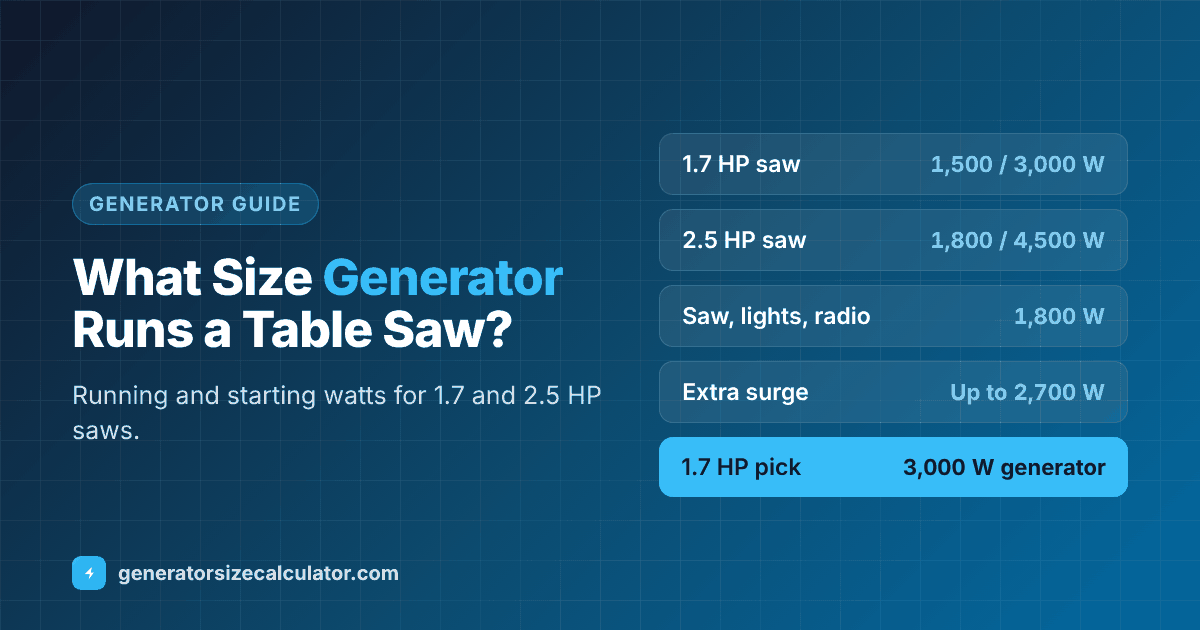
Table saw watts by horsepower
| Table saw | Running watts | Starting watts | Extra start-up surge |
|---|---|---|---|
| 1.7 HP | 1,500 | 3,000 | 1,500 |
| 2.5 HP | 1,800 | 4,500 | 2,700 |
These are Honda's typical figures. A saw draws more while it is cutting thick or wet wood than when it spins freely, so a label or a plug-in watt meter is the best check. Honda's guide also notes that motor tools can draw about three times their running amps at start-up. See starting vs running watts.
Which generator size to choose
| Table saw | Generator for the saw alone | Why |
|---|---|---|
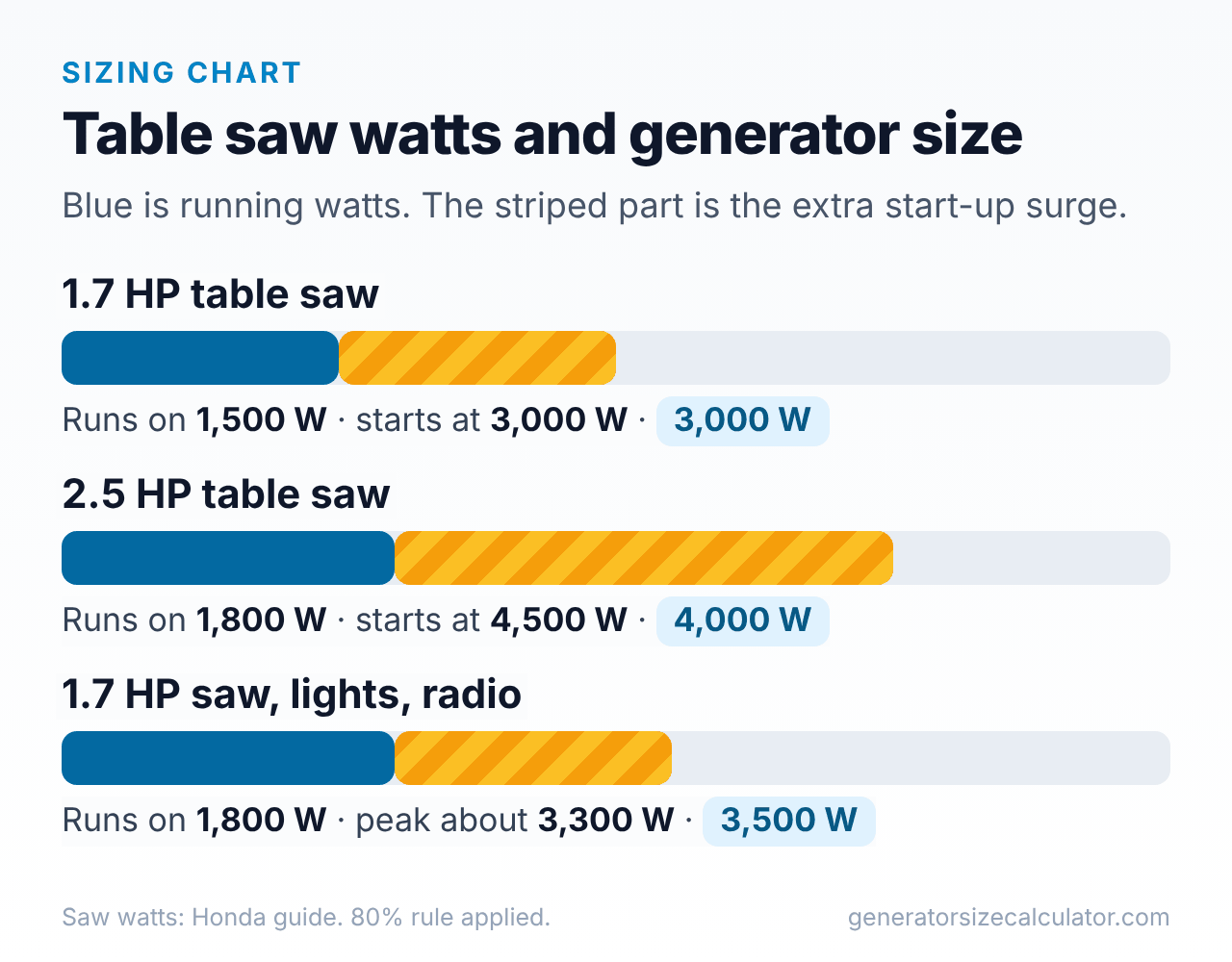
| 1.7 HP (1,500 / 3,000 W) | 3,000 W | Surge fits within about 3,750 starting watts |
| 2.5 HP (1,800 / 4,500 W) | 4,000 W | Surge needs about 4,500 starting watts, so 3,500 W is a bit short |
Sizes keep the running load under 80% of the rating and assume a starting capacity of about 125% of the running rating. Check your generator's own starting watts, since inverter models list a peak that lasts only a few seconds. For other saws, see what size generator runs a circular saw and what size generator a workshop needs.
Example: saw, lights and a radio
| Load | Running watts |
|---|---|
| Table saw, 1.7 HP | 1,500 |
| Work lights | 200 |
| Radio | 100 |
| Running total | 1,800 |
The saw's extra start-up load is 1,500 watts, so the peak is about 3,300 watts. A 3,500-watt generator carries 1,800 running watts under its 80% mark (2,800 watts), and its approximate 4,400-watt starting capacity covers the peak. The lights and radio are examples, so replace them with your own.
List the saw, a dust collector and lights to see the total.
Tips for a clean start
- Start the saw first, with nothing else running, then add lights and a radio.
- Use a short, heavy cord. A long, thin cord drops voltage and makes the motor strain. Check the extension cord calculator and the voltage drop calculator.
- Keep the blade sharp. A dull blade makes the motor draw more watts while cutting.
- Plan for dust. A shop vacuum adds 900 to 1,300 watts. See generator size for a vacuum cleaner.
Run the generator outdoors, at least 20 feet from doors, windows and vents. Never in a garage or shed, even with the door open. Never run one inside a workshop. See how far a generator should be from your house.
Frequently asked questions
What size generator do I need to run a table saw?
Honda lists a 1.7 HP table saw at 1,500 running and 3,000 starting watts, so a 3,000-watt generator is a realistic minimum. A 2.5 HP saw at 1,800 and 4,500 watts needs about 4,000 watts.
Can a 2000-watt generator run a table saw?
Not a full-size one. A 1.7 HP saw starts at 3,000 watts, above the 2,000-watt peak of a typical small inverter. A small benchtop saw with a lower label may work, so check yours.
Can a 3500-watt generator run a table saw?
A 1.7 HP saw, yes, with some lights. A 2.5 HP saw starts at 4,500 watts, which is above the roughly 4,400 starting watts of a 3,500-watt generator.
Why does a table saw need so many starting watts?
The motor draws a large current for a moment as it spins up, often two to three times its running watts.
Can I run a dust collector at the same time?
Only if the generator covers the saw plus the collector, with the largest start-up surge on top. Check the collector label and start the biggest motor first.
Related calculators
Sources: Running and starting watts from the Honda generator wattage guide (table saws), plus Honda's note on motor start-up current. Generator sizes apply the 80% running rule and an assumed starting capacity about 25% above the running rating. The lights and radio in the example are assumed values.