What Size Generator Do You Need to Run a Circular Saw?
By the Generator Size Calculator Team · Updated · 6 min read
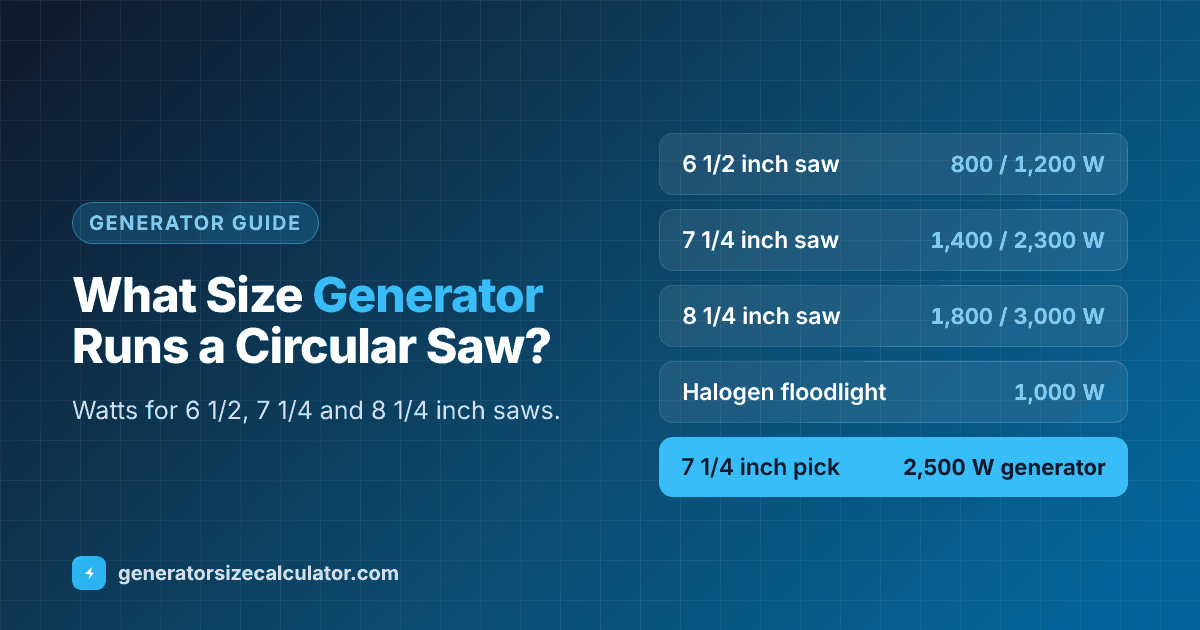
Quick answer: Honda lists a circular saw at 800 running and 1,200 starting watts for 6 1/2 inch, 1,400 and 2,300 for 7 1/4 inch and 1,800 and 3,000 for 8 1/4 inch. That points to about a 2,000-watt generator for a 6 1/2 inch saw, 2,500 watts for 7 1/4 inch and 3,000 watts for 8 1/4 inch. A halogen floodlight adds 1,000 watts, so job sites usually need a bigger unit.
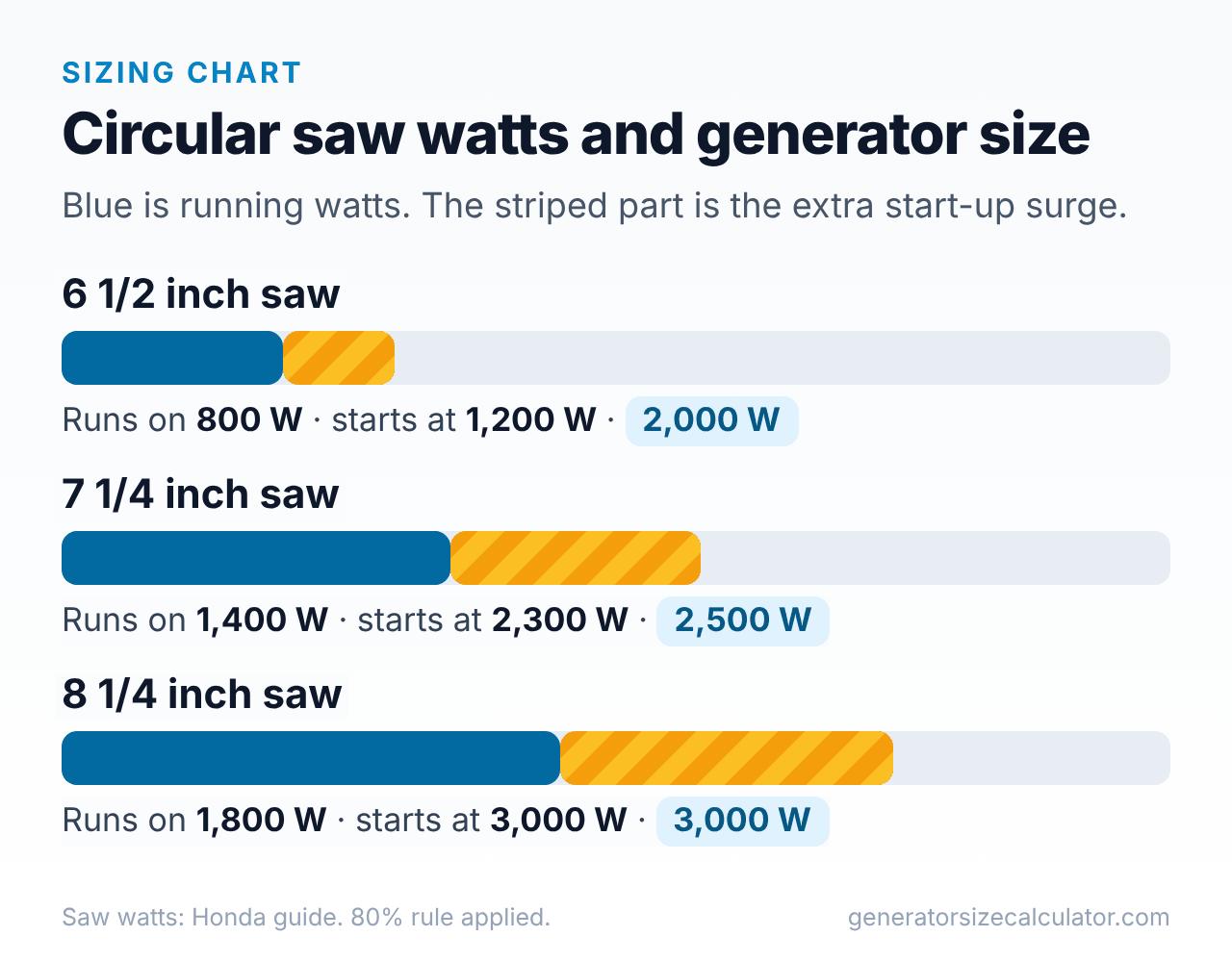
Circular saw watts by size
| Circular saw | Running watts | Starting watts |
|---|---|---|
| 6 1/2 inch | 800 | 1,200 |
| 7 1/4 inch | 1,400 | 2,300 |
| 8 1/4 inch | 1,800 | 3,000 |
These are Honda's typical figures. A saw cutting dense or wet lumber pulls more than one running free, so check the label on yours. Many cordless saws avoid all of this, but a corded saw on a generator is still very common on job sites.
Which generator size to choose
| Circular saw | Generator for the saw alone |
|---|---|
| 6 1/2 inch (800 / 1,200 W) | 2,000 W |
| 7 1/4 inch (1,400 / 2,300 W) | 2,500 W |
| 8 1/4 inch (1,800 / 3,000 W) | 3,000 W |
A typical 2,000-watt inverter delivers about 1,600 running watts, which is under the 1,750 you want for a 7 1/4 inch saw at the 80% rule, so that saw is better matched to a 2,500-watt generator. The sizes assume a starting capacity about 25% above the running rating. For the full tool list, see what size generator a workshop needs.
Example: saw and a floodlight
| Load | Running watts |
|---|---|
| Circular saw, 7 1/4 inch | 1,400 |
| Floodlight, mercury halogen | 1,000 |
| Radio | 100 |
| Running total | 2,500 |
The saw's start-up surge is about 900 watts (2,300 minus 1,400), so the peak is about 3,400 watts. A 4,000-watt generator keeps 2,500 running watts under its 80% mark (3,200 watts), and its approximate 5,000-watt starting capacity covers the peak. Swapping the halogen floodlight for an LED work light cuts the running total sharply.
Add the saw, lights and a charger to see the generator size.
Tips for job-site power
- Use LED work lights. Honda lists a mercury halogen floodlight at 1,000 watts each.
- Use the right cord. A long, thin cord drops voltage. See the extension cord calculator.
- Start the saw before other loads so the surge does not stack with anything else.
- Pair it with a bigger tool plan. A table saw needs more, see generator size for a table saw.
Run the generator outdoors, at least 20 feet from doors, windows and vents. Never in a garage or shed, even with the door open. See how far a generator should be from your house.
Frequently asked questions
How many watts does a circular saw use?
Honda lists a 7 1/4 inch circular saw at 1,400 running and 2,300 starting watts. A 6 1/2 inch saw is 800 and 1,200, and an 8 1/4 inch saw is 1,800 and 3,000.
Can a 2000-watt generator run a circular saw?
A 6 1/2 inch saw, yes. A 7 1/4 inch saw at 1,400 running watts is above the 80% mark of a typical 1,600-watt-running inverter, so a 2,500-watt generator is safer.
Can a 3500-watt generator run a circular saw and a light?
Yes. A 7 1/4 inch saw with a few LED lights is well within a 3,500-watt generator. A 1,000-watt halogen floodlight brings you near the limit.
Do circular saws have a starting surge?
Yes. The motor draws extra for a moment, about 900 watts above running for a 7 1/4 inch saw.
Can I run two saws at once?
Only if the generator covers both running loads plus the larger surge. Most crews use one saw at a time.
Related calculators
Sources: Running and starting watts from the Honda generator wattage guide (circular saws, mercury halogen floodlight). Generator sizes apply the 80% running rule and an assumed starting capacity about 25% above the running rating. The radio in the example is an assumed value.