What Size Generator Do You Need to Run a Milk Cooler and Milking Machine?
By the Generator Size Calculator Team · Updated · 5 min read
Quick answer: Honda lists a milk cooler at 1,100 running and 2,300 starting watts and a 2 hp milking machine at 1,000 and 2,300. A 2,500-watt generator runs either one. Run both with lights and a 3,500-watt generator is the comfortable size, as long as the two motors start one at a time. Check your equipment's data plates, since farm equipment varies a lot.
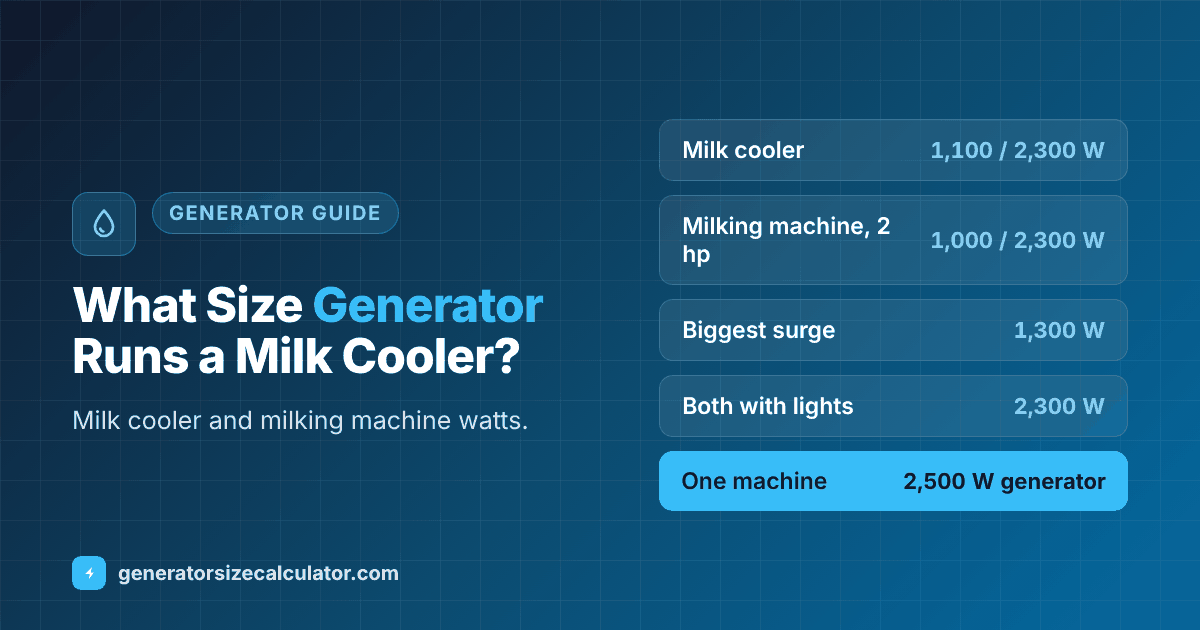
Dairy equipment watts
| Equipment | Running watts | Starting watts | Extra start-up surge |
|---|---|---|---|
| Milk cooler | 1,100 | 2,300 | 1,200 |
| Milking machine, 2 hp | 1,000 | 2,300 | 1,300 |
These are Honda's typical figures from its farm equipment list. A real cooler or vacuum pump may be bigger or smaller, so read the data plate or measure it.
Which generator size to choose
| Setup | Generator |
|---|---|
| Milk cooler alone (1,100 / 2,300 W) | 2,500 W |
| Milking machine alone (1,000 / 2,300 W) | 2,500 W |
| Both, with lights | 3,500 W |
Sizes keep the running load under 80% of the rating and assume a starting capacity about 25% above it. A 2,500-watt generator has an 80% mark of 2,000 watts and about 3,125 starting watts, which covers either motor's 2,300 start. Both together run about 2,100 watts, which needs a 3,500-watt unit once lights are added.
Example: cooler, milking machine and lights
| Load | Running watts |
|---|---|
| Milk cooler | 1,100 |
| Milking machine, 2 hp | 1,000 |
| Barn lights | 200 |
| Running total | 2,300 |
If the motors start one at a time, the largest extra start-up load is 1,300 watts (2,300 minus 1,000), so the peak is about 3,600 watts. A 3,500-watt generator carries 2,300 running watts under its 80% mark (2,800 watts), and its approximate 4,375-watt starting capacity covers the peak. The barn lights are an example value.
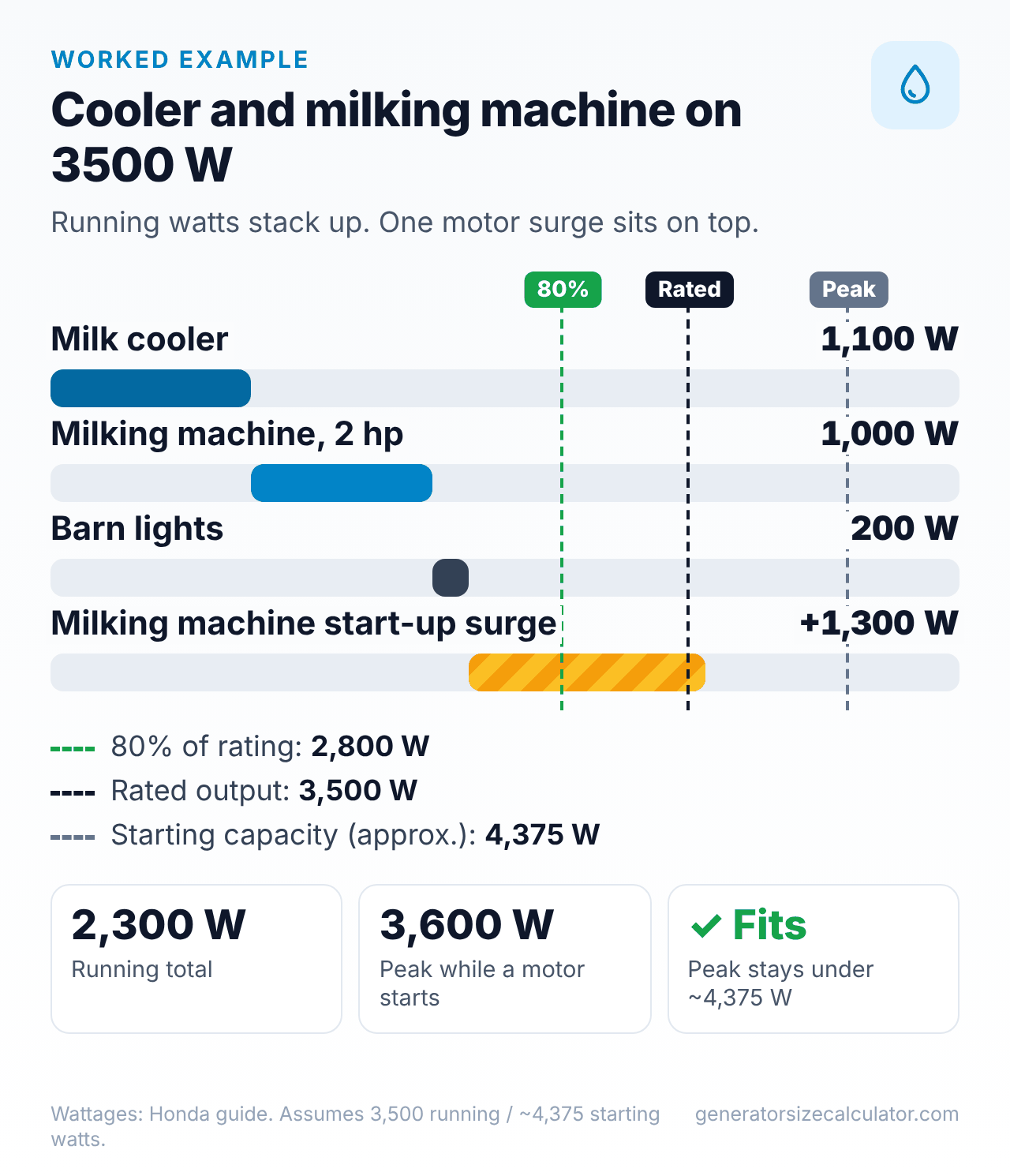
List every motor and light you run together.
Tips for a farm outage
- Start one motor at a time, letting each settle before the next.
- Use heavy outdoor cords and keep connections dry. See the extension cord calculator.
- Keep a safe distance from the barn. Carbon monoxide can build up around animals too.
- Consider a standby unit if outages are frequent. See the standby generator calculator.
Run the generator outdoors, at least 20 feet from doors, windows and vents. Never in a garage, barn or shed, even with the door open. Never run one inside a milking parlor or barn. See how far a generator should be from your house.
Frequently asked questions
How many watts does a milk cooler use?
Honda lists a milk cooler at about 1,100 running and 2,300 starting watts.
How many watts does a milking machine use?
Honda lists a 2 hp milking machine at about 1,000 running and 2,300 starting watts.
Can one generator run both?
Yes, on about 3,500 watts with lights, if the two motors start one at a time.
Can a 2000-watt generator run a milk cooler?
Not reliably. Its 2,300-watt start-up is above a typical 2,000-watt inverter's peak.
Is a bigger generator better for farm equipment?
It gives more headroom for the start-up surge, but costs more fuel. Size to your data plates plus some margin.
Related calculators
Sources: Running and starting watts from the Honda generator wattage guide (milk cooler and milking machine from the farm equipment list). Generator sizes apply the 80% running rule and an assumed starting capacity about 25% above the running rating. The barn lights in the example are an assumed value.