How Much Power Does a Generator Lose at High Altitude?
By the Generator Size Calculator Team · Updated · 5 min read
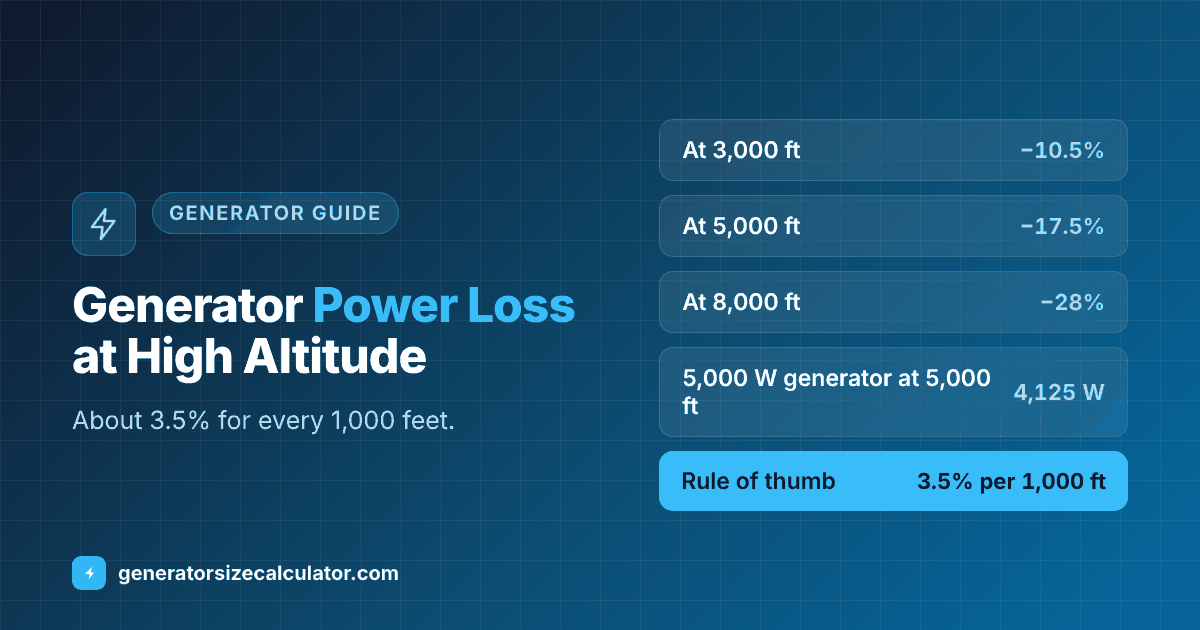
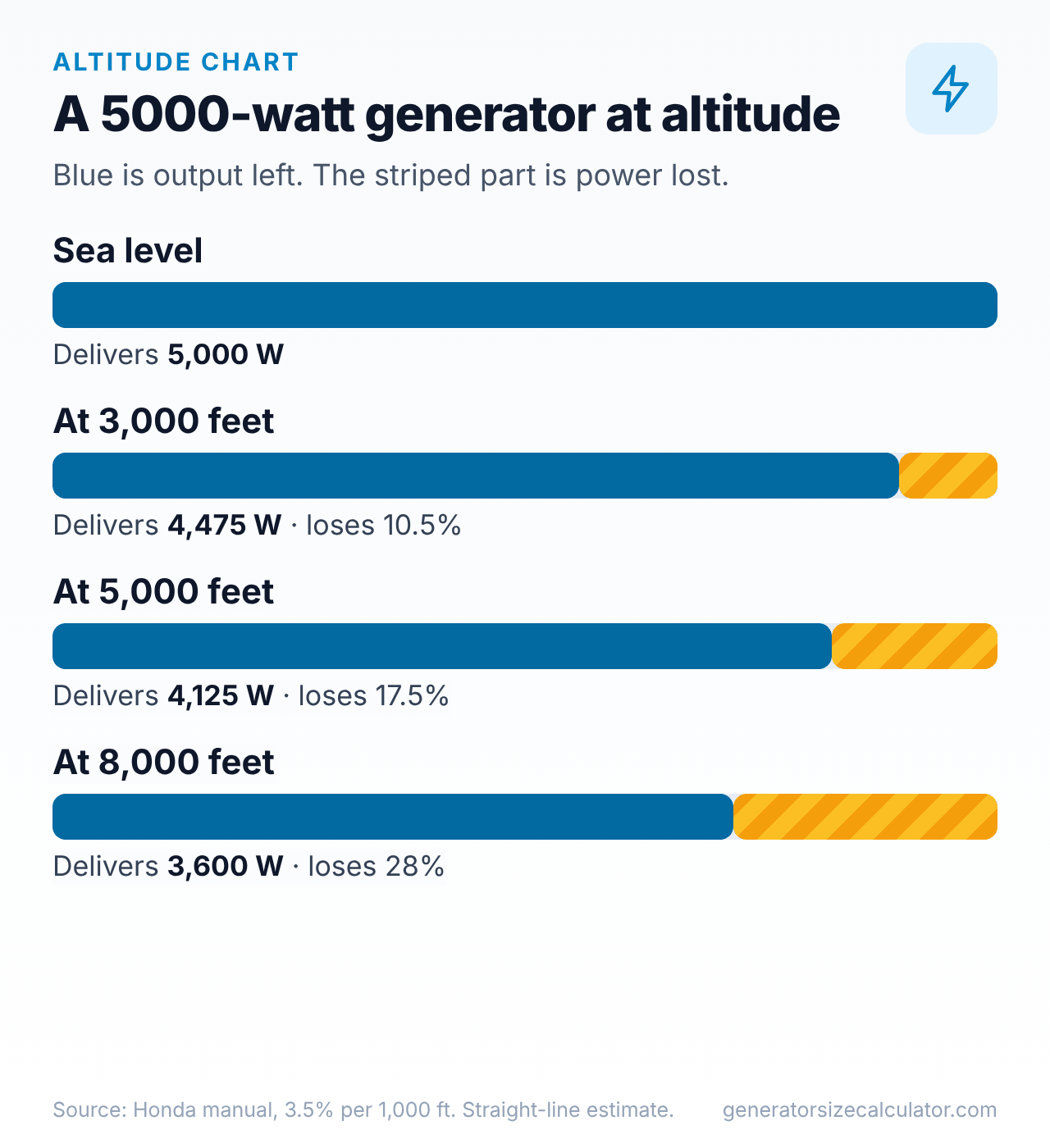
Quick answer: A Honda generator manual says engine power decreases approximately 3.5% for each 1,000-foot increase in altitude, and the loss is greater if the carburetor is not adjusted. At that rate a 5,000-watt generator delivers about 4,125 watts at 5,000 feet and about 3,600 watts at 8,000 feet. Size up for the loss, and check your own manual, since engines differ.
Your manual comes first. This page uses figures from one Honda generator manual (the EM1600X, EM1800X and EM2200X, with a GX140 engine). Other engines, and fuel-injected or inverter models, can behave differently, so check your own owner's manual.
The 3.5% rule
Thinner air means less oxygen per engine stroke, so the engine makes less power. The Honda manual says horsepower decreases approximately 3.5% for each 1,000-foot increase in altitude, and that the loss is greater without a carburetor modification. A generator's output follows the engine's power, so its usable watts fall in about the same proportion. Treat the rule as a straight-line estimate, since real engines and conditions vary.
Output by elevation
| Elevation | Power lost | 3,000 W generator | 5,000 W generator |
|---|---|---|---|
| Sea level | 0% | 3,000 W | 5,000 W |
| 2,000 ft | 7% | 2,790 W | 4,650 W |
| 3,000 ft | 10.5% | 2,685 W | 4,475 W |
| 5,000 ft | 17.5% | 2,475 W | 4,125 W |
| 6,000 ft | 21% | 2,370 W | 3,950 W |
| 8,000 ft | 28% | 2,160 W | 3,600 W |
| 10,000 ft | 35% | 1,950 W | 3,250 W |
The table applies 3.5% per 1,000 feet. The rule is about the engine, and fuel-injected or inverter models can differ, so check what your maker says.
How to size for altitude
Work out the watts you need, then divide by the share of power left. At 5,000 feet about 82.5% is left, so a load of 3,000 running watts needs a generator rated for about 3,640 watts of engine power before you apply the usual 80% rule, which points to roughly 4,500 watts. The steps:
- Add your running watts and your largest start-up surge. Use the generator load calculator.
- Find your elevation and the power lost from the table.
- Divide your needed watts by the share left (for example 0.825 at 5,000 feet), then size up to the next generator.
The portable generator calculator helps with the final size.
Tips for the mountains
- Ask about a high-altitude carburetor kit if you always run above 6,000 feet. See do you need to rejet a generator for high altitude.
- Plan loads in steps, starting motors one at a time, since the start-up surge shrinks with the engine.
- Consider a battery power station for small loads. See the portable power station calculator.
Add your loads, then size up for altitude.
Run the generator outdoors, at least 20 feet from the home. Never in a garage or shed. Carbon monoxide has no smell or color. See how far a generator should be from your house.
Frequently asked questions
How much power does a generator lose at altitude?
Honda's manual says about 3.5% for each 1,000-foot increase in altitude, more without a carburetor modification.
How much power does a 5000-watt generator lose at 5000 feet?
About 17.5% on the 3.5% rule, so it delivers about 4,125 watts.
Do inverter generators lose power at altitude?
The Honda figure is for a carbureted engine. Other designs vary, so check the maker's guidance.
What size generator do I need at 8000 feet?
Divide the watts you need by about 0.72, then size up. A 3,000-watt load needs roughly a 4,200-watt engine before the 80% rule.
Can I fix altitude power loss?
You can reduce it with a high-altitude carburetor modification, but you cannot get the lost air back.
Related calculators
Sources: Honda owner's manual for the EM1600X, EM1800X and EM2200X generators (power decreases approximately 3.5% for each 1,000 foot increase in altitude, loss greater without carburetor modification). The elevation table and sizing example are arithmetic using that rate, assuming a straight-line loss.