How Loud Is Too Loud? Generator Noise and Hearing Protection
By the Generator Size Calculator Team · Updated · 5 min read
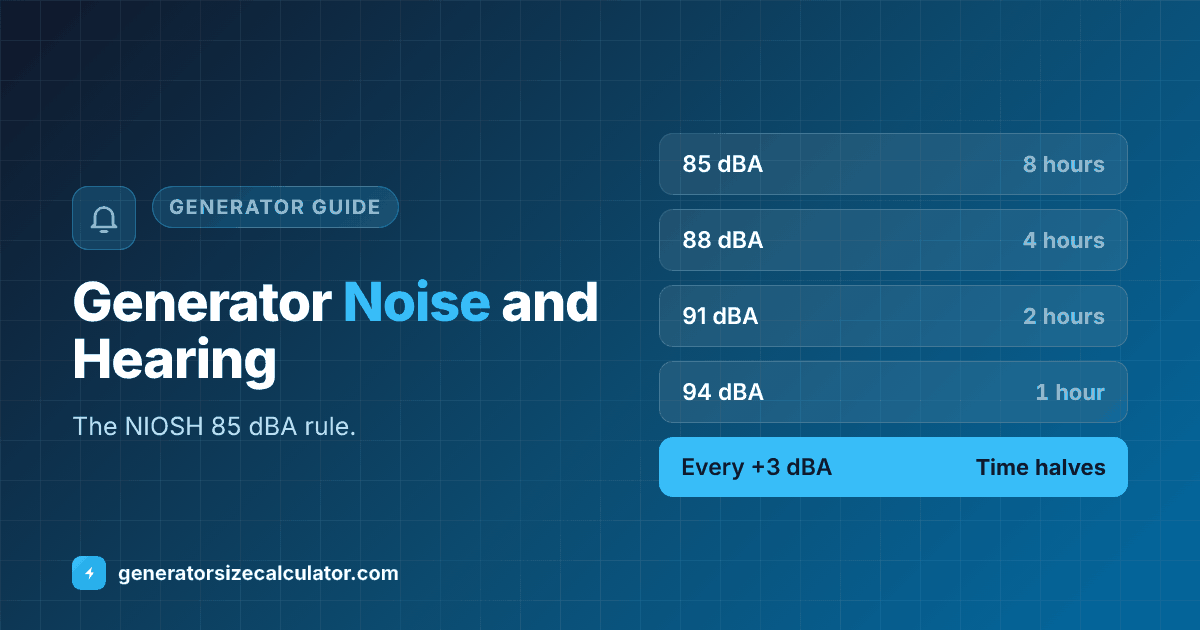
Quick answer: NIOSH recommends a limit of 85 A-weighted decibels (dBA) averaged over an eight-hour day, and says that for each 3 dBA increase you should cut the time in half. So 88 dBA is four hours, 91 dBA two hours and 94 dBA one hour. NIOSH's page does not list generators, so use the decibel rating on yours, and wear hearing protection when noise is above 85 dBA.
The NIOSH limit
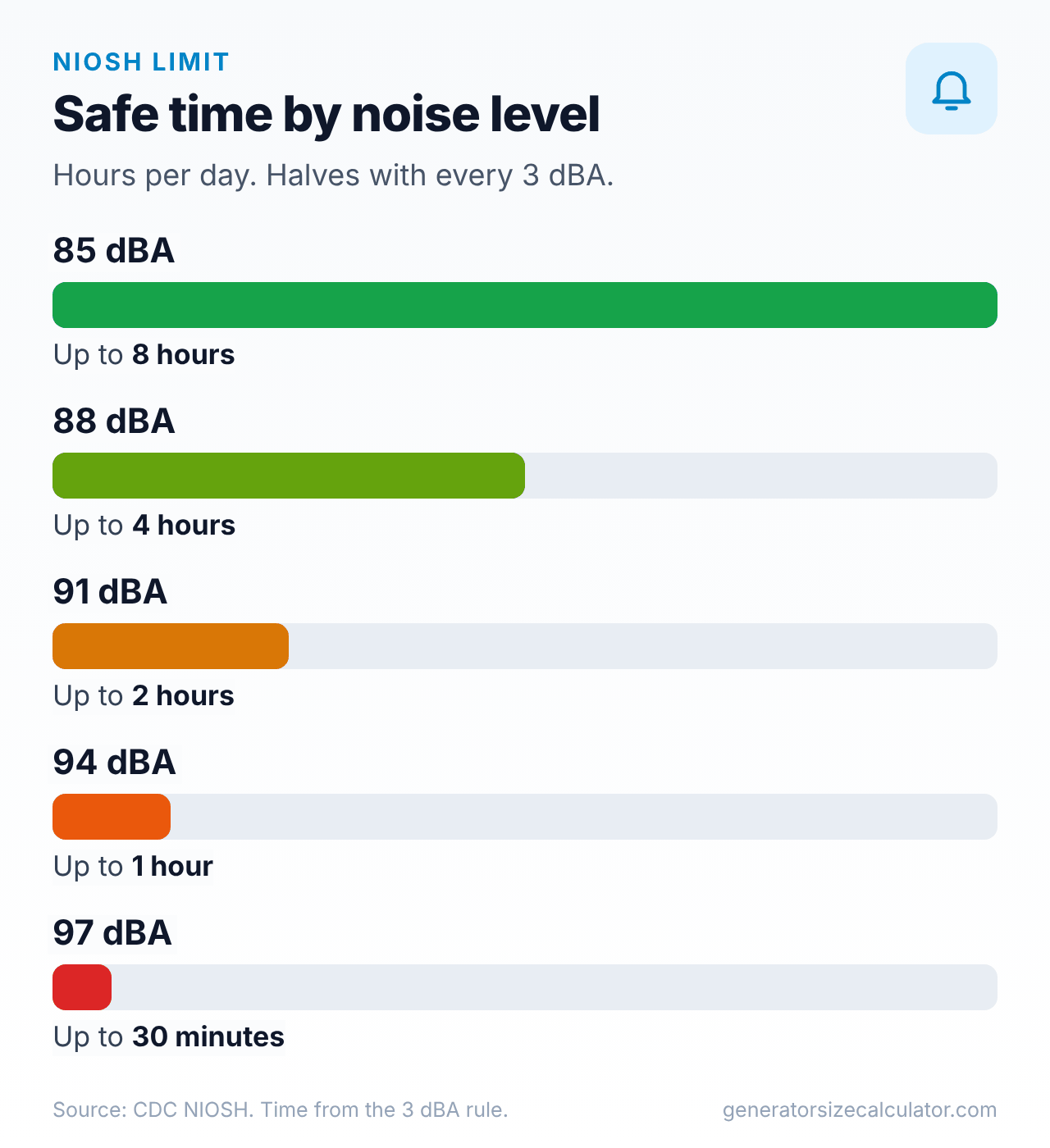
NIOSH, part of the CDC, recommends an exposure limit of 85 dBA averaged over an eight-hour workday. It also recommends cutting the exposure time in half for each 3 dBA increase in noise. Workers exposed at or above that limit are at risk of significant hearing loss over a working lifetime. NIOSH says to use hearing protection when noise levels exceed 85 dBA, however short the exposure.
Safe time by noise level
| Noise level | Recommended maximum time per day |
|---|---|
| 85 dBA | 8 hours |
| 88 dBA | 4 hours |
| 91 dBA | 2 hours |
| 94 dBA | 1 hour |
| 97 dBA | 30 minutes |
| 100 dBA | 15 minutes |
These times follow directly from NIOSH's 85 dBA limit and its 3 dBA halving rule. NIOSH describes around 85 dBA as the level at which you often must raise your voice to be heard 3 feet away, and 95 dBA or more as the level at which you likely must shout.
What this means for generators
NIOSH's page does not list generators, so you cannot read a figure for one there. Your generator's own label or spec sheet gives its rated sound level, and the distance it was measured at matters: noise falls as you move away. Honda's EM-series manual, for example, states no decibel level. If you must raise your voice to be heard 3 feet from a running generator, treat it as around 85 dBA or more and wear hearing protection when working next to it for long. Inverter models are usually the quieter choice. See inverter vs conventional generators.
Tips to reduce noise
- Put distance between you and the generator. A generator 20 feet or more from the house is also the safety rule. See how far a generator should be from your house.
- Point the exhaust away from where people sit or sleep.
- Wear earplugs or earmuffs when working beside it.
- Choose a quieter model for a campsite or neighborhood. See the inverter generator calculator.
- Never box it in to muffle noise. An enclosure traps carbon monoxide and heat.
Check the inverter option for your loads.
Run the generator outdoors, at least 20 feet from the home. Never in a garage or shed. Carbon monoxide has no smell or color. See how far a generator should be from your house.
Frequently asked questions
What is a safe noise level for hearing?
NIOSH recommends a limit of 85 dBA averaged over eight hours, with the time cut in half for each 3 dBA increase.
How long can I be around 91 dBA noise?
About two hours a day by the NIOSH rule.
How loud is a generator?
It varies by model. Check the rated sound level and its measurement distance on your generator, since NIOSH does not list generators.
Do I need hearing protection near a generator?
NIOSH says to use it when noise exceeds 85 dBA. If you must raise your voice to be heard 3 feet away, wear it.
Can I put a generator in a box to make it quieter?
Not an enclosed one. It traps carbon monoxide and heat. Use distance or a quieter model.
Related calculators
Sources: CDC NIOSH, noise-induced hearing loss (85 dBA over eight hours, cut the time in half for each 3 dBA, hearing protection above 85 dBA, 85 and 95 dBA conversation cues); Honda owner's manual for the EM1600X, EM1800X and EM2200X generators (no decibel level stated). The time table is arithmetic from the 3 dBA rule.