What Size Generator Do You Need to Run a Microwave?
By the Generator Size Calculator Team · Updated · 5 min read
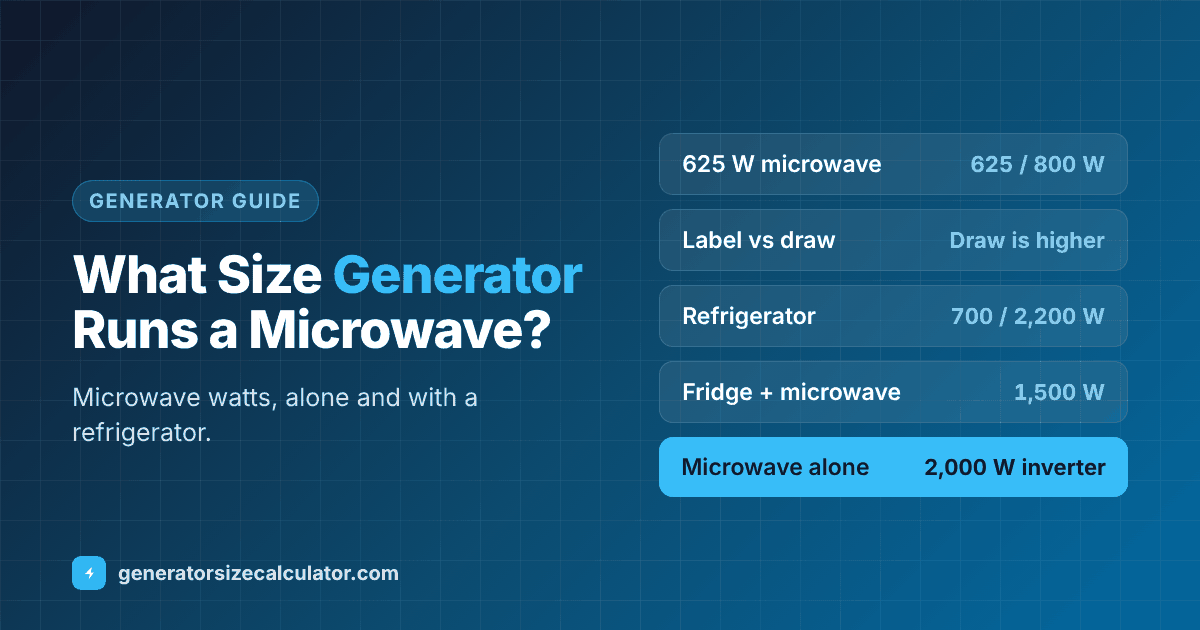
Quick answer: Honda lists a 625-watt microwave oven at 625 running and 800 starting watts, so a 2,000-watt inverter generator runs one comfortably. A full-size microwave draws more than its cooking-power label, with a "1,000 W" oven often near 1,500 watts, which suits a 2,500-watt generator. With a refrigerator and a few lights, a 3,000-watt generator covers a 625-watt microwave.
Microwave watts
| Appliance | Running watts | Starting watts |
|---|---|---|
| Microwave oven (625 W) | 625 | 800 |
| Refrigerator or freezer | 700 | 2,200 |
| Coffee maker | 1,750 | 1,750 |
Honda's guide lists a 625-watt microwave at 625 running and 800 starting watts. A microwave has no big surge, since it has no large motor, but it draws its full power the whole time it heats.
Why the label understates the draw
The wattage on the front of most microwaves is the cooking power delivered to the food. The oven pulls more from the outlet, because the magnetron is not 100% efficient, and Bob Vila notes the same gap, with a "1,000 W" oven often drawing closer to 1,500 watts. Check the rating plate on the back or the inside of the door for amps, then multiply by 120 volts. Our generator amps calculator does the conversion.
Which generator size to choose
| Setup | Running load | Generator |
|---|---|---|
| 625-watt microwave alone | 625 W | 2,000 W inverter |
| Microwave that draws about 1,500 W | 1,500 W | 2,500 W |
| 625-watt microwave, fridge and lights | 1,500 W | 3,000 W |
Sizes keep the running load under 80% of the rating. For the bigger kitchen picture, see what size generator runs kitchen appliances.
Example: microwave, fridge and lights
| Load | Running watts |
|---|---|
| Refrigerator | 700 |
| Microwave oven (625 W) | 625 |
| Lights, chargers, Wi-Fi | 175 |
| Running total | 1,500 |
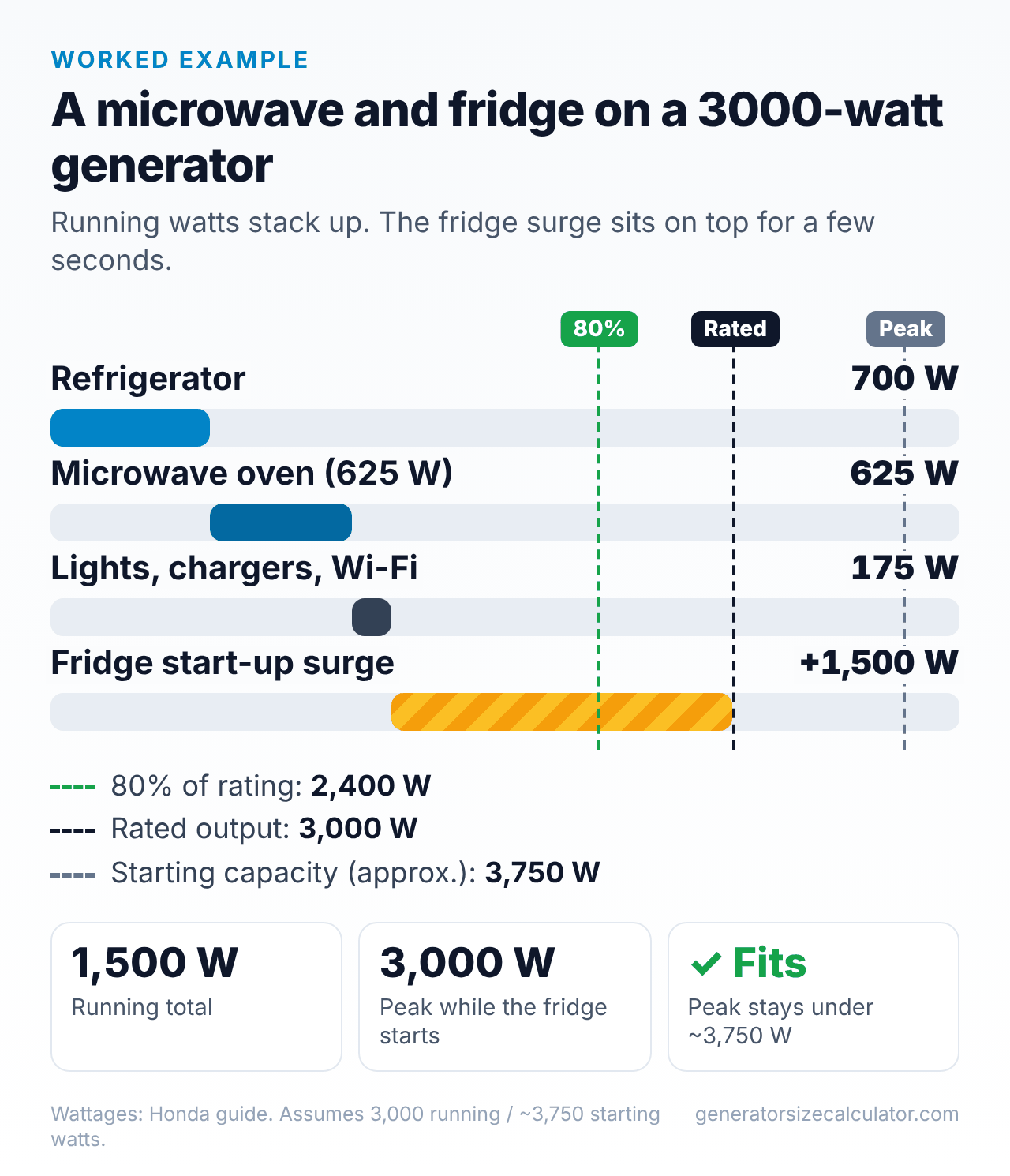
The fridge compressor adds about 1,500 watts when it starts, so the peak is about 3,000 watts. A 3,000-watt generator carries 1,500 running watts well under its 80% mark (2,400 watts), and its approximate 3,750-watt starting capacity covers the peak. If your microwave really draws 1,500 watts, the running total rises to 2,375 watts and the peak to about 3,875, so choose a 3,500-watt unit.
Add your fridge, microwave and anything else.
Tips
- Use the microwave in short bursts and let the fridge run between uses.
- Plug it in directly or use a heavy cord. See the extension cord calculator.
- Add one heating appliance at a time. A coffee maker is 1,750 watts and a toaster up to 1,650.
Run the generator outdoors, at least 20 feet from doors, windows and vents. Never in a garage or shed, even with the door open. See how far a generator should be from your house.
Frequently asked questions
How many watts does a microwave use?
Honda lists a 625-watt microwave at 625 running and 800 starting watts. Larger ovens draw more, and a "1,000 W" oven can pull closer to 1,500 watts from the outlet.
Can a 2000-watt generator run a microwave?
Yes, a typical small microwave on its own, with room for a few lights. A microwave drawing about 1,500 watts is near the 80% limit of a 1,600-watt-running inverter.
Can a 3000-watt generator run a microwave and a fridge?
Yes. A 625-watt microwave, a refrigerator and lights total about 1,500 running watts and a peak near 3,000 watts.
Does a microwave have a starting surge?
A small one, about 800 starting watts versus 625 running for Honda's example. The big surge in a kitchen comes from the fridge compressor.
How do I find my microwave's real watts?
Look at the rating plate for amps and multiply by 120 volts, or measure with a plug-in watt meter.
Related calculators
Sources: Running and starting watts from the Honda generator wattage guide (microwave oven, refrigerator, coffee maker); the gap between a microwave's cooking power and its draw from Bob Vila. Generator sizes apply the 80% running rule and an assumed starting capacity about 25% above the running rating.