Propane vs Gasoline Generator: Which Fuel Is Better?
By the Generator Size Calculator Team · Updated · 7 min read
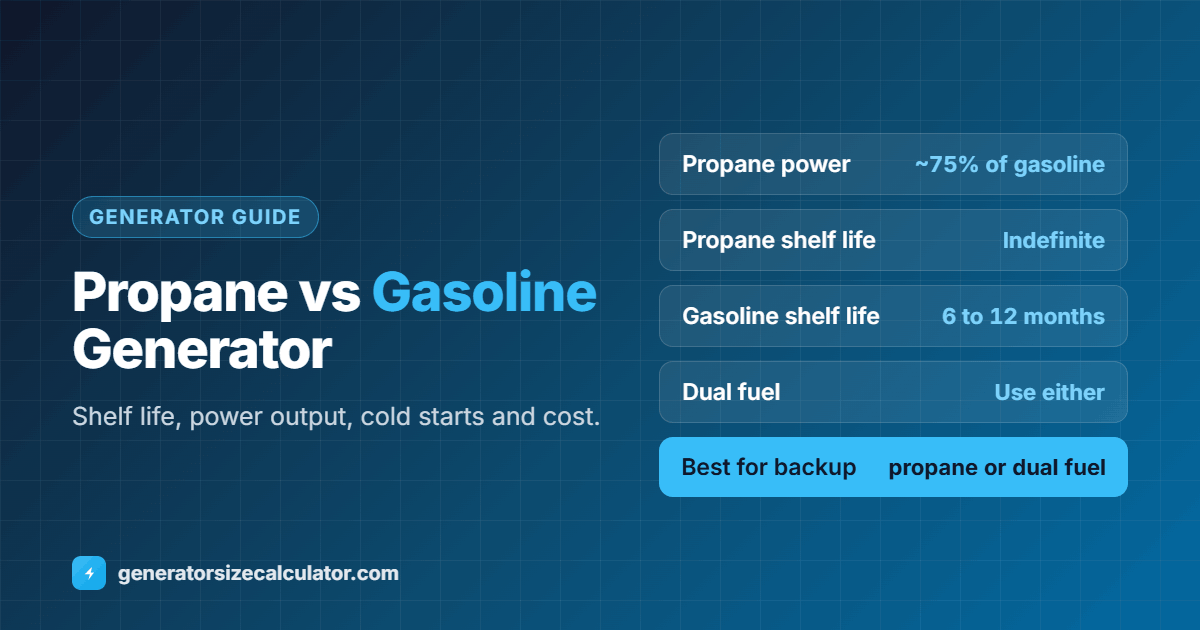
Quick answer: Propane stores indefinitely, starts easier in the cold and burns cleaner, but gives roughly 75% of the power gasoline does from the same engine. Gasoline is cheap to find and gives full power, but goes stale in about 6 to 12 months even with stabilizer. A dual fuel generator lets you use either, which is why many buyers choose one for emergency backup.
Storage and shelf life
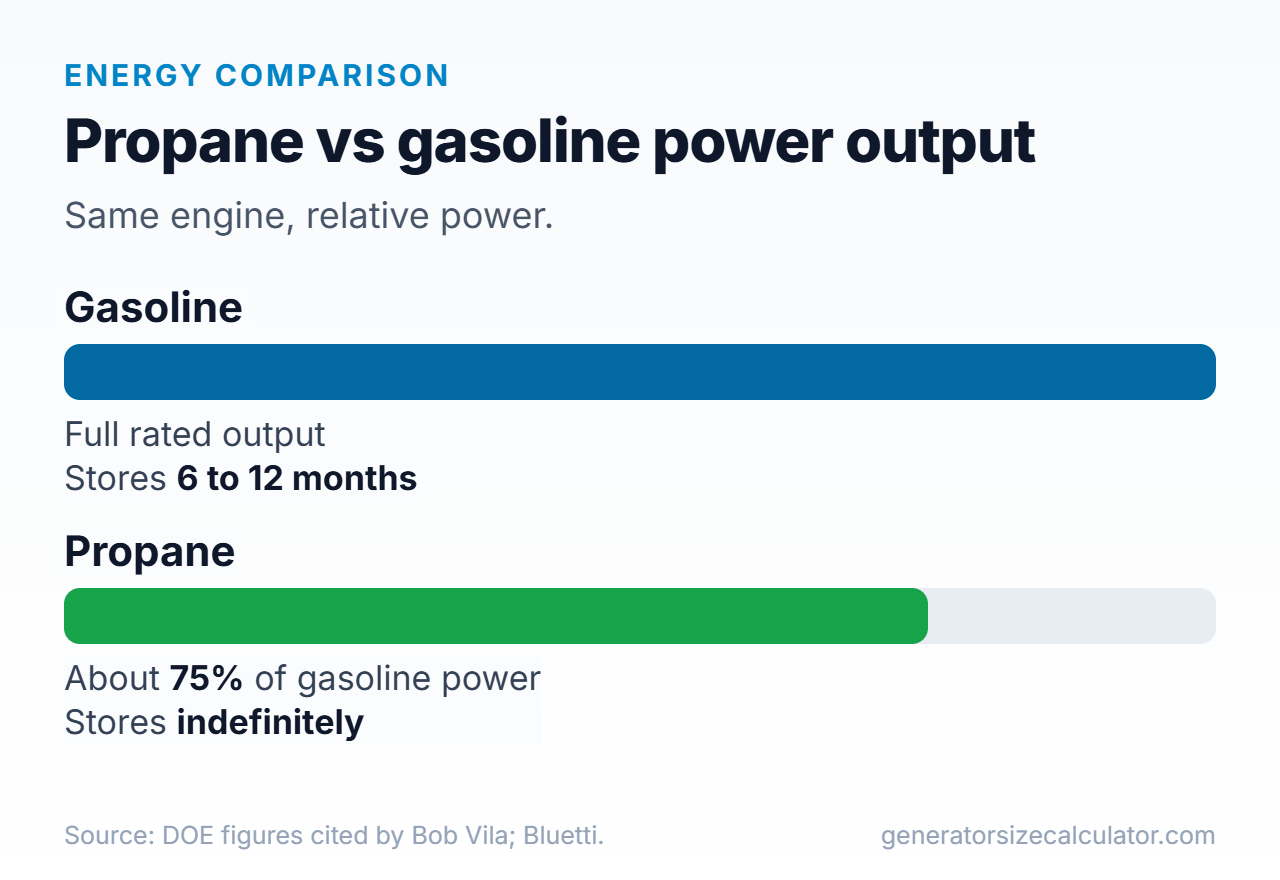
This is where propane clearly wins. Gasoline stored in a can or a generator tank typically lasts only about 6 to 12 months, even with a stabilizer, before it degrades and can gum up the carburetor. Propane in a sealed cylinder has an indefinite shelf life, so a tank bought today will work in an emergency years from now. If your generator sits unused for long periods, that matters.
Power output
Gasoline packs more energy per gallon, and the same engine usually makes less power on propane. According to the U.S. Department of Energy figures cited by Bob Vila, propane produces about 75% of the power of gasoline. In practice a generator rated 5,000 watts on gasoline might be rated closer to 4,500 watts on propane, and dual fuel models list both ratings on the label.
| Fuel | Typical output | Shelf life | Cold starts |
|---|---|---|---|
| Gasoline | 100% of rating | 6 to 12 months | Can be harder in deep cold |
| Propane | About 75% of the gasoline rating | Indefinite | Yes, easier |
Always size from the rating on your fuel of choice. Our propane generator calculator estimates runtime from the tank size.
Cold weather and cleanliness
Propane vapor is easy for an engine to ignite in cold weather, so propane units usually start more readily in winter than gasoline ones. Propane also burns cleaner, with less soot and less engine wear. Neither fuel removes the carbon monoxide risk, so the placement rules stay the same: outdoors, well away from windows and doors.
Availability and cost
During a widespread outage, gas stations can lose power and run out of fuel, but many homes already have a propane cylinder or a large tank. Per hour of running, propane is typically a bit more expensive than gasoline on a small portable, though prices vary by region and season. Bob Vila reports standby propane generators use about 2 to 4 gallons per hour at full capacity, so a 20 kW unit might burn about 3.0 gal/hr at full load and 1.5 gal/hr at half load. Use the fuel consumption calculator to estimate your own use.
Estimate how long a tank or cylinder lasts at your load.
Dual fuel: the compromise
A dual fuel generator can run on gasoline or propane. You can keep gasoline for convenience and a propane cylinder for the long term, and switch when you need to. The trade-off is a higher purchase price and the lower propane rating. See the dual fuel generator calculator for sizing both ways.
Which should you choose?
- Emergency backup that sits for years: propane or dual fuel.
- Maximum power from a small unit: gasoline.
- Cold climate and winter outages: propane or dual fuel.
- Flexibility during a long outage: dual fuel.
Store fuel safely. Keep gasoline in approved containers and propane cylinders upright, outdoors and away from ignition sources. Never refuel a hot generator. Compare your options in how long a generator runs on a tank of gas.
Frequently asked questions
Is a propane generator better than a gasoline generator?
It depends. Propane stores indefinitely, starts easier in the cold and burns cleaner, but gives about 75% of the power gasoline does. Gasoline gives full power but must be rotated every 6 to 12 months.
How much less power does a generator make on propane?
About 75% of the gasoline output, according to Department of Energy figures cited by Bob Vila. Check the propane rating on the generator label.
How long does gasoline last in a generator?
Typically 6 to 12 months even with stabilizer, so rotate stored fuel and run the generator periodically.
How much propane does a generator use?
Standby propane generators use roughly 2 to 4 gallons per hour at full capacity. A 20 kW unit uses about 3.0 gal/hr at full load and 1.5 gal/hr at half load.
Is a dual fuel generator worth it?
Often, for emergency backup. You can use gasoline when it is available and propane when it is not, at the cost of a higher price and a lower propane rating.
Related calculators
Sources: Propane output of about 75% of gasoline and standby propane consumption figures from Bob Vila, citing U.S. Department of Energy data; gasoline shelf life and propane storage and cold-start characteristics from Bluetti. Real numbers vary by model, so read your generator's rating label.